
Martial Arts Library
Yagli Gures
6/17/2026 · Kyle Brenner
Origin
Turkey
Primary Focus
Standing control, leverage, and takedowns under low-friction conditions
What It Is
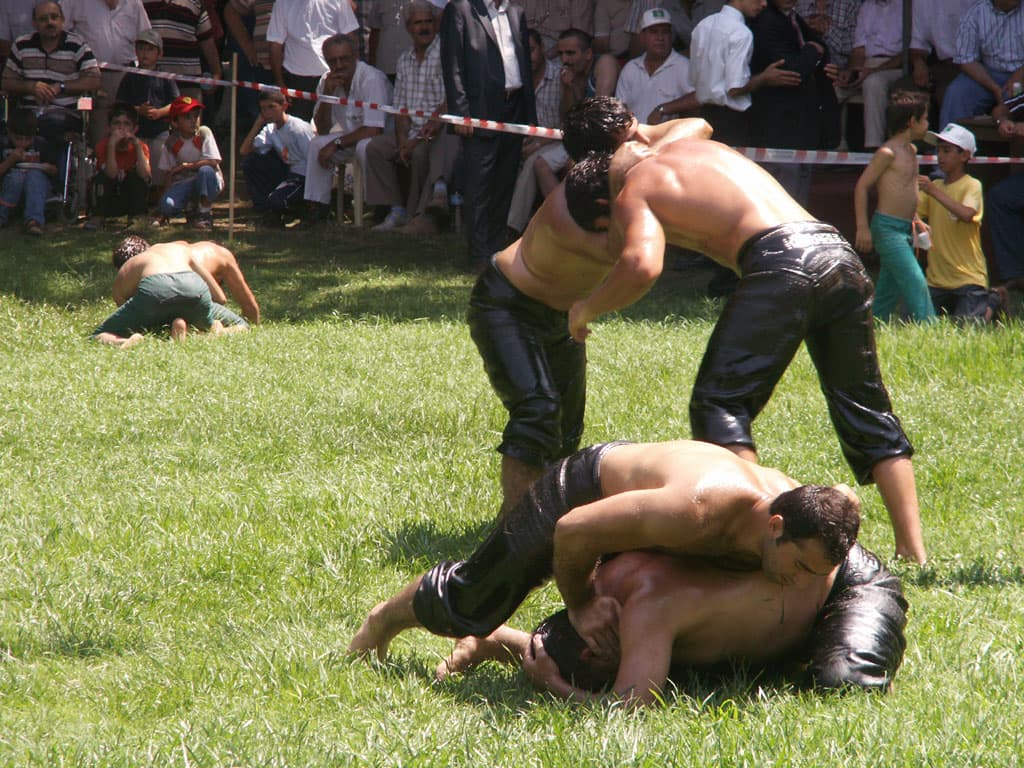
Yagli Gures is Turkish oil wrestling, a grappling tradition where wrestlers compete while covered in oil, radically changing grip and control dynamics.
History Snapshot
Yagli Gures is a traditional Turkish folk wrestling in which competitors, drenched in olive oil, grapple in leather trousers. Long associated with Ottoman-era culture and the historic Kirkpinar festival, it endures as a celebrated national tradition.
What It Is
Yagli Gures, Turkish for "oiled wrestling," is exactly what the name promises: two wrestlers, stripped to tight leather trousers and doused head to toe in olive oil, grappling for control on an open grass field. The oil is not a gimmick; it is the entire strategic puzzle. It makes every grip treacherous and every hold prone to sliding free, so the ordinary certainties of wrestling dissolve. Competitors, called pehlivan (a word carrying overtones of "hero" or "champion"), must rely on balance, body positioning, endurance, and cleverness rather than the firm handholds a dry wrestler takes for granted. It is at once a serious sport and a deeply ceremonial cultural ritual.
Origins and History
Oil wrestling is old, and its early history has to be described in broad strokes rather than precise dates. Wrestling traditions have flourished across Anatolia, the Balkans, Central Asia, and the wider region for a very long time, and greased or oiled forms of grappling appear in several ancient cultures, so it is best to say that Yagli Gures grew out of this deep regional heritage rather than to pin it to a single moment of invention. What is clear is that the sport became firmly woven into Turkish and Ottoman culture over the centuries, prized as a display of martial virtue, physical excellence, and manly honor.
Its most famous institution is the Kirkpinar festival, held near Edirne in northwestern Turkey. According to widely repeated tradition, the tournament traces to the 14th century and Ottoman soldiers, and it is often cited as one of the oldest continuously held sporting competitions in the world, though the precise details of that founding story belong as much to legend as to documented record. Whatever its exact age, Kirkpinar has for a very long time been the sport's grand stage, a multi-day event where pehlivan compete for the coveted title of başpehlivan, the chief wrestler, and a prized golden belt. The festival blends athletic contest with music, prayer, and elaborate ritual, underscoring that Yagli Gures has always been more than a mere sport.
Development Over Time
For much of its history the sport passed down through community practice, regional tournaments, and the mentorship of established pehlivan, sustained by local pride rather than formal bureaucracy. Over time it acquired more structure: recognized weight and rank divisions, a governing framework in modern Turkey, and standardized ceremony surrounding the matches, including the pre-bout parade and the traditional invocation. The distinctive leather trousers, known as kispet and historically made of water buffalo hide, and the ritual oiling remain unchanged hallmarks. Rules on how a bout is won have also evolved and been clarified over the years, but the essential character, oiled bodies grappling on grass under the summer sun, has been preserved with obvious cultural pride. In recognition of its heritage, the Kirkpinar oil wrestling festival has been honored internationally as an element of intangible cultural heritage.
Core Techniques and Concepts
- Grip unreliability: Oil makes conventional handholds slip, forcing wrestlers to rethink every hold.
- The kispet advantage: Much control is sought through the leather trousers, a rare reliable gripping surface.
- Balance and body control: Positioning and off-balancing matter more than raw gripping strength.
- Endurance and patience: Slippery conditions and long bouts reward stamina and persistence.
- Ceremonial framework: Ritual oiling, dress, and pre-match ceremony are integral to the tradition.
Modern Practice and Relevance
Yagli Gures remains a living, celebrated tradition in Turkey, drawing large crowds to Kirkpinar each summer and holding a place of genuine national affection rather than existing only as a museum piece. In practical combat-sports terms it is a folk discipline rather than a feeder for MMA or Olympic wrestling, but it offers a fascinating lesson about how environment reshapes technique. Take away reliable grips, and a grappler must lean far harder on balance, leverage, and positional intelligence, the same underlying skills that separate elite wrestlers everywhere. As much as anything, though, Yagli Gures endures because it is a spectacular and proud piece of cultural heritage, a direct link to centuries of tradition still contested on the grass today.
Technical Deep Dive
Yagli Gures is most effective when practitioners can control the transition moments between range, rhythm, and balance. Those transition moments are where technical identity becomes visible under pressure.
A useful way to study this style is to separate visible techniques from invisible skills. The visible layer includes strikes, entries, grips, and finishes; the invisible layer includes posture management, timing discipline, and recovery decisions after failed attempts.
In grappling-heavy contexts, the deepest competitive edge usually comes from connection quality rather than move count. Hand-fighting, shoulder pressure, and angle denial often decide outcomes before obvious scoring actions appear.
Strengths
- Standing control, leverage, and takedowns under low-friction conditions
- Clear technical pathways that are easy to study and pressure-test
- Strong transfer into modern competition when timing and distance matter
- Reliable clinch and control structures that reward leverage over raw strength
Trade-offs
- Training quality varies widely between schools, so fundamentals matter more than labels
- Sport rules can sharpen some attributes while reducing others
- The style's original context may differ from how it is practiced today
- Ground-heavy systems can be harder to apply against strong anti-grappling or striking-heavy opponents without cross-training
Priority Focus
- Consistent drilling under light to medium pressure
- Testing fundamentals against resisting partners before advancing
- Building attributes from basic to complex
- Practice position control and transitions before submissions
Coaching Notes
- Progress from cooperative drills to constrained sparring before full resistance
- Prioritize repeatable combinations and transitions over isolated highlight techniques
- Use video review to compare tactical intent with actual round behavior
- Track conditioning in relation to technical quality, not only output volume
- Build positional chains first, then layer submissions once control is consistent