
Martial Arts Library
Wrestling
6/17/2026 · Lena Fischer
Origin
Ancient global roots; modern competitive styles developed in Europe and worldwide
Primary Focus
Takedowns, top control, mat returns, and pressure
What It Is
Wrestling is a grappling sport emphasizing positional control, takedowns, and sustained pressure.
History Snapshot
Wrestling is among the oldest human activities, depicted in ancient art across many civilizations and contested at the earliest Olympic Games. Its modern codified forms, Greco-Roman and freestyle, took shape in 19th-century Europe and became global Olympic sports.
What It Is
Wrestling is the art of imposing your will through grip, leverage, and body position. Strip away the varied rulesets and it comes down to a few brutal essentials: taking an opponent down, keeping them there, and controlling them while denying them the same. There are no strikes and no weapons, just two people fighting for position with everything they have, which is exactly why it has served as the foundation for so many other combat disciplines. This overview covers wrestling in the broad sense, the family of grappling styles ranging from ancient contests and national folk traditions to the two modern Olympic codes, freestyle and Greco-Roman.
Origins and History
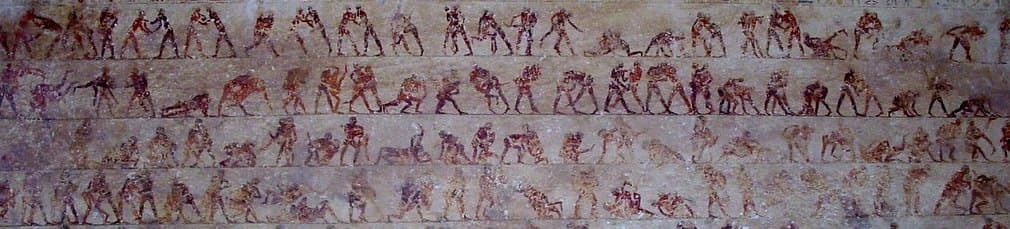
No martial art has deeper roots. Wrestling is very likely one of the oldest forms of organized physical competition on the planet, and evidence for it turns up almost everywhere humans left records. Cave paintings in France thought to be many thousands of years old appear to depict wrestlers; carved reliefs at the ancient Egyptian site of Beni Hasan, dated to roughly four thousand years ago, show hundreds of wrestling positions that any modern grappler would recognize. Sumerian and Babylonian artifacts reference it, and it features in the Epic of Gilgamesh. This near-universal appearance is not a coincidence: grappling for dominance is such a basic human contest that virtually every culture developed its own version.
In the classical Mediterranean, wrestling became a cornerstone of Greek athletic and military culture and a central event of the ancient Olympic Games, which by tradition began in 776 BCE. Greek wrestling prized throws and upright control, and it formed part of the punishing combined event known as the pankration. Alongside these formal contests, countless regional folk styles took root over the centuries and survive to this day, among them Turkish oil wrestling, Mongolian bökh, Iranian varzesh-e pahlavani, Indian pehlwani and kushti, Swiss schwingen, and the catch-as-catch-can styles of the British Isles. Each reflects local custom, dress, and terrain, but all share the same combative heart.
Development Over Time
The wrestling most fans watch today was codified in 19th-century Europe. Greco-Roman style, which forbids attacks below the waist and holds using the legs, was formalized in France and spread through the professional and carnival circuits before being featured at the first modern Olympic Games in Athens in 1896. Freestyle, which allows leg attacks and grabbing below the waist, developed largely out of the catch-as-catch-can tradition and entered the Olympics in the early 1900s. Both became international amateur sports governed by a global federation, with weight classes, defined scoring, and evolving rules aimed at rewarding action. Nations built powerful wrestling cultures, the United States, the Soviet Union and its successor states, Iran, Japan, Turkey, and Cuba among them, and the collegiate folkstyle system in American schools became one of the sport's great talent engines.
Core Techniques and Concepts
- Takedowns: Shots to the legs such as the double and single leg, plus upper-body throws and trips, to put an opponent on the mat.
- Hand fighting and setups: Controlling ties and wrists to create clean openings for attacks.
- Chain wrestling: Flowing immediately from a failed attack into the next, keeping constant offensive pressure.
- Top control and rides: Pinning, turning, and dominating a downed opponent while preventing escape.
- Sprawl and defense: Reacting instantly to stuff shots and scramble back to safety.
Modern Practice and Relevance
Wrestling thrives as an Olympic sport, a school and university staple, and a living folk tradition, but in combat-sports circles its influence runs even wider. Its grappling base is widely regarded as one of the single most valuable skill sets in mixed martial arts, because a strong wrestler decides where a fight takes place, standing or on the mat, and controls the pace from there. Champions from Khabib Nurmagomedov to Georges St-Pierre and Kamaru Usman built their dominance on wrestling foundations. For any fighter, the conditioning, mental toughness, and positional intelligence that wrestling instills translate directly, which is why it remains a bedrock of the modern game.
Technical Deep Dive
Wrestling is most effective when practitioners can control the transition moments between range, rhythm, and balance. Those transition moments are where technical identity becomes visible under pressure.
A useful way to study this style is to separate visible techniques from invisible skills. The visible layer includes strikes, entries, grips, and finishes; the invisible layer includes posture management, timing discipline, and recovery decisions after failed attempts.
In grappling-heavy contexts, the deepest competitive edge usually comes from connection quality rather than move count. Hand-fighting, shoulder pressure, and angle denial often decide outcomes before obvious scoring actions appear.
Strengths
- Takedowns, top control, mat returns, and pressure
- Clear technical pathways that are easy to study and pressure-test
- Strong transfer into modern competition when timing and distance matter
- Reliable clinch and control structures that reward leverage over raw strength
Trade-offs
- Training quality varies widely between schools, so fundamentals matter more than labels
- Sport rules can sharpen some attributes while reducing others
- The style's original context may differ from how it is practiced today
- Ground-heavy systems can be harder to apply against strong anti-grappling or striking-heavy opponents without cross-training
Priority Focus
- Consistent drilling under light to medium pressure
- Testing fundamentals against resisting partners before advancing
- Building attributes from basic to complex
- Practice position control and transitions before submissions
Coaching Notes
- Progress from cooperative drills to constrained sparring before full resistance
- Prioritize repeatable combinations and transitions over isolated highlight techniques
- Use video review to compare tactical intent with actual round behavior
- Track conditioning in relation to technical quality, not only output volume
- Build positional chains first, then layer submissions once control is consistent