
Martial Arts Library
Wing Chun
6/17/2026 · Ray Coleman
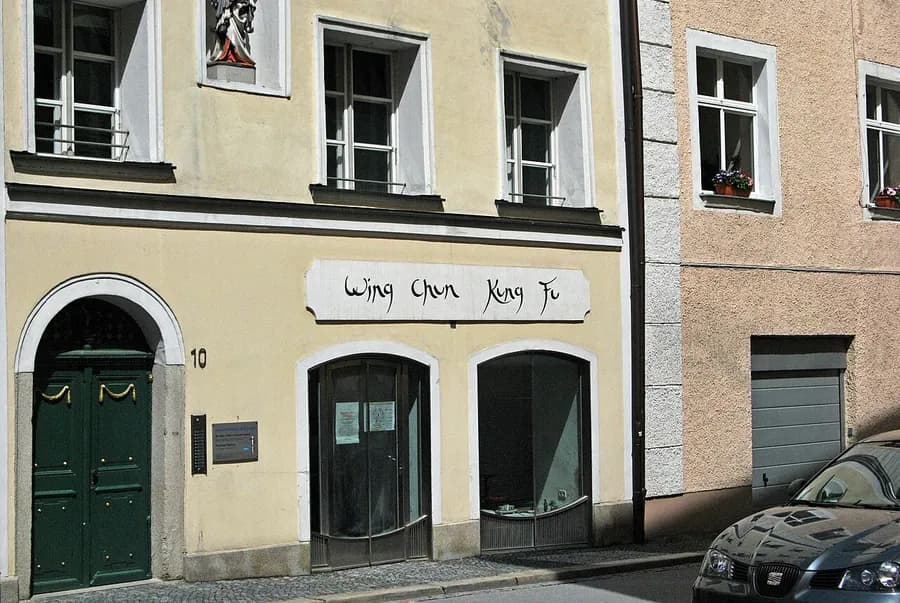
Origin
China
Primary Focus
Centerline striking, trapping concepts, and close-range efficiency
What It Is
Wing Chun is a Chinese martial art associated with direct punching, structure-based defense, and centerline control at short range.
History Snapshot
Wing Chun is a southern Chinese kung fu style whose origins are wrapped in legend rather than firm records. It gained worldwide fame in the 20th century through the Hong Kong teacher Ip Man and his most famous student, Bruce Lee.
What It Is
Wing Chun is a close-range striking art that prizes efficiency above almost everything else. Its central bet is simple: if you control the centerline, the straight path between you and your opponent, and you occupy it with good structure and quick, direct attacks, you can beat a bigger, more forceful fighter through timing and geometry rather than raw power. Practitioners train to feel pressure through contact and respond instantly, flowing around resistance and firing straight punches down the middle. It is an art of economy, angles, and touch, designed for the crowded, in-close phase of a fight where there is no room to wind up.
Origins and History
Wing Chun's origins are famously murky, and any honest account has to separate the beloved legend from the thin historical record. The traditional story credits a Buddhist nun named Ng Mui, said to have survived the destruction of the southern Shaolin temple and devised a compact, efficient system that did not rely on size or strength. She supposedly taught it to a young woman named Yim Wing Chun, who used it to fend off a bully seeking to force her into marriage, and the art took her name. It is a wonderful story, and there is essentially no contemporary documentation to confirm any of it. Most researchers treat the Ng Mui tale as founding myth rather than history.
What is on firmer ground is that Wing Chun emerged as a southern Chinese style, associated with the Guangdong and Fujian regions, and that its verifiable lineage sharpens in the 19th century. The teacher Leung Jan of Foshan is a well-attested early figure, and the line running through him is where the modern art's documented history really begins. From regional obscurity, Wing Chun's decisive leap to fame came in the 20th century through one man: Ip Man (Yip Man), who learned in Foshan and, after fleeing to Hong Kong around 1949 amid China's upheaval, began teaching openly there. In the crowded, competitive martial world of postwar Hong Kong, Ip Man's Wing Chun flourished and produced a generation of influential students.
Development Over Time
Ip Man's teaching turned a local style into an international one, and much of that reach came through his most famous pupil. A teenage Bruce Lee studied Wing Chun under Ip Man in Hong Kong before emigrating to the United States, and although Lee later broke from tradition to develop his own approach, Jeet Kune Do, his fame drew enormous global attention back to his Wing Chun roots. From the 1970s onward the art spread across the world through Ip Man's students and their students in turn, splintering into numerous lineages that argue, sometimes fiercely, over correct structure and interpretation. In the 21st century a hugely popular series of Ip Man films starring Donnie Yen introduced the style to a new mass audience, cementing its pop-culture image even as its combat effectiveness came under sharper scrutiny.
Core Techniques and Concepts
- Centerline theory: Attacking and defending along the direct line to the opponent, controlling the most efficient path.
- Chain punching: Rapid, straight vertical-fist punches thrown in continuous succession down the middle.
- Chi sao (sticking hands): A signature partner drill developing sensitivity, reflexes, and control through constant contact.
- Trapping and simultaneous defense-attack: Clearing or pinning an opponent's arms while striking in the same motion.
- Economy of motion and structure: Short, efficient movements backed by body alignment rather than muscular force.
Modern Practice and Relevance
Few traditional arts are argued over as intensely as Wing Chun. Its defenders point to a coherent set of close-range principles and its historic influence on figures like Bruce Lee; its critics note that it has fared poorly in full-contact and MMA settings, and that some schools drill compliant patterns rather than resisting opponents. Both camps have a point. For today's combat-sports fan, Wing Chun is most interesting as a case study in the gap between elegant theory and pressure-tested reality, and its better ideas, centerline control, sensitivity through contact, and economy of motion, still have real value when they are trained honestly against someone trying to hit back.
Technical Deep Dive
Wing Chun is most effective when practitioners can control the transition moments between range, rhythm, and balance. Those transition moments are where technical identity becomes visible under pressure.
A useful way to study this style is to separate visible techniques from invisible skills. The visible layer includes strikes, entries, grips, and finishes; the invisible layer includes posture management, timing discipline, and recovery decisions after failed attempts.
In striking-heavy contexts, this style rewards athletes who can maintain stance integrity while changing pace. Distance ownership, exit discipline, and defensive resets determine whether offensive output remains sustainable late in rounds.
Strengths
- Centerline striking, trapping concepts, and close-range efficiency
- Clear technical pathways that are easy to study and pressure-test
- Strong transfer into modern competition when timing and distance matter
Trade-offs
- Training quality varies widely between schools, so fundamentals matter more than labels
- Sport rules can sharpen some attributes while reducing others
- The style's original context may differ from how it is practiced today
Priority Focus
- Consistent drilling under light to medium pressure
- Testing fundamentals against resisting partners before advancing
- Building attributes from basic to complex
- Develop footwork, head movement, and distance management
Coaching Notes
- Progress from cooperative drills to constrained sparring before full resistance
- Prioritize repeatable combinations and transitions over isolated highlight techniques
- Use video review to compare tactical intent with actual round behavior
- Track conditioning in relation to technical quality, not only output volume
- Drill entries and exits as one unit so offense and defense stay connected