
Martial Arts Library
Tai Chi Chuan
6/18/2026 · Diego Alvarez
Origin
China, traditionally attributed to Chen Wangting in the 16th–17th century; popularized widely in 20th century
Primary Focus
Flowing movements, balance, relaxation, internal energy (qi) cultivation, and health optimization
What It Is
Tai Chi is a Chinese martial art emphasizing slow, controlled movements integrated with breathing and meditation, serving both as a martial discipline and a wellness practice.
History Snapshot
Tai Chi Chuan is documented from the 17th century in the Chen village of Henan, though legend pushes its origins further back. The Yang family carried it to Beijing in the 1800s, and 20th-century reformers spread it worldwide as much for health as for combat.
What It Is
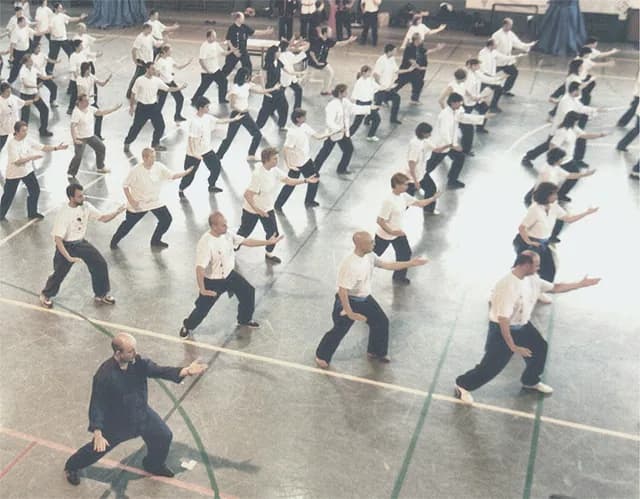
To most people, Tai Chi is the sight of practitioners moving in slow motion through a park at dawn, and that image is not wrong, but it hides half the story. Tai Chi Chuan, "supreme ultimate fist," is a genuine martial art built on soft, spiraling movement rather than muscular force. The slowness is a training method, not the goal: by rehearsing techniques at a crawl, practitioners learn to stay relaxed, aligned, and rooted so that force can flow through a connected body. Beneath the graceful forms lie throws, joint controls, and strikes, all governed by the principle of yielding to an opponent's power and turning it back on them.
Origins and History
Tai Chi's origins are wrapped in a famous legend and a more sober documented record, and it is worth keeping the two apart. The romantic story credits a semi-mythical Daoist immortal named Zhang Sanfeng, said to have devised a soft internal art after watching a snake and a crane fight on Wudang Mountain. It is a beautiful tale with essentially no reliable historical support, and most serious historians treat it as folklore layered on later.
The documented trail begins in the 17th century in Chenjiagou, the Chen family village in Henan province. There, a retired soldier named Chen Wangting is traditionally credited with synthesizing the family's martial routines into what became Chen-style Tai Chi, drawing on older Ming-dynasty military boxing manuals, ideas of qi circulation, and the yin-yang philosophy of the classics. For generations the art stayed largely within the Chen clan. Its wider fame came through Yang Luchan, an outsider who learned the Chen system in the early 1800s and then taught in Beijing, where he reportedly earned the nickname "Yang the Invincible" through challenge matches. Yang softened and streamlined the movements into a form more accessible to city students and officials, and from his lineage the art fanned outward.
Development Over Time
From the Yang line grew the major recognized branches, Chen, Yang, Wu, Wu (Hao), and Sun, each named for the family that shaped it and each balancing martial intensity against gentler practice differently. Chen retains its explosive coiling and stamping; Yang became the smooth, expansive style most people picture. The 20th century transformed the art again. In the early Republican era, reformers promoted Tai Chi as a patriotic health exercise for a modernizing nation, and after 1949 the government simplified it further, producing the standardized 24-form in 1956 to spread it to millions as public health practice. That reform made Tai Chi a global phenomenon, but it also pushed the martial content into the background for most casual practitioners, creating the split we see today between health-focused and combat-focused schools.
Core Techniques and Concepts
- Yielding and redirection: Rather than clashing with force, the practitioner absorbs and steers it away, exploiting the opponent's overcommitment.
- Rooting: A stable connection to the ground through the legs allows power to be received and delivered without being uprooted.
- Silk-reeling (chan si jin): Continuous spiraling of the joints and torso generates and transmits force through the whole body.
- Song (relaxation): Deliberate looseness under structure, not collapse, keeping the body responsive.
- Push hands (tui shou): A partner drill for sensing, controlling, and off-balancing an opponent through touch.
Modern Practice and Relevance
Today Tai Chi lives a double life. For the vast majority it is a low-impact wellness practice, and a growing body of research supports its benefits for balance, fall prevention, and stress, which explains its popularity among older adults worldwide. For a smaller circle it remains a fighting art, though its combat credibility has been sharply questioned, most publicly after Chinese MMA fighter Xu Xiaodong repeatedly beat self-styled Tai Chi masters in the 2010s. For combat-sports fans the honest takeaway is nuanced: pure slow-form practice does not prepare anyone for a modern bout, but the underlying principles of relaxation, rooting, and redirecting force are real and echo in the sensitivity and structure that skilled grapplers and clinch fighters use every day.
Technical Deep Dive
Tai Chi Chuan is most effective when practitioners can control the transition moments between range, rhythm, and balance. Those transition moments are where technical identity becomes visible under pressure.
A useful way to study this style is to separate visible techniques from invisible skills. The visible layer includes strikes, entries, grips, and finishes; the invisible layer includes posture management, timing discipline, and recovery decisions after failed attempts.
In weapons-influenced systems, understanding line control and timing windows is as important as tool mechanics. Clean positioning and tactical patience often matter more than speed alone.
Strengths
- Flowing movements, balance, relaxation, internal energy (qi) cultivation, and health optimization
- Clear technical pathways that are easy to study and pressure-test
- Strong transfer into modern competition when timing and distance matter
Trade-offs
- Training quality varies widely between schools, so fundamentals matter more than labels
- Sport rules can sharpen some attributes while reducing others
- The style's original context may differ from how it is practiced today
Priority Focus
- Consistent drilling under light to medium pressure
- Testing fundamentals against resisting partners before advancing
- Building attributes from basic to complex
Coaching Notes
- Progress from cooperative drills to constrained sparring before full resistance
- Prioritize repeatable combinations and transitions over isolated highlight techniques
- Use video review to compare tactical intent with actual round behavior
- Track conditioning in relation to technical quality, not only output volume