
Martial Arts Library
Taekwondo
6/17/2026 · Lena Fischer
Origin
Korea
Primary Focus
Kicking mechanics, range control, and speed
What It Is
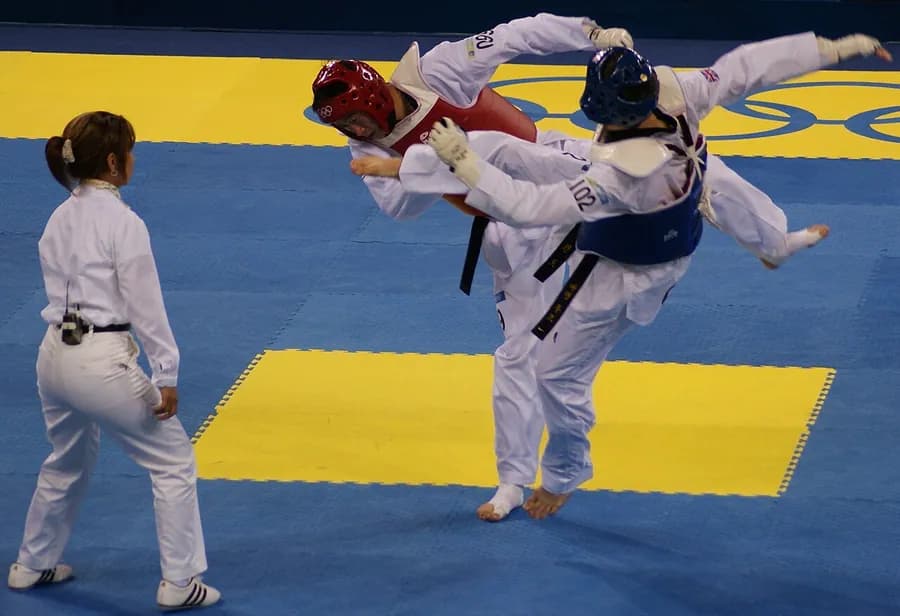
Taekwondo is a striking art known for powerful, fast kicking combinations and movement-based point control.
History Snapshot
Modern taekwondo was assembled in South Korea during the 1940s and 1950s from a cluster of new schools, then codified and named as a unified art. It became a global sport, reaching full Olympic medal status at Sydney 2000.
What It Is
Taekwondo is the kicking art. Other systems kick; taekwondo builds almost its entire identity around the legs, treating them as longer, heavier, faster weapons than the hands and organizing footwork, timing, and distance to set them loose. A skilled practitioner controls range like a fencer, floating just outside reach and then closing the gap with a snapping roundhouse or a spinning back kick before an opponent can react. The name itself, roughly "the way of the foot and fist," signals the priority, and modern sport rules have only sharpened the emphasis on rapid, high-scoring kicks.
Origins and History
Taekwondo's history is more recent and more political than its traditional image suggests. Its roots lie in the turbulent years around the end of Japanese colonial rule in Korea in 1945. During the occupation, Korean martial practice had been suppressed while Japanese arts like karate and judo were taught, and many of the young Koreans who would go on to shape taekwondo had trained in karate abroad. When the occupation ended, a wave of new schools, called kwans, opened in and around Seoul, each with its own instructor, curriculum, and blend of Korean, Chinese, and Japanese influences. The early kwans, names like Chung Do Kwan, Moo Duk Kwan, and Song Moo Kwan, are the true seedbed of the art.
Through the 1950s there was a strong push to unite these schools under a single Korean name and identity, partly as a matter of national pride in a country rebuilding after division and war. The term "taekwondo" was adopted in the mid-1950s, with the military officer and kwan figure Choi Hong-hi often credited as a driving force behind both the name and the early technical standardization, though the process involved many hands and plenty of disagreement. Promoters also drew connections to ancient Korean fighting traditions such as taekkyeon and the warrior culture of the Silla-era hwarang. Those links lend the art a proud lineage, but historians generally see modern taekwondo as a 20th-century creation shaped mainly by the kwan founders rather than a direct unbroken descent from antiquity.
Development Over Time
Institution-building followed quickly. The Korea Taekwondo Association helped consolidate the kwans, and in 1973 the World Taekwondo Federation was founded in Seoul, establishing the Kukkiwon as a headquarters and the sport-sparring style most people recognize today. A separate stream, the International Taekwon-Do Federation founded by Choi in 1966, preserved a different set of patterns and a distinct technical flavor, and the two organizations diverged over decades along both technical and political lines. Sport taekwondo, meanwhile, kept climbing the Olympic ladder: a demonstration event at Seoul 1988, and full medal status from Sydney 2000 onward. Electronic scoring, introduced to reduce judging disputes, reshaped tactics yet again, rewarding fast, accurate contact and changing how fighters move.
Core Techniques and Concepts
- Range advantage: Long, fast kicks let a fighter score and defend from a distance where hands cannot reach.
- Fast chambering and retraction: Efficient knee lift and quick recoil allow rapid, repeatable combinations.
- Angle entries: Lateral footwork opens clean lines for the lead-leg and turning kicks.
- Spinning and jumping techniques: Back kicks, tornado kicks, and jumping variations add power and unpredictability.
- Rule-set adaptation: Competitive strategy shifts with scoring criteria, especially under electronic protectors.
Modern Practice and Relevance
With tens of millions of practitioners worldwide, taekwondo is one of the most widely trained martial arts on earth, a fixture in schools, dojangs, and Olympic arenas. Its competitive form is often criticized as too point-focused for real fighting, yet its influence on combat sports is undeniable. A generation of kickboxers and MMA strikers, from Anderson Silva's foundations to specialists like Yair Rodriguez and Anthony Pettis, has borrowed taekwondo's spinning and switch kicks to devastating effect. What the art offers modern fighters is a deep vocabulary of long-range leg attacks and the deceptive footwork to land them, tools that can crack open opponents built on more conventional boxing rhythms.
Technical Deep Dive
Taekwondo is most effective when practitioners can control the transition moments between range, rhythm, and balance. Those transition moments are where technical identity becomes visible under pressure.
A useful way to study this style is to separate visible techniques from invisible skills. The visible layer includes strikes, entries, grips, and finishes; the invisible layer includes posture management, timing discipline, and recovery decisions after failed attempts.
In striking-heavy contexts, this style rewards athletes who can maintain stance integrity while changing pace. Distance ownership, exit discipline, and defensive resets determine whether offensive output remains sustainable late in rounds.
Strengths
- Kicking mechanics, range control, and speed
- Clear technical pathways that are easy to study and pressure-test
- Strong transfer into modern competition when timing and distance matter
- Useful footwork, tempo control, and scoring mechanics under pressure
Trade-offs
- Training quality varies widely between schools, so fundamentals matter more than labels
- Sport rules can sharpen some attributes while reducing others
- The style's original context may differ from how it is practiced today
- Pure striking systems may need clinch and takedown defense layers for mixed-rule environments
Priority Focus
- Consistent drilling under light to medium pressure
- Testing fundamentals against resisting partners before advancing
- Building attributes from basic to complex
- Develop footwork, head movement, and distance management
Coaching Notes
- Progress from cooperative drills to constrained sparring before full resistance
- Prioritize repeatable combinations and transitions over isolated highlight techniques
- Use video review to compare tactical intent with actual round behavior
- Track conditioning in relation to technical quality, not only output volume
- Drill entries and exits as one unit so offense and defense stay connected