
Martial Arts Library
Sumo
6/18/2026 · Tunde Balogun
Origin
Japan, originating from Shinto rituals and codified into a competitive sport over centuries
Primary Focus
Footwork, balance, explosive pushes, and forcing opponents out of the ring
What It Is
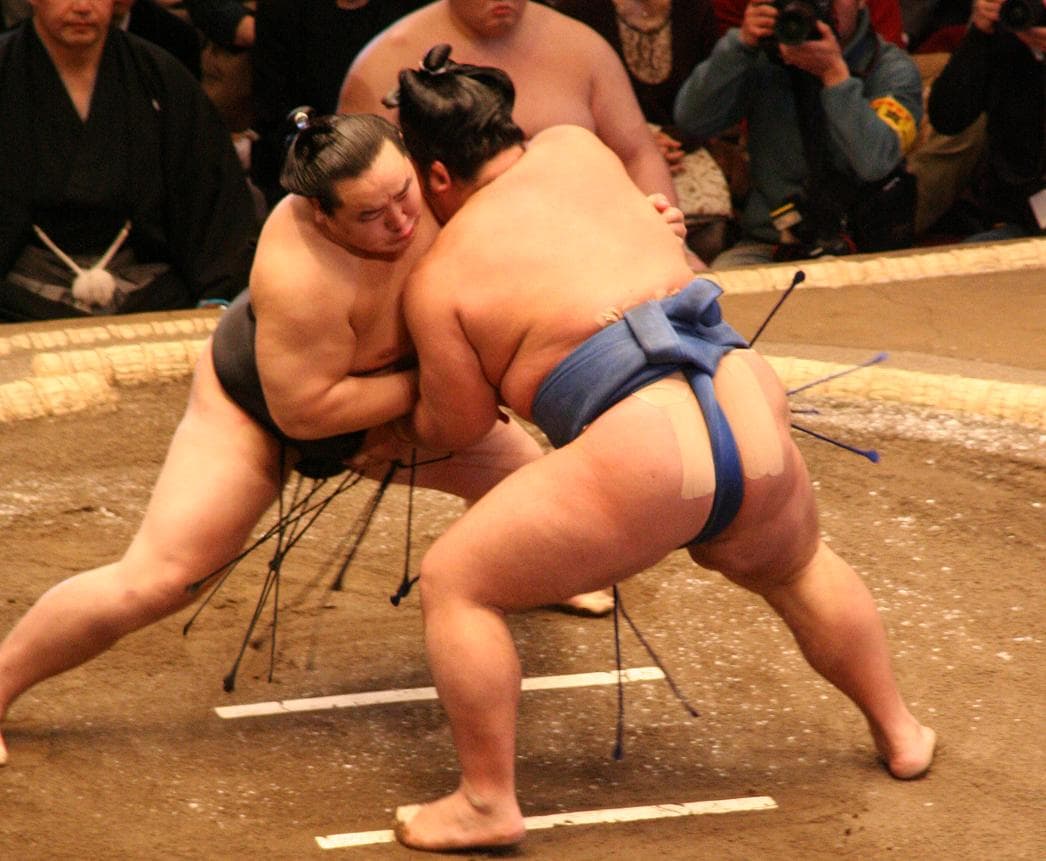
Sumo is a Japanese grappling sport in which two wrestlers try to force each other out of a circular clay ring or to touch the ground with any part of the body besides the soles of the feet.
History Snapshot
Sumo traces its roots to ancient Shinto ritual and imperial ceremony in Japan, where wrestling was performed as an offering and a test of strength. Over centuries it evolved into a professional spectator sport, taking its recognizable modern form in the Edo period and remaining Japan's national wrestling tradition to this day.
What Sumo Is
Sumo is deceptively simple to describe and endlessly rich to watch. Two wrestlers, or rikishi, face each other in a dohyo — a raised ring of packed clay about fifteen feet across, its boundary marked by a circle of rice-straw bales. At a signal they charge, and the bout is won the instant one wrestler is forced out of the ring or made to touch the ground with anything other than the soles of his feet. Matches often last only seconds, decided by a single explosive collision and the scramble that follows. But wrapped around those seconds is one of the most ritual-laden sports on earth, thick with ceremony, hierarchy, and centuries of tradition that reach back to Japan's religious life.
Origins and History
Sumo's beginnings are inseparable from Shinto, Japan's indigenous religion. In its earliest identifiable forms, wrestling was performed as a sacred act — a ritual offering to the gods, a way of praying for a good harvest, and a means of divining or honoring divine will. Much of the ceremony that still surrounds professional sumo, from the throwing of purifying salt into the ring to the sequences of stamping and ritual gesture, descends directly from these religious roots. The ring itself is treated as sacred ground. To understand sumo, you have to see that it began not as entertainment but as worship and ritual contest.
Wrestling also entered the historical record through the imperial court. Over the centuries, sumo was staged as a ceremonial event associated with the court calendar, performed before nobility as both spectacle and ritual. Precise early details are difficult to reconstruct and are wrapped in legend as much as documented fact, so it is best to speak of a long, layered development rather than a single starting point. Alongside its courtly and religious life, wrestling of a rougher, more practical kind also existed among ordinary people and, in some periods, in connection with warrior training.
The transformation that produced sumo as we know it belongs largely to the Edo period, the long era of relative peace under the Tokugawa shogunate. In those centuries, sumo grew into a popular professional entertainment. Wrestlers organized into professional ranks, tournaments were staged to raise funds and draw crowds, and the sport developed the ranking hierarchy, ceremonies, and much of the structure that still governs it. This is the period that gave sumo its recognizable modern shape and turned it from ritual and pastime into an established professional institution with paying spectators and celebrated champions.
Development Over Time
As sumo professionalized, it built the elaborate framework that defines it today. Wrestlers came to live and train in communal heya, or stables, under a master's authority, following a strict regimen and a rigid hierarchy in which lower-ranked wrestlers serve their seniors. A banked ranking system rose toward the exalted top divisions, crowned by the honorary rank of yokozuna, the grand champion held to the highest standards of skill and dignity. Referees, ceremonial dress, and precise ritual all became codified parts of the professional world.
In the modern era, sumo was organized under a national governing association that administers the professional tournaments held through the year, each a multi-day competition in which wrestlers accumulate wins and losses that decide their rise or fall in rank. The sport has weathered change — including a gradual internationalization, as wrestlers from Mongolia, the Pacific islands, Eastern Europe, and elsewhere have risen to its highest levels — while holding fiercely to its traditions. Few sports have kept their essential character so intact across so many centuries.
Core Techniques and Concepts
- The tachi-ai — the explosive initial charge and collision at the start of a bout, often decisive on its own.
- Pushing and thrusting — techniques that drive an opponent backward and out of the ring with hands and body.
- Belt grappling — grips on the mawashi (the wrestler's belt) enable throws and forcing techniques.
- Balance and low center of gravity — staying rooted while breaking the opponent's base is fundamental.
- Ring awareness — knowing one's position relative to the straw boundary shapes every decision.
- Ritual and etiquette — salt-throwing, stamping, and formal bearing are inseparable from the contest itself.
Modern Practice and Relevance
Professional sumo remains Japan's national sport and a powerful cultural institution, drawing devoted audiences to its tournaments and treating its grand champions as national figures. Beyond Japan, amateur sumo has spread internationally as a competitive grappling sport open to all sizes. For the wider combat-sports world, sumo's lessons are concrete despite its narrow rules: its emphasis on explosive first contact, balance, leverage, and forward pressure translates usefully to any grappling art, and more than one mixed-martial-arts fighter has come from a sumo background. Above all, sumo endures as a striking example of a fighting tradition that never severed its ties to ritual, remaining as much ceremony as sport after well over a thousand years.
Technical Deep Dive
Sumo is most effective when practitioners can control the transition moments between range, rhythm, and balance. Those transition moments are where technical identity becomes visible under pressure.
A useful way to study this style is to separate visible techniques from invisible skills. The visible layer includes strikes, entries, grips, and finishes; the invisible layer includes posture management, timing discipline, and recovery decisions after failed attempts.
In grappling-heavy contexts, the deepest competitive edge usually comes from connection quality rather than move count. Hand-fighting, shoulder pressure, and angle denial often decide outcomes before obvious scoring actions appear.
In weapons-influenced systems, understanding line control and timing windows is as important as tool mechanics. Clean positioning and tactical patience often matter more than speed alone.
Strengths
- Footwork, balance, explosive pushes, and forcing opponents out of the ring
- Clear technical pathways that are easy to study and pressure-test
- Strong transfer into modern competition when timing and distance matter
- Reliable clinch and control structures that reward leverage over raw strength
Trade-offs
- Training quality varies widely between schools, so fundamentals matter more than labels
- Sport rules can sharpen some attributes while reducing others
- The style's original context may differ from how it is practiced today
- Ground-heavy systems can be harder to apply against strong anti-grappling or striking-heavy opponents without cross-training
Priority Focus
- Consistent drilling under light to medium pressure
- Testing fundamentals against resisting partners before advancing
- Building attributes from basic to complex
- Practice position control and transitions before submissions
Coaching Notes
- Progress from cooperative drills to constrained sparring before full resistance
- Prioritize repeatable combinations and transitions over isolated highlight techniques
- Use video review to compare tactical intent with actual round behavior
- Track conditioning in relation to technical quality, not only output volume
- Build positional chains first, then layer submissions once control is consistent