
Martial Arts Library
Ssireum
6/17/2026 · Sofia Marchetti
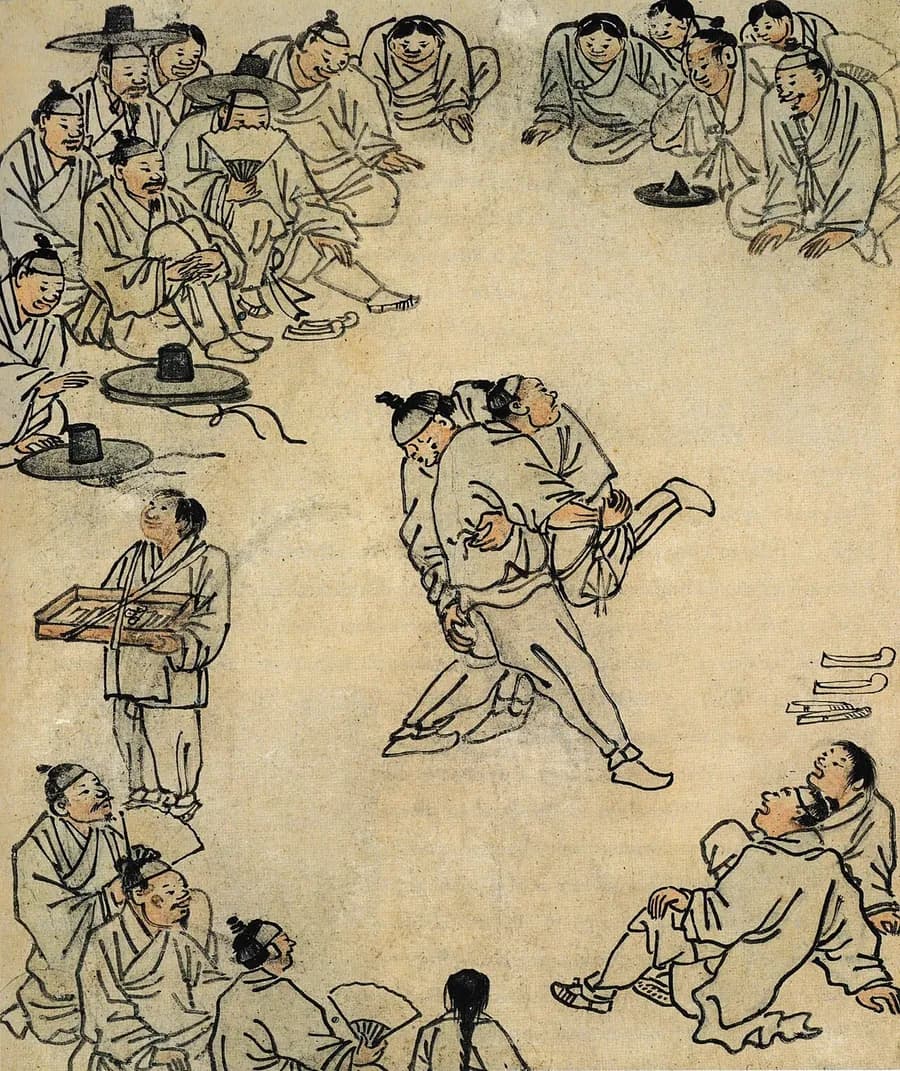
Origin
Korea
Primary Focus
Belt-grip wrestling, posture control, and fast takedowns
What It Is
Ssireum is a Korean folk wrestling sport in which competitors grip a fabric belt called the satba around the waist and thigh and try to force each other to the ground in a sandpit.
History Snapshot
Ssireum appears to be one of Korea's oldest sporting traditions, long tied to seasonal festivals and communal celebration across the peninsula. It endured through the centuries as a folk custom before being organized in the modern era into a formal competitive sport with professional bouts and a place in the region's shared cultural heritage.
What It Is
Ssireum is Korea's traditional wrestling, a grappling contest fought on sand between two competitors bound together by a fabric belt. That belt, the satba, wraps around the waist and one thigh, and each wrestler takes a fixed grip on the opponent's satba before the bout begins. From that locked-in starting position, they use strength, leverage, and technique to force one another down; the wrestler who makes any part of his opponent's body above the knee touch the ground wins. It is an upright, explosive style, and because both competitors start with a guaranteed grip, the action tends to erupt immediately into a battle of posture, timing, and off-balancing.
Origins and History
Ssireum is generally regarded as one of the oldest athletic traditions on the Korean peninsula, though its earliest history is inevitably hazy and best described in broad strokes rather than precise dates. Wrestling of this kind seems to have existed among Korean communities since ancient times, and images and references associated with early Korean history are often cited as evidence that belt wrestling was long part of the culture. As with most folk traditions passed down through practice rather than documentation, exact origins are impossible to fix, and grand claims should be treated cautiously.
What is clear is that ssireum was woven into the rhythm of communal life. It flourished as a festival activity, especially around seasonal holidays and harvest celebrations, when villages would gather and their strongest men would test themselves against one another. These contests were entertainment, a source of local pride, and a way of marking the calendar's important days. Winning wrestlers earned prestige within their community, and prizes often reflected the sport's agricultural roots — an ox, a valuable animal in a farming society, has long been associated with victory in the grandest ssireum contests.
Because it lived as a popular folk custom rather than an institutional martial art, ssireum had no single founder or codified lineage. It was simply part of what people did — a shared inheritance carried from one generation to the next through festivals, family, and village life across the whole peninsula. This gave it deep roots but also meant that, for most of its history, it existed as tradition rather than as an organized, rule-bound sport.
Development Over Time
The transformation of ssireum from folk pastime into structured sport belongs mainly to the modern era. Over the twentieth century, organizers standardized rules, defined the sandpit ring and the satba, established weight considerations, and built the competitive and administrative framework that a modern sport requires. This process turned village strongman contests into a formal discipline with recognized champions and a professional dimension, and for a time professional ssireum enjoyed considerable popularity as a spectator sport, its biggest stars becoming well-known athletes.
Like many traditional sports, ssireum has navigated the pressures of a changing entertainment landscape, seeing waves of enthusiasm and quieter periods. Efforts to preserve and promote it have emphasized its status as cultural heritage, and it has been recognized internationally as an intangible cultural tradition of the Korean people, celebrated on both sides of the peninsula. That recognition underscores how ssireum functions as more than sport — it is a living link to Korea's communal past.
Core Techniques and Concepts
- The satba grip — the fabric belt around waist and thigh gives each wrestler a fixed, guaranteed hold to work from.
- Upright posture — competitors wrestle standing, fighting to control and break the opponent's balance.
- Hip and leg techniques — throws and trips driven by the hips and legs are central to bringing an opponent down.
- Leverage over size — proper use of angle and timing lets a wrestler topple a stronger opponent.
- Explosive entries — because both start with a grip, bouts favor quick, committed attacks.
- The sandpit — the soft sand ring shapes footing and cushions falls, framing the whole contest.
Modern Practice and Relevance
Ssireum today is both a competitive sport and a cherished cultural symbol, still contested at festivals and in organized tournaments and taught as part of Korea's heritage. For the broader combat-sports world, its interest lies in its distinct takedown logic: a wrestling game built entirely around a fixed belt grip and upright throws, with none of the leg-attack shooting that dominates freestyle wrestling. That makes it a useful reference point for anyone thinking about clinch control and off-balancing, and it broadens the picture of how many different, culturally specific ways humans have devised to solve the same basic problem — putting an opponent on the ground.
Technical Deep Dive
Ssireum is most effective when practitioners can control the transition moments between range, rhythm, and balance. Those transition moments are where technical identity becomes visible under pressure.
A useful way to study this style is to separate visible techniques from invisible skills. The visible layer includes strikes, entries, grips, and finishes; the invisible layer includes posture management, timing discipline, and recovery decisions after failed attempts.
In grappling-heavy contexts, the deepest competitive edge usually comes from connection quality rather than move count. Hand-fighting, shoulder pressure, and angle denial often decide outcomes before obvious scoring actions appear.
In weapons-influenced systems, understanding line control and timing windows is as important as tool mechanics. Clean positioning and tactical patience often matter more than speed alone.
Strengths
- Belt-grip wrestling, posture control, and fast takedowns
- Clear technical pathways that are easy to study and pressure-test
- Strong transfer into modern competition when timing and distance matter
- Reliable clinch and control structures that reward leverage over raw strength
Trade-offs
- Training quality varies widely between schools, so fundamentals matter more than labels
- Sport rules can sharpen some attributes while reducing others
- The style's original context may differ from how it is practiced today
- Ground-heavy systems can be harder to apply against strong anti-grappling or striking-heavy opponents without cross-training
Priority Focus
- Consistent drilling under light to medium pressure
- Testing fundamentals against resisting partners before advancing
- Building attributes from basic to complex
- Practice position control and transitions before submissions
Coaching Notes
- Progress from cooperative drills to constrained sparring before full resistance
- Prioritize repeatable combinations and transitions over isolated highlight techniques
- Use video review to compare tactical intent with actual round behavior
- Track conditioning in relation to technical quality, not only output volume
- Build positional chains first, then layer submissions once control is consistent