
Martial Arts Library
Silat
6/17/2026 · Kenji Watanabe
Origin
Southeast Asia
Primary Focus
Angular movement, close-range disruption, and weapon-aware self-defense
What It Is
Silat is a broad family of indigenous Southeast Asian martial systems built on angular movement, close-range trapping, and a self-defense logic deeply shaped by bladed weapons.
History Snapshot
Silat developed across the Malay world of Southeast Asia over many centuries, shaped by local communities, trade, warfare, and the region's blade culture into hundreds of distinct styles. Rather than one founder or lineage, it is a mosaic of traditions bound together by shared movement principles and by cultural, ritual, and spiritual dimensions.
What It Is
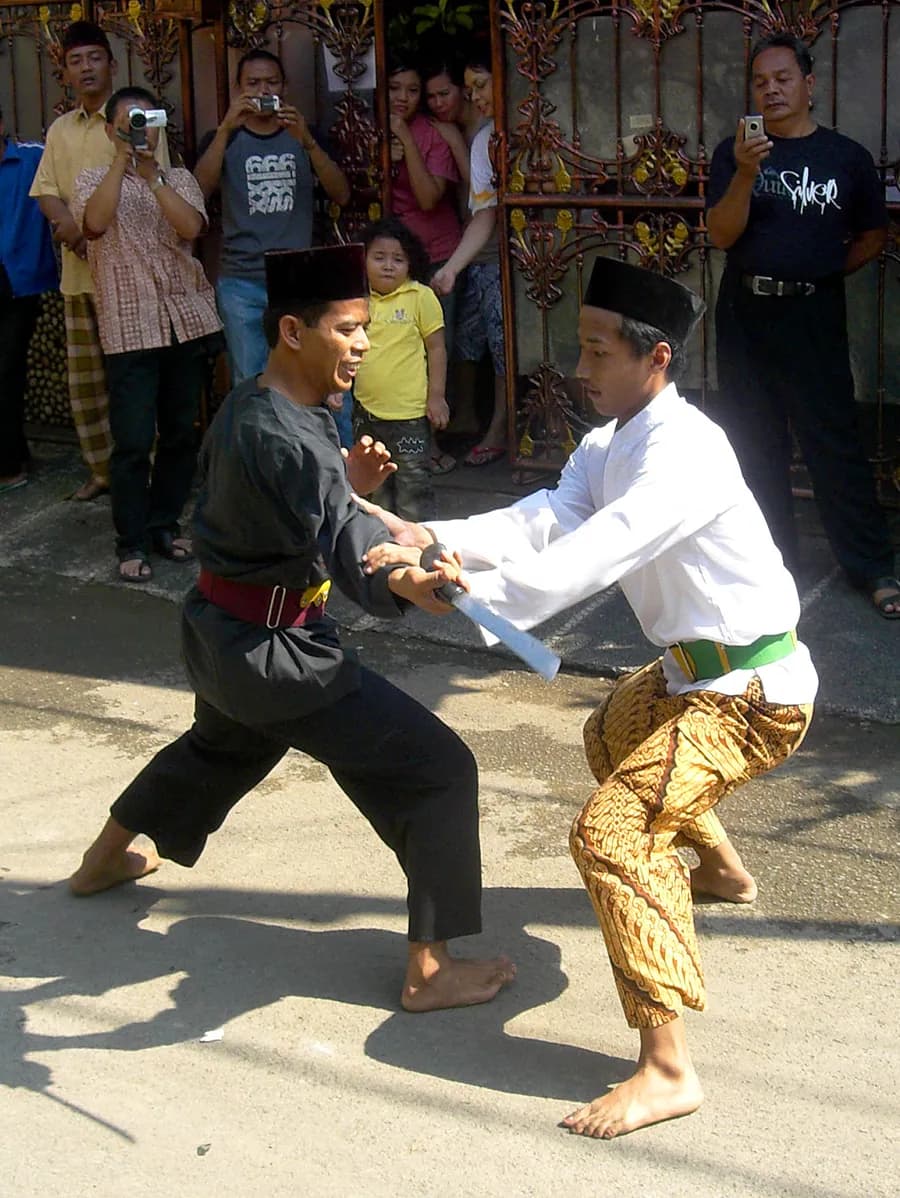
Silat is not a single style but a sprawling family of martial arts native to the Malay world — the lands and islands that today make up Indonesia, Malaysia, Brunei, Singapore, the southern Philippines, and parts of Thailand. Across that vast region it takes hundreds of local forms, known by names like pencak silat and silat Melayu, each with its own flavor. What unites them is a recognizable movement logic: fighting off the line of attack rather than straight into it, flowing between striking, trapping, joint manipulation, and takedowns, and always keeping an awareness of weapons — especially the blade — even in empty-hand work. Many styles also carry a strong artistic and ceremonial dimension, blurring the line between combat, dance, and ritual.
Origins and History
The origins of silat lie deep in the history of Southeast Asia, and because the tradition was long carried by oral teaching and local custom rather than written record, its early story is genuinely uncertain. It is wise to be skeptical of any tidy founding myth. What can be said is that silat grew organically out of the needs of communities across the Malay archipelago over many centuries — a landscape of villages, kingdoms, and seafaring peoples where self-defense, warfare, and hunting were facts of life.
Several forces shaped that development. The region sat astride some of the world's busiest maritime trade routes, and centuries of contact with Chinese, Indian, Arab, and other travelers brought cultural and possibly technical exchange, layered onto indigenous fighting methods. The area's political history — competing sultanates, warrior traditions, and periods of conflict — rewarded martial skill and helped local styles flourish and diversify. And the deep culture of bladed weapons, above all the wavy-bladed dagger known as the keris (or kris) that carries profound cultural and spiritual meaning, meant that silat's movement was fundamentally organized around defending against and wielding sharp edges.
Because it grew from so many separate communities, silat never had a single founder, canonical text, or unified lineage. Instead it fragmented into a huge number of styles, each often tied to a particular village, family, teacher, or ethnic group, and frequently guarded closely. Some traditions wrapped their combat teaching in music, ceremony, and spiritual practice, so that a style might function simultaneously as a fighting method, a cultural performance for weddings and festivals, and a vehicle for religious or philosophical values. This diversity is not a footnote to silat; it is its defining characteristic.
Development Over Time
Over the centuries, silat spread and evolved alongside the movement of peoples throughout the region, and colonial-era disruptions and migrations carried styles into new areas and communities. In the modern era, efforts emerged to organize and preserve the art. National and regional bodies were formed to standardize aspects of pencak silat, promote it as cultural heritage, and turn parts of it into a regulated sport with rules for competition, uniforms, and judging. This sportive silat now features in Southeast Asian multi-sport games and has its own international competitive scene.
Yet standardization only ever captured part of the picture. Alongside the sport, countless traditional schools continue to teach in the older way, preserving combative, artistic, and spiritual content that no tournament rulebook could hold. Silat also traveled globally through the Southeast Asian diaspora and through martial-arts enthusiasts abroad, gaining particular visibility when its distinctive movement appeared in international action films.
Core Techniques and Concepts
- Angular footwork — practitioners move to angles, stepping off the line of attack rather than meeting force head-on.
- Weapon awareness — empty-hand technique is shaped by blade logic, especially defense against and use of the keris.
- Close-range trapping — hands control, trap, and redirect an opponent's limbs at short distance.
- Sweeps and takedowns — off-balancing and leg techniques bring opponents down, often after a disruption.
- Deception and timing — fluid, sometimes low postures disguise intent and set up sudden entries.
- Cultural forms — many styles preserve ritual movement, sometimes performed to music, linking combat and heritage.
Modern Practice and Relevance
Silat lives today in three overlapping worlds: as competitive sport, as traditional cultural art, and as a self-defense system with a devoted following. Its influence on the wider combat-sports conversation has grown, thanks partly to cinema and partly to fighters and coaches curious about its off-line movement, trapping, and weapon-aware concepts. A handful of professional fighters from Southeast Asia have carried silat elements into MMA, and its ideas circulate in the self-defense community where deception, angles, and blade awareness are valued. More than a fighting style, silat endures as one of the great living martial traditions of the world, inseparable from the cultures that created it.
Technical Deep Dive
Silat is most effective when practitioners can control the transition moments between range, rhythm, and balance. Those transition moments are where technical identity becomes visible under pressure.
A useful way to study this style is to separate visible techniques from invisible skills. The visible layer includes strikes, entries, grips, and finishes; the invisible layer includes posture management, timing discipline, and recovery decisions after failed attempts.
In weapons-influenced systems, understanding line control and timing windows is as important as tool mechanics. Clean positioning and tactical patience often matter more than speed alone.
Strengths
- Angular movement, close-range disruption, and weapon-aware self-defense
- Clear technical pathways that are easy to study and pressure-test
- Strong transfer into modern competition when timing and distance matter
- Strong awareness of range, line selection, and tool-to-body integration
Trade-offs
- Training quality varies widely between schools, so fundamentals matter more than labels
- Sport rules can sharpen some attributes while reducing others
- The style's original context may differ from how it is practiced today
- Weapons-based training often needs careful adaptation before it translates into sporting or self-defense contexts
Priority Focus
- Consistent drilling under light to medium pressure
- Testing fundamentals against resisting partners before advancing
- Building attributes from basic to complex
Coaching Notes
- Progress from cooperative drills to constrained sparring before full resistance
- Prioritize repeatable combinations and transitions over isolated highlight techniques
- Use video review to compare tactical intent with actual round behavior
- Track conditioning in relation to technical quality, not only output volume