
Martial Arts Library
Shuai Jiao
6/17/2026 · Marcus Delgado
Origin
China
Primary Focus
Stand-up grappling, trips, reaps, and throwing control
What It Is
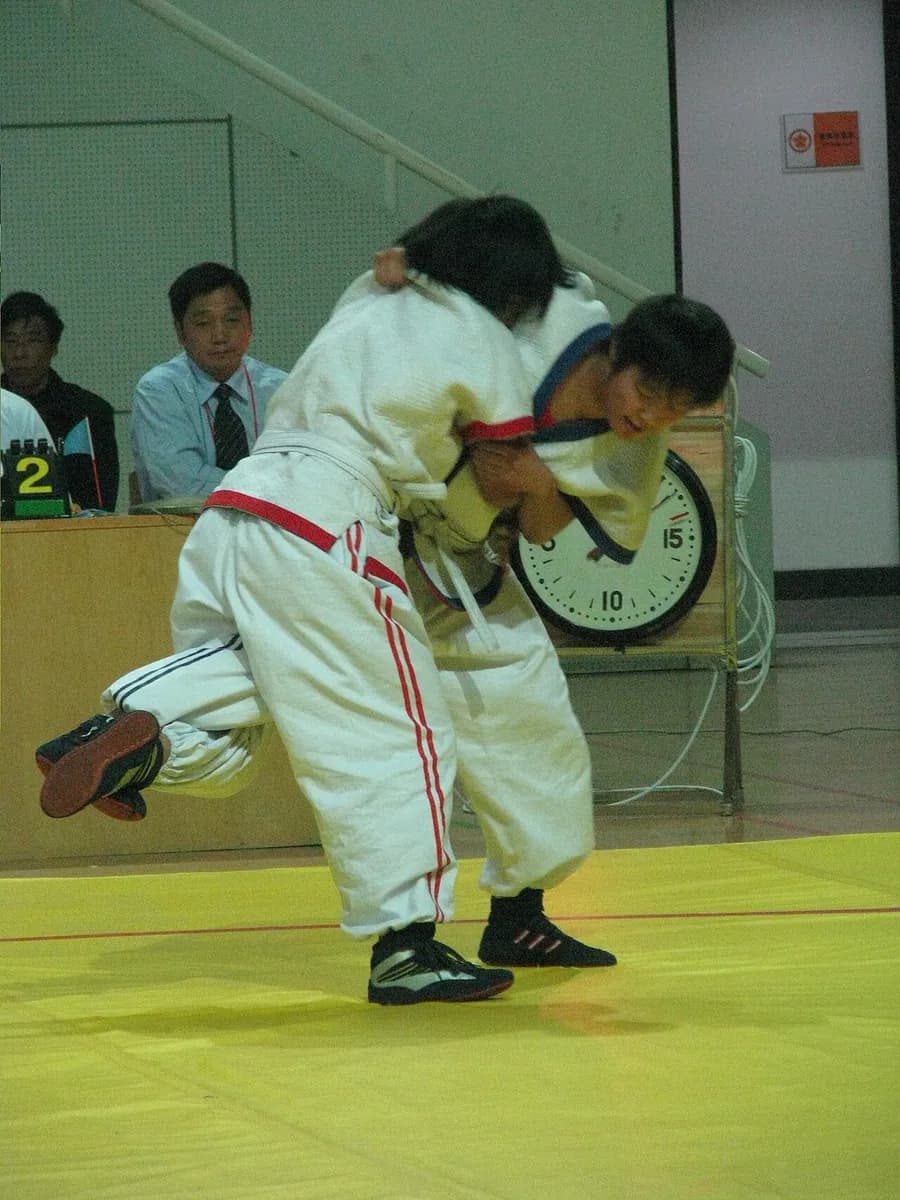
Shuai Jiao is a Chinese jacket-wrestling art that emphasizes upright grappling, balance disruption, and fast, efficient throws finished from the standing clinch.
History Snapshot
Shuai Jiao descends from very old Chinese wrestling traditions that were shaped over centuries by military training and court patronage, including the elite wrestlers of imperial guards. It was later organized into a standardized modern sport with a formal jacket, weight classes, and competition rules while keeping its distinctive standing throwing game.
What It Is
Shuai Jiao is the throwing art at the heart of Chinese grappling. Practitioners wear a stout short jacket and fight from an upright, mobile clinch, hunting for the grip that lets them break an opponent's balance and slam them to the ground. Where some grappling styles pull the fight downward into the mat, Shuai Jiao keeps it standing: the aim is a decisive throw, and once a competitor hits the ground the exchange typically resets. This gives the art a fast, punchy rhythm built on grip fighting, trips, reaps, and hip throws, with footwork and posture prized as highly as raw strength.
Origins and History
Few martial arts can claim a lineage as long as Chinese wrestling, and Shuai Jiao is its modern inheritor. Grappling contests appear in Chinese cultural memory stretching back into antiquity, referenced in early legends and historical accounts of strength contests staged for rulers and armies. Naturally, the details of these ancient forms are hazy, and it would be a mistake to draw a straight, unbroken line from a legendary ancient bout to a modern tournament. What the long record does show is that some form of jacketed or clothing-grip wrestling has been part of Chinese life for a very long time, valued both as entertainment and as a practical fighting skill.
Two forces shaped this tradition more than any other: the military and the court. Wrestling was a natural component of soldiers' training, a way to build toughness and teach unarmed control, and it appears repeatedly in connection with martial preparation across successive dynasties. At the same time, wrestling was patronized as spectacle by rulers, who kept skilled grapplers for competition and display. This dual identity — battlefield-adjacent skill and courtly sport — helped preserve and refine the art through changing dynasties.
The tradition reached a notable high point under the later imperial period, when wrestling was cultivated among elite guard units associated with the Qing court. These professional wrestlers, drawn into palace service, trained intensively and competed at a high level, and this milieu is often credited with sharpening the techniques and standards that fed into the modern art. The regional flavors that developed around major centers — each with its own tactical preferences and training culture — trace much of their character to this era of concentrated, high-level practice.
Development Over Time
As China modernized in the twentieth century, Shuai Jiao was reorganized along the lines of a contemporary sport. Reformers and martial-arts institutions worked to standardize its rules, adopt a regulation jacket, introduce weight divisions, and define clear scoring for throws — turning a cluster of regional wrestling customs into a codified competitive discipline. The name Shuai Jiao itself came to serve as the umbrella term for this systematized art, even as older local styles retained their distinctive habits.
Through the century the sport spread within China and to Chinese communities abroad, carried by teachers who valued both its combative substance and its cultural heritage. It also became intertwined with the broader world of Chinese martial arts, where its standing throws were sometimes studied as the grappling complement to striking systems. While it never achieved the global tournament footprint of judo, Shuai Jiao developed a devoted international following and a reputation among grapplers as a deep, distinct throwing method.
Core Techniques and Concepts
- Jacket grips — control begins with grips on the sturdy short jacket, which anchor throws and set up entries.
- Upright posture — competitors stay tall and mobile, wrestling from a standing base rather than pulling to the ground.
- Trips and reaps — the legs sweep, hook, and reap an opponent's base, often before they sense the danger.
- Balance breaking — off-balancing the opponent is the essential setup that makes every throw possible.
- Hip and body throws — powerful rotational throws load the opponent onto the hips or back.
- Footwork — precise stepping and weight placement decide whether a grip becomes a finish.
Modern Practice and Relevance
Shuai Jiao remains a living competitive sport and a respected repository of standing grappling knowledge. For modern fighters, its value is concrete: it offers a whole vocabulary of clinch control, grip fighting, and throws that differs from the more familiar judo and freestyle-wrestling entries. Athletes in MMA and submission grappling who want to broaden their takedown game increasingly look to systems like Shuai Jiao for off-balancing tricks and upright throwing mechanics. As one of the oldest continuously practiced wrestling traditions on earth, it also carries real cultural weight — a direct link between today's mats and millennia of Chinese grappling.
Technical Deep Dive
Shuai Jiao is most effective when practitioners can control the transition moments between range, rhythm, and balance. Those transition moments are where technical identity becomes visible under pressure.
A useful way to study this style is to separate visible techniques from invisible skills. The visible layer includes strikes, entries, grips, and finishes; the invisible layer includes posture management, timing discipline, and recovery decisions after failed attempts.
In grappling-heavy contexts, the deepest competitive edge usually comes from connection quality rather than move count. Hand-fighting, shoulder pressure, and angle denial often decide outcomes before obvious scoring actions appear.
Strengths
- Stand-up grappling, trips, reaps, and throwing control
- Clear technical pathways that are easy to study and pressure-test
- Strong transfer into modern competition when timing and distance matter
- Reliable clinch and control structures that reward leverage over raw strength
Trade-offs
- Training quality varies widely between schools, so fundamentals matter more than labels
- Sport rules can sharpen some attributes while reducing others
- The style's original context may differ from how it is practiced today
- Ground-heavy systems can be harder to apply against strong anti-grappling or striking-heavy opponents without cross-training
Priority Focus
- Consistent drilling under light to medium pressure
- Testing fundamentals against resisting partners before advancing
- Building attributes from basic to complex
- Practice position control and transitions before submissions
Coaching Notes
- Progress from cooperative drills to constrained sparring before full resistance
- Prioritize repeatable combinations and transitions over isolated highlight techniques
- Use video review to compare tactical intent with actual round behavior
- Track conditioning in relation to technical quality, not only output volume
- Build positional chains first, then layer submissions once control is consistent