
Martial Arts Library
Shotokan Karate
6/18/2026 · Priya Nair
Origin
Okinawa and Japan, developed in early 20th century and popularized by Gichin Funakoshi
Primary Focus
Linear footwork, stance power, hand and foot strikes, and kata forms
What It Is
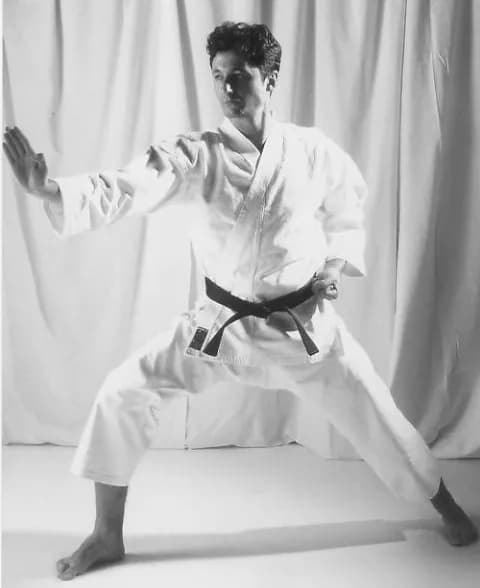
Shotokan is a traditional karate style built on deep stances, linear movement, and the interplay between kata (forms) and kumite (sparring) to develop explosive striking technique.
History Snapshot
Shotokan grew from Okinawan karate as reshaped by Gichin Funakoshi, who introduced the art to mainland Japan in the 1920s and gave it a modern, systematic form. His students carried it worldwide after the Second World War, and its deep stances and formal kata made it the most widely taught karate style on earth.
What Shotokan Karate Is
Shotokan is the karate most people picture when they imagine the art: crisp white uniforms, long low stances, sharp linear techniques, and the disciplined repetition of kata. It is a striking system built around powerful punches, kicks, and strikes delivered from deep, stable positions, with movement that tends to travel in straight lines. Training rests on three pillars — kihon (basics), kata (forms), and kumite (sparring) — and the style treats the endless refinement of fundamentals as the path to real fighting ability. More than a set of techniques, Shotokan carries a philosophy of character development that its founder considered inseparable from the physical practice.
Origins and History
Shotokan's roots lie in Okinawa, the island chain that was for centuries a crossroads of trade and culture between Japan, China, and Southeast Asia. Out of that mix grew te, and later the local streams of Shuri-te, Naha-te, and Tomari-te, blending indigenous fighting methods with Chinese martial arts. For much of its history this practice was taught quietly, sometimes secretively, among Okinawans rather than presented to the wider world.
The pivotal figure in Shotokan's story is Gichin Funakoshi, born in Okinawa in the late nineteenth century. A schoolteacher by profession and a student of leading masters of the Shuri tradition — most notably Anko Itosu — Funakoshi was steeped in the older Okinawan karate before he ever thought of spreading it abroad. He was also a scholar and a man of calm temperament, qualities that shaped how he would present the art. In the early decades of the twentieth century, as Okinawan karate began to step out of the shadows, Funakoshi took part in public demonstrations that brought the practice to Japanese attention.
The decisive moment came in the 1920s, when Funakoshi traveled to mainland Japan and demonstrated karate to influential audiences, including within the Japanese martial-arts establishment. He chose to stay and teach, and in doing so he became the central figure in introducing karate to Japan proper. To fit the conventions of Japanese budo, the art was reorganized: it adopted the uniform and colored-belt ranking borrowed from judo, formalized its dojo etiquette, and framed itself as a path of personal cultivation. Funakoshi even helped reinterpret the very name "karate" to mean "empty hand," giving it a broader philosophical resonance beyond its older reading.
The name Shotokan itself came later and somewhat indirectly. "Shoto" was Funakoshi's pen name, used in his calligraphy and poetry, and "kan" means hall or house — so Shotokan was, in effect, "Shoto's hall," the name attached to the training place associated with him. Funakoshi himself reportedly preferred to speak simply of karate rather than of styles, but the label stuck to the tradition his teaching produced.
Development Over Time
Shotokan as a distinct, standardized style owes a great deal to the generation after Funakoshi, and especially to his son and to a cohort of vigorous younger instructors. They sharpened the deep stances, emphasized dynamic movement, and helped build the organizational structures that would carry the art forward. After the Second World War, karate spread rapidly, and Shotokan practitioners were among the most active in taking the art overseas. Instructors dispatched around the globe planted the style in Europe, the Americas, and beyond, often establishing the first karate anyone in a given country had ever seen.
This global expansion also brought debate and division. Questions about sport competition, about how rigid or mobile the stances should be, and about organizational control led to the growth of multiple Shotokan associations. Yet the shared technical identity persisted: whatever the banner, Shotokan remained recognizable by its long stances, linear power, and devotion to kata.
Core Techniques and Concepts
- Deep stances — positions such as zenkutsu-dachi (front stance) and kokutsu-dachi (back stance) create a stable base for power.
- Linear movement — techniques and footwork favor straight-line entries and retreats.
- Kata — formal solo sequences encode technique, timing, and breathing to be internalized through repetition.
- Kihon and kumite — disciplined basics feed into structured sparring, from prearranged drills to freer exchange.
- Hip rotation — power is driven from the hips and legs into hand and foot strikes.
- Kiai — a sharp coordinated shout focuses breath, timing, and intent at the moment of impact.
Modern Practice and Relevance
Shotokan is almost certainly the most widely practiced karate style in the world, and it formed the competitive backbone that helped carry karate onto the international sporting stage. Its explosive, single-strike ethic and its rigorous stance work build genuine power and discipline, and many strikers value the timing and distance control it teaches. Purists and modern combat-sports coaches sometimes note that its deep stances and straight-line footwork need adapting for the constant lateral movement of the cage or ring. Even so, Shotokan's emphasis on committed, well-structured technique keeps it relevant, both as a foundational striking education and as a living tradition with millions of practitioners.
Technical Deep Dive
Shotokan Karate is most effective when practitioners can control the transition moments between range, rhythm, and balance. Those transition moments are where technical identity becomes visible under pressure.
A useful way to study this style is to separate visible techniques from invisible skills. The visible layer includes strikes, entries, grips, and finishes; the invisible layer includes posture management, timing discipline, and recovery decisions after failed attempts.
In striking-heavy contexts, this style rewards athletes who can maintain stance integrity while changing pace. Distance ownership, exit discipline, and defensive resets determine whether offensive output remains sustainable late in rounds.
Strengths
- Linear footwork, stance power, hand and foot strikes, and kata forms
- Clear technical pathways that are easy to study and pressure-test
- Strong transfer into modern competition when timing and distance matter
- Useful footwork, tempo control, and scoring mechanics under pressure
Trade-offs
- Training quality varies widely between schools, so fundamentals matter more than labels
- Sport rules can sharpen some attributes while reducing others
- The style's original context may differ from how it is practiced today
- Pure striking systems may need clinch and takedown defense layers for mixed-rule environments
Priority Focus
- Consistent drilling under light to medium pressure
- Testing fundamentals against resisting partners before advancing
- Building attributes from basic to complex
- Develop footwork, head movement, and distance management
Coaching Notes
- Progress from cooperative drills to constrained sparring before full resistance
- Prioritize repeatable combinations and transitions over isolated highlight techniques
- Use video review to compare tactical intent with actual round behavior
- Track conditioning in relation to technical quality, not only output volume
- Drill entries and exits as one unit so offense and defense stay connected