
Martial Arts Library
Shin-Kicking
6/17/2026 · Kenji Watanabe
Origin
England
Primary Focus
Close-range leg attacks and off-balancing
What It Is
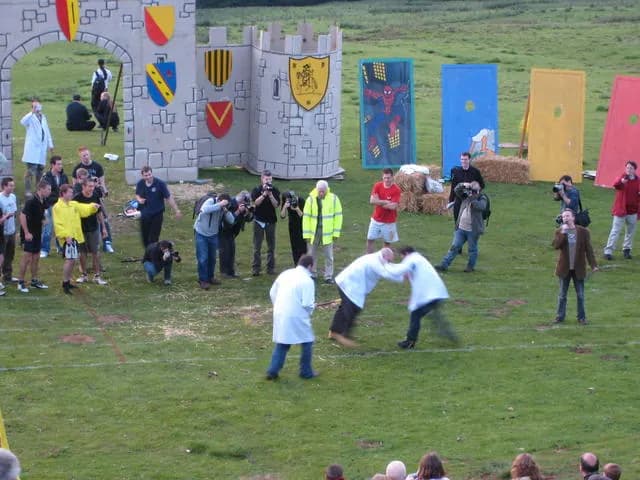
Shin-kicking is a historic English folk contest where two opponents hold each other by the collar and kick at the shins, trying to force a fall or submission.
History Snapshot
Shin-kicking appears to have emerged from the rough rural sporting culture of the English countryside, where it became associated with traditional festival games. It faded and revived over the centuries and now survives largely as a folk spectacle, kept alive by regional festivals rather than any formal competitive circuit.
What It Is
Shin-kicking is exactly what its blunt name promises, and yet there is a little more craft to it than an outsider expects. Two competitors face off, take hold of each other by the collar or shoulders, and begin kicking one another in the shins while trying to throw or topple the opponent to the ground. A bout is usually won by making the other person fall, or by wearing them down until they concede. Traditionally, contestants have padded their lower legs with straw stuffed inside their trousers — a modest concession to safety that hardly removes the sting. It is at once a genuine test of pain tolerance and grip strength and a piece of living folk theatre.
Origins and History
The roots of shin-kicking lie in the rural sporting culture of England, and like most folk games they are murky rather than precisely documented. It is best to treat any specific claim about its exact birth with skepticism. What is reasonably well understood is that shin-kicking became associated with the tradition of country games and festivals that flourished in the English countryside — informal, boisterous gatherings where wrestling, running, and various trials of toughness were the entertainment for working communities.
The contest is particularly linked in popular memory with the Cotswold region and with a long-running set of country games traditionally held on a hillside there. These sorts of festival games gathered together a whole menu of rustic competitions, and shin-kicking fit right in as a crowd-pleasing test of grit. In an age with few organized sports and plenty of hard physical labor, a contest that pitted two people against each other in a straightforward battle of endurance had obvious appeal. It required nothing more than two willing participants, and it produced a clear, dramatic winner.
Because it belonged to folk culture rather than to any institution, shin-kicking left few careful records and had no single founding figure or governing lineage. It was passed along through custom and local reputation. Its fortunes rose and fell with the fortunes of the festivals that hosted it. During periods when such rowdy country gatherings were discouraged or suppressed — and there were stretches when authorities frowned on the disorder and drinking that accompanied them — the game receded. When the festivals were revived, shin-kicking tended to come back with them.
Development Over Time
The broad arc of shin-kicking is one of decline and revival rather than steady growth. The old country games that nurtured it were interrupted and reshaped over the nineteenth and twentieth centuries, and for long stretches the practice was more memory than active sport. Its survival owes much to deliberate efforts to revive traditional festivals, which reintroduced shin-kicking to new audiences as a curiosity and a link to the past.
In its modern revived form the contest has picked up light touches of organization — informal rules, a nod toward safety with the straw padding and softer footwear, and the framework of an annual event where a champion can be crowned. But it has resisted turning into a mainstream sport. There is no professional circuit, no international federation of the kind that governs judo or boxing, and no real path to a career. That is largely the point: its charm lies in being a stubborn, eccentric survival from an older sporting world.
Core Techniques and Concepts
- The collar hold — competitors grip each other's upper body, which both anchors the clinch and provides leverage for a throw.
- Targeted kicking — repeated kicks to the shin aim to weaken the opponent's stance and resolve.
- Off-balancing — the real goal is often to topple the opponent, using their reaction to the kicks to pull them down.
- Pain tolerance — composure under a barrage of shin strikes is as decisive as any technique.
- Straw padding — the traditional protective stuffing is part safety measure, part folk custom.
Modern Practice and Relevance
Shin-kicking has no direct influence on the striking or grappling seen in modern combat sports, and it would be a stretch to claim otherwise. Its relevance is different and arguably more interesting: it is a window into how humans have always found ways to compete physically, long before rings, gloves, and rulebooks. For fans of fighting sports, it is a reminder that the family tree of combat traditions includes strange, hyper-local branches — games shaped entirely by their community and their festival calendar, valued not for producing champions but for keeping a piece of heritage stubbornly alive.
Technical Deep Dive
Shin-Kicking is most effective when practitioners can control the transition moments between range, rhythm, and balance. Those transition moments are where technical identity becomes visible under pressure.
A useful way to study this style is to separate visible techniques from invisible skills. The visible layer includes strikes, entries, grips, and finishes; the invisible layer includes posture management, timing discipline, and recovery decisions after failed attempts.
Strengths
- Close-range leg attacks and off-balancing
- Clear technical pathways that are easy to study and pressure-test
- Strong transfer into modern competition when timing and distance matter
Trade-offs
- Training quality varies widely between schools, so fundamentals matter more than labels
- Sport rules can sharpen some attributes while reducing others
- The style's original context may differ from how it is practiced today
Priority Focus
- Consistent drilling under light to medium pressure
- Testing fundamentals against resisting partners before advancing
- Building attributes from basic to complex
- Develop footwork, head movement, and distance management
Coaching Notes
- Progress from cooperative drills to constrained sparring before full resistance
- Prioritize repeatable combinations and transitions over isolated highlight techniques
- Use video review to compare tactical intent with actual round behavior
- Track conditioning in relation to technical quality, not only output volume