
Martial Arts Library
Savate
6/17/2026 · Priya Nair
Origin
France
Primary Focus
Long-range kicking, footwork, and clean striking precision
What It Is
Savate is a French kickboxing system that blends formal boxing hands with specialized kicking mechanics delivered in footwear.
History Snapshot
Savate grew out of nineteenth-century French street-fighting and dockside brawling before reformers pulled it into the gymnasium and gave it rules. Over roughly a century it hardened into a codified ring sport that keeps its distinctive shoes-on, point-of-the-toe kicking to this day.
What It Is
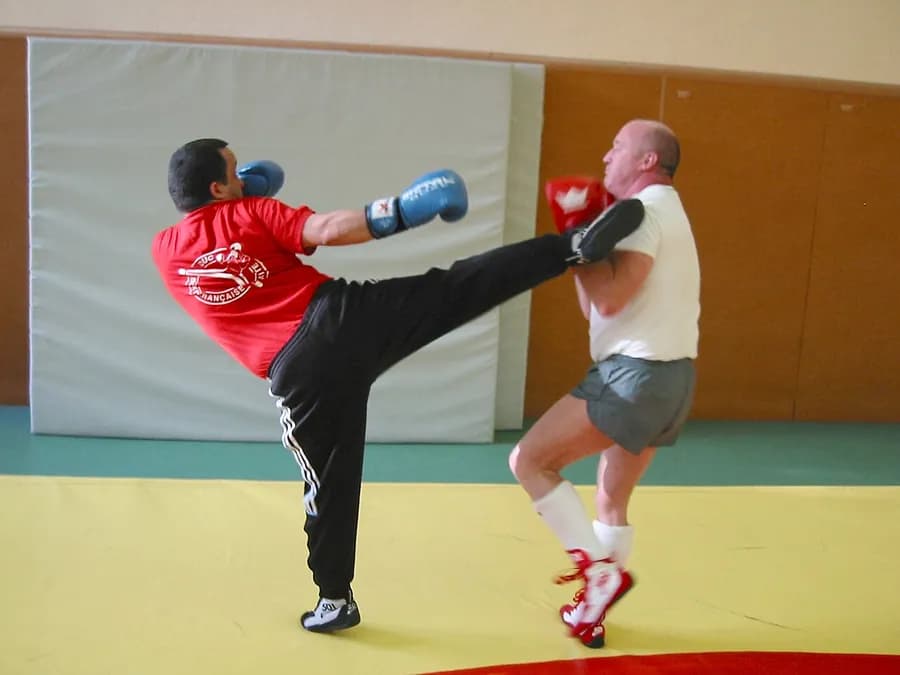
Watch a few seconds of high-level savate and it announces itself. The stance is tall and bladed, the hands carry a clean boxing shape, and the kicks arrive on straight lines with the foot pointed like a rapier. Competitors fight in specialized boots, which is not a costume detail but a mechanical one: strikes land with the tip or edge of the shoe rather than the shin. The result is a sport that feels closer to fencing than to the heavy, clinch-driven rhythm of Muay Thai. Range is everything. Fighters glide in and out, measuring distance, and treat a well-timed lead-leg kick as both a weapon and a ruler.
Origins and History
Savate's story begins in the crowded, hard-edged France of the early nineteenth century. The word itself refers to an old kind of worn-out shoe, a hint that this was a fighting method of the streets rather than the salon. In the port cities and the poorer quarters of Paris, men who could not or would not use their fists in an English boxing sense developed a habit of kicking, shoving, and slapping to settle disputes. Two rough currents fed the early art. One was Parisian street fighting, sometimes called chausson in its southern, more acrobatic form as it circulated among sailors around Marseille. The other was the general culture of dockside and barracks brawling, where low kicks to the shins and open-hand strikes were practical tools for men in heavy footwear.
For a long stretch, savate carried a disreputable air. It was linked in the public mind with street toughs and the criminal underworld, and that reputation both fueled its spread and threatened its survival. The turning point came through a handful of teachers who set out to civilize the practice. The name most associated with this shift is Charles Lecour, who in the 1830s trained with English boxers and became convinced that French kicking needed proper hand technique to be complete. By marrying the kicks of savate to the punches of English pugilism, he helped create something recognizable as boxe française — French boxing — a system with structure, drills, and a teachable curriculum rather than a bag of brawling tricks.
Through the middle and later nineteenth century, that gentrified version moved indoors. Instructors opened salles, published manuals, and taught savate to a broader clientele that included the middle and upper classes who wanted exercise, self-defense, and a fashionable pastime. Figures such as Joseph Charlemont and his son Charles are remembered for codifying technique and pushing savate toward respectability and competition. By the turn of the twentieth century, French boxing had a defined vocabulary of kicks, target zones, and sparring conventions.
Development Over Time
The twentieth century nearly killed it. Two World Wars devastated the generation of young men who practiced and taught savate, and the art came close to vanishing. Its revival owes a great deal to a smaller group of dedicated instructors in the mid-century who rebuilt clubs, reassembled the curriculum, and organized it into a modern federated sport. Out of that recovery came the ranking system many practitioners know today, which borrows the color imagery of gloves — moving through technical grades toward the coveted higher levels — rather than the belt system of Asian arts.
As it stabilized, savate settled into recognizable competitive formats: lighter contact assaut, where clean technique and control are scored, and full-power combat, where knockouts are possible. Governing bodies spread the sport internationally, and world championships gave it a genuine global footprint beyond France, particularly across Europe. The shoes stayed, the point-toe kicks stayed, and the fencing-like emphasis on distance and timing remained its signature.
Core Techniques and Concepts
- Fouetté — a whipping roundhouse-style kick that lands with the tip or instep of the shoe, aimed at the leg, body, or head.
- Chassé — a piston-like thrusting kick, front or side, used to keep opponents at range and control distance.
- Revers — a reverse or hooking kick that sweeps across a target, useful for surprising an opponent circling to the side.
- Coup de pied bas — a low kick to the shin or knee, one of the oldest street tools in the system.
- Boxing hands — jab, cross, hook, and uppercut, integrated directly from Western boxing.
- Distance and mobility — the tall, mobile stance treats footwork and range control as primary weapons, not support skills.
Modern Practice and Relevance
Today savate lives a double life. It remains a proud national sport in France with a competitive circuit and a lineage of champions, and it has also found a niche in the wider combat-sports world as a source of unusual striking tools. Fighters who cross-train savate value its long-range kicking mechanics, its sharp lead-leg game, and its habit of controlling distance rather than trading in the pocket. In an era where kickboxing and MMA striking often converge on similar templates, savate stands out as a reminder that footwear, scoring rules, and cultural taste can steer a striking art toward something genuinely its own.
Technical Deep Dive
Savate is most effective when practitioners can control the transition moments between range, rhythm, and balance. Those transition moments are where technical identity becomes visible under pressure.
A useful way to study this style is to separate visible techniques from invisible skills. The visible layer includes strikes, entries, grips, and finishes; the invisible layer includes posture management, timing discipline, and recovery decisions after failed attempts.
In striking-heavy contexts, this style rewards athletes who can maintain stance integrity while changing pace. Distance ownership, exit discipline, and defensive resets determine whether offensive output remains sustainable late in rounds.
In weapons-influenced systems, understanding line control and timing windows is as important as tool mechanics. Clean positioning and tactical patience often matter more than speed alone.
Strengths
- Long-range kicking, footwork, and clean striking precision
- Clear technical pathways that are easy to study and pressure-test
- Strong transfer into modern competition when timing and distance matter
- Useful footwork, tempo control, and scoring mechanics under pressure
Trade-offs
- Training quality varies widely between schools, so fundamentals matter more than labels
- Sport rules can sharpen some attributes while reducing others
- The style's original context may differ from how it is practiced today
- Pure striking systems may need clinch and takedown defense layers for mixed-rule environments
Priority Focus
- Consistent drilling under light to medium pressure
- Testing fundamentals against resisting partners before advancing
- Building attributes from basic to complex
- Develop footwork, head movement, and distance management
Coaching Notes
- Progress from cooperative drills to constrained sparring before full resistance
- Prioritize repeatable combinations and transitions over isolated highlight techniques
- Use video review to compare tactical intent with actual round behavior
- Track conditioning in relation to technical quality, not only output volume
- Drill entries and exits as one unit so offense and defense stay connected