
Martial Arts Library
Sanda (Chinese Kickboxing)
6/18/2026 · Kyle Brenner
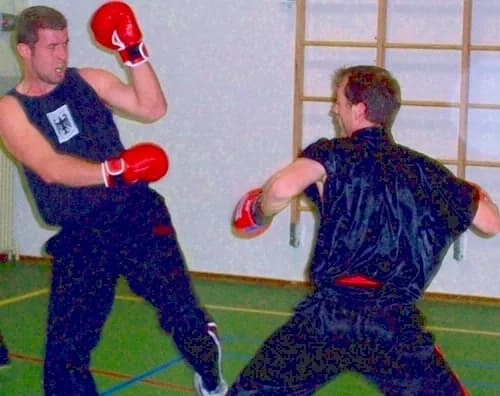
Origin
China, developed from long-range Chinese martial arts methods and formalized as a sport in the 1950s–1960s
Primary Focus
High kicks, sweeps, explosive footwork, and hand combinations
What It Is
Sanda is a striking and throwing sport that combines punches, kicks, sweeps, and takedown techniques within a ruleset designed to reward bold, explosive entries.
History Snapshot
Sanda was developed in twentieth-century China as the full-contact fighting component of modern wushu, distilling techniques from traditional kung fu into a testable competitive format shaped by the military. It combines kickboxing with catches, sweeps, and throws, and has since become a proving ground that crosses over into kickboxing and MMA.
What It Is
Sanda, also written sanshou, is China's full-contact fighting sport, essentially Chinese kickboxing with a grappling twist. Fighters throw punches and kicks like any kickboxer, but the ruleset also rewards catches, sweeps, and throws, so a fighter who catches an incoming kick can dump the opponent to the canvas for points, and clinch exchanges resolve quickly into takedowns rather than prolonged infighting. The name translates loosely as "free fighting," and that captures the intent: it is the practical, sparring side of Chinese martial arts, meant to test techniques against a resisting opponent rather than perform them in forms.
Origins and History
Sanda's story is inseparable from the twentieth-century project to modernize Chinese martial arts. Traditional kung fu was vast, diverse, and heavily oriented toward taolu, the solo forms, and there was a longstanding desire to have a standardized, safe, full-contact way to actually fight. Historic bare-knuckle challenge matches, the lei tai platform bouts of earlier eras, provided a cultural memory of open combat, but they were dangerous and unregulated.
The decisive development came after the founding of the People's Republic of China, when the state took an active hand in organizing martial arts into modern wushu. From roughly the 1950s and into the following decades, sanda was formalized as the sparring, combat half of that system, the counterpart to the performance-oriented forms competition. The military played a central role: the sport was shaped in part as practical unarmed combat training for soldiers, which is why it prizes efficiency, takedowns, and decisive entries over flashy or purely traditional movements. Its designers surveyed techniques across many kung fu styles and kept what functioned under pressure, giving sanda a distilled, pragmatic character.
An important and distinctive feature is the fighting surface. Competitive sanda is often contested on a raised platform, the leitai, echoing the historic challenge stages, and pushing or throwing an opponent off the platform can score or even end a bout. That single rule shapes the whole strategy of the sport, rewarding fighters who can off-balance and displace an opponent, not merely out-strike him.
Development Over Time
As wushu spread internationally through the late twentieth century, sanda spread with it, and standardized rules under the international wushu federation allowed for world championships and cross-border competition. The sport developed both an amateur format, using protective gear such as headgear and padded gloves, and more professional, higher-contact versions that stripped protection back and drew closer to kickboxing spectacle.
Two currents shaped its modern identity. On one side, sanda positioned itself as the credible fighting expression of Chinese martial arts, a rebuttal to the criticism that kung fu had become all form and no function. On the other, it began meeting foreign striking sports directly, with high-profile China-versus-the-world events pitting sanda fighters against Muay Thai, kickboxing, and karate competitors. Those exchanges highlighted sanda's signature strength, its ability to blend punches and kicks with sudden catches and throws that pure strikers were not trained to defend.
Core Techniques and Concepts
- Kicks as range weapons: Long and high kicks open distance and set up entries, delivered with an emphasis on speed.
- Catch-and-dump: Grabbing a kicking leg to sweep or throw the opponent is a defining, high-scoring tactic.
- Sweeps and throws: Trips, leg sweeps, and quick takedowns score independently and blur striking with grappling.
- Explosive entries: Sudden blitzing advances combining a kick or hand combination to overwhelm and off-balance.
- Footwork resets: Rapid disengagement to avoid extended clinch battles and reset to striking range.
- Platform strategy: On the leitai, displacing an opponent off the raised stage is itself a goal.
Modern Practice and Relevance
Sanda has proven to be one of the more directly transferable traditional-derived sports for modern combat. Its long-range kicking, and especially its catch-and-throw game, give a striker tools that mesh naturally with MMA, where catching kicks into takedowns is standard practice. Several fighters have carried sanda backgrounds into international kickboxing and the cage, the veteran Cung Le being the best-known example, whose spectacular sanda throws translated visibly into his MMA career. As a modern sport, sanda continues to serve two roles at once, as competitive Chinese kickboxing in its own right, and as living proof that traditional Chinese martial arts, when pressure-tested and distilled, produce genuinely effective fighting.
Technical Deep Dive
Sanda (Chinese Kickboxing) is most effective when practitioners can control the transition moments between range, rhythm, and balance. Those transition moments are where technical identity becomes visible under pressure.
A useful way to study this style is to separate visible techniques from invisible skills. The visible layer includes strikes, entries, grips, and finishes; the invisible layer includes posture management, timing discipline, and recovery decisions after failed attempts.
In striking-heavy contexts, this style rewards athletes who can maintain stance integrity while changing pace. Distance ownership, exit discipline, and defensive resets determine whether offensive output remains sustainable late in rounds.
In weapons-influenced systems, understanding line control and timing windows is as important as tool mechanics. Clean positioning and tactical patience often matter more than speed alone.
Strengths
- High kicks, sweeps, explosive footwork, and hand combinations
- Clear technical pathways that are easy to study and pressure-test
- Strong transfer into modern competition when timing and distance matter
- Useful footwork, tempo control, and scoring mechanics under pressure
Trade-offs
- Training quality varies widely between schools, so fundamentals matter more than labels
- Sport rules can sharpen some attributes while reducing others
- The style's original context may differ from how it is practiced today
- Pure striking systems may need clinch and takedown defense layers for mixed-rule environments
Priority Focus
- Consistent drilling under light to medium pressure
- Testing fundamentals against resisting partners before advancing
- Building attributes from basic to complex
- Develop footwork, head movement, and distance management
Coaching Notes
- Progress from cooperative drills to constrained sparring before full resistance
- Prioritize repeatable combinations and transitions over isolated highlight techniques
- Use video review to compare tactical intent with actual round behavior
- Track conditioning in relation to technical quality, not only output volume
- Drill entries and exits as one unit so offense and defense stay connected