
Martial Arts Library
Sambo
6/17/2026 · Ray Coleman
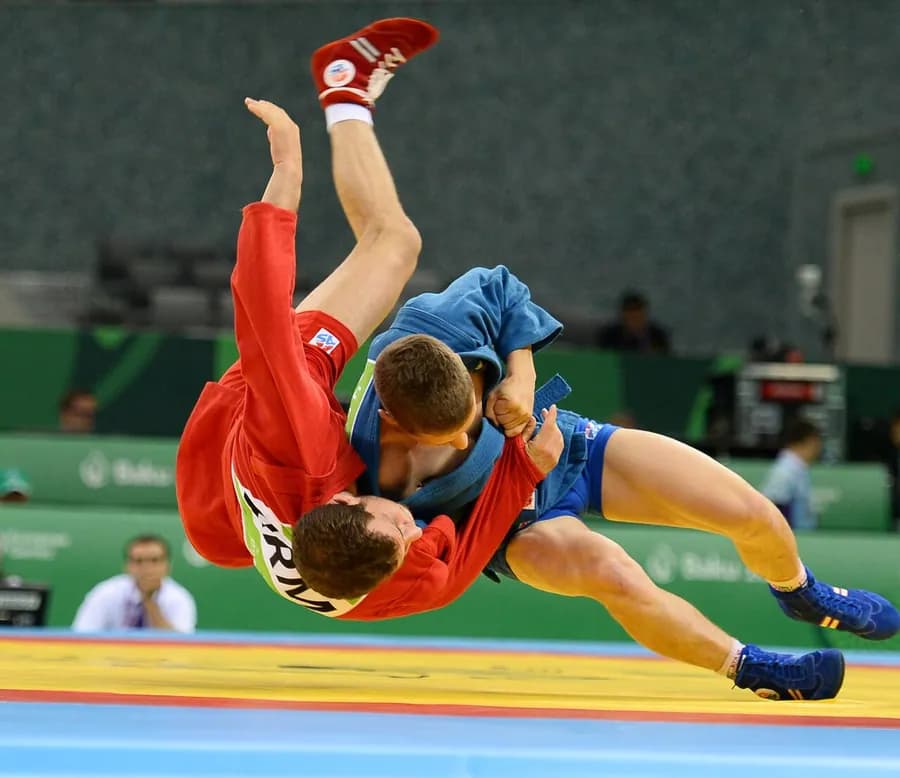
Origin
Soviet Union
Primary Focus
Throws, submissions, leg locks, and integrated combat skills
What It Is
Sambo is a Soviet-developed combat sport and martial system that combines wrestling, jacket grappling, and in some formats striking.
History Snapshot
Sambo was developed in the Soviet Union in the 1920s and 1930s, engineered by figures like Vasili Oshchepkov and Viktor Spiridonov from judo and the many folk wrestling styles of the USSR. It split into sport and combat forms and went on to shape generations of grapplers and MMA fighters.
What It Is
Sambo is a grappling-based combat system developed in the Soviet Union, and its name is an acronym of a Russian phrase meaning "self-defense without weapons." It exists in more than one form. Sport sambo is a jacket-grappling sport of throws, pins, and submissions, with a special fondness for leg locks that long distinguished it from judo. Combat sambo adds striking, punches, kicks, elbows, knees, and headbutts, alongside the grappling, making it closer to a full mixed-fighting discipline. Underneath both is a shared engineering philosophy: take what works from wherever it exists and weld it into a practical, testable whole.
Origins and History
Sambo is a deliberately manufactured art, and that is the key to its story. It was created in the young Soviet Union in the 1920s and 1930s as part of a state interest in physical culture and in equipping the military and police, the Red Army and the internal-security forces, with an effective unarmed method. Rather than inventing techniques from nothing, its architects surveyed and combined existing systems, above all judo and the enormous variety of folk wrestling styles found across the USSR's many peoples, from Georgian chidaoba to the belt-wrestling traditions of Central Asia.
Two men are usually named as its principal founders, and they came at the problem from different directions. Vasili Oshchepkov was one of the first Russians to study judo directly in Japan, reaching a black-belt grade under the Kodokan system, and he taught a judo-derived method while encouraging his students to test and modify it against other wrestling styles. Viktor Spiridonov, from a military background, developed a more self-defense-oriented, pragmatic system drawing on jujutsu and native wrestling. Their streams, along with the work of later organizers, merged into what became sambo. Oshchepkov's fate reflects the era's brutality: he died in 1937 during Stalin's purges, arrested as an alleged spy, a grim footnote to the art's origins.
The consolidation and public naming of the sport is closely associated with Anatoly Kharlampiev, a student of the tradition who tirelessly documented, systematized, and promoted it, and who is often credited with sambo's official recognition. In 1938 the Soviet sports authorities formally acknowledged the discipline as a national sport, giving it institutional backing, competitions, and a place in the vast Soviet athletic machine.
Development Over Time
Through the mid-twentieth century, sambo grew into a mature competitive sport with national championships across the Soviet republics and a deep talent pool. Its distinctiveness on the international stage became clear when Soviet samboka entered international judo competition and did unexpectedly well, precisely because sambo's leg-lock game and different throwing sensibilities caught judoka off guard. An international federation, FIAS, eventually organized world championships and spread the sport beyond the Soviet bloc.
The art also branched. Sport sambo refined its throw-and-submission ruleset in a distinctive red or blue kurtka jacket with shorts and wrestling boots, while combat sambo preserved and developed the striking-inclusive military side, later becoming a competitive format in its own right, complete with protective gear. When the Soviet Union dissolved, sambo's practitioners scattered into a globalizing combat-sports world at exactly the moment mixed martial arts was taking off, and that timing proved enormously consequential.
Core Techniques and Concepts
- Jacket grappling: Kurtka grips create a throwing and control game distinct from no-gi wrestling, borrowed and adapted from judo.
- Leg locks: The signature emphasis on ankle locks, kneebars, and other lower-body submissions long set sambo apart.
- Explosive throws: A broad takedown arsenal blending judo and folk-wrestling throws, rewarding aggressive entries.
- Pins and control: Positional dominance scored toward victory, encouraging transition over static holding.
- Striking (combat sambo): Punches, kicks, knees, and elbows integrated with the grappling in the combat format.
Modern Practice and Relevance
Sambo's influence on modern combat sports is out of all proportion to its public profile. Its blend of takedown pressure, control, and finishing awareness adapts beautifully to open rulesets, which is why so many elite MMA fighters carry a sambo base. The most prominent example is Khabib Nurmagomedov, whose smothering, submission-hunting style is deeply rooted in combat sambo, and Fedor Emelianenko, a multiple-time world combat-sambo champion widely regarded among the greatest heavyweights in MMA history. Sambo's early leadership in leg locks also presaged a technique category that has since swept through submission grappling worldwide. As both a standalone sport and a feeder system for mixed martial arts, sambo remains one of the most practically influential grappling traditions of the last century.
Technical Deep Dive
Sambo is most effective when practitioners can control the transition moments between range, rhythm, and balance. Those transition moments are where technical identity becomes visible under pressure.
A useful way to study this style is to separate visible techniques from invisible skills. The visible layer includes strikes, entries, grips, and finishes; the invisible layer includes posture management, timing discipline, and recovery decisions after failed attempts.
In grappling-heavy contexts, the deepest competitive edge usually comes from connection quality rather than move count. Hand-fighting, shoulder pressure, and angle denial often decide outcomes before obvious scoring actions appear.
In striking-heavy contexts, this style rewards athletes who can maintain stance integrity while changing pace. Distance ownership, exit discipline, and defensive resets determine whether offensive output remains sustainable late in rounds.
In weapons-influenced systems, understanding line control and timing windows is as important as tool mechanics. Clean positioning and tactical patience often matter more than speed alone.
Strengths
- Throws, submissions, leg locks, and integrated combat skills
- Clear technical pathways that are easy to study and pressure-test
- Strong transfer into modern competition when timing and distance matter
- Reliable clinch and control structures that reward leverage over raw strength
Trade-offs
- Training quality varies widely between schools, so fundamentals matter more than labels
- Sport rules can sharpen some attributes while reducing others
- The style's original context may differ from how it is practiced today
- Ground-heavy systems can be harder to apply against strong anti-grappling or striking-heavy opponents without cross-training
Priority Focus
- Consistent drilling under light to medium pressure
- Testing fundamentals against resisting partners before advancing
- Building attributes from basic to complex
- Develop footwork, head movement, and distance management
- Practice position control and transitions before submissions
Coaching Notes
- Progress from cooperative drills to constrained sparring before full resistance
- Prioritize repeatable combinations and transitions over isolated highlight techniques
- Use video review to compare tactical intent with actual round behavior
- Track conditioning in relation to technical quality, not only output volume
- Build positional chains first, then layer submissions once control is consistent
- Drill entries and exits as one unit so offense and defense stay connected