
Martial Arts Library
Pro Wrestling
6/18/2026 · Diego Alvarez
Origin
United States, emerging from carnival wrestling and European catch wrestling in late 19th century
Primary Focus
Throws, impacts, aerial maneuvers, and narrative-driven athletic entertainment
What It Is
Professional wrestling is a sport-entertainment hybrid combining legitimate grappling techniques with choreographed storylines, theatrical performance, and dramatic presentation for audience engagement.
History Snapshot
Professional wrestling grew out of legitimate 19th-century catch wrestling and carnival contests, then shifted toward worked, predetermined matches as promoters chased drama and drawing power. Over the twentieth century it evolved into a global sports-entertainment industry while retaining real athletic risk.
What It Is
Professional wrestling is a hybrid of athletic competition and theater. The matches are performances with predetermined outcomes, but the throws, slams, and falls are executed with real bodies and carry real risk, which is what separates wrestling from ordinary acting. Performers combine legitimate grappling mechanics with storytelling, character work, and dramatic pacing to move a crowd. The industry's own phrase, "sports entertainment," captures the split personality: it is staged like drama and physically punishing like sport, and its practitioners are athletes and actors at the same time.
Origins and History
The roots run into the nineteenth century, into two overlapping worlds: legitimate competitive wrestling and the traveling carnival. In this era, catch-as-catch-can wrestling, a rough, submission-friendly grappling style that grew out of British and American folk wrestling, was a genuine spectator sport. Champions drew real crowds, and Greco-Roman wrestling was popular across continental Europe. Carnivals took the same activity on the road with the "athletic show," where a house wrestler would challenge locals for a prize.
Those carnival roots are where the theatrical seed was planted. Handling paying challengers and drawing repeat crowds pushed operators toward manipulation, and the trade developed its own language for it, "kayfabe" for the maintained illusion, "work" for a staged match, "shoot" for a real one. Legitimate contests had a commercial problem: they could be long, dull, and grinding, sometimes going to hours of stalemate. Audiences wanted drama. By the early twentieth century, promoters increasingly steered toward worked finishes and manufactured rivalries because they simply drew better and could be booked to build stars.
A landmark figure in that shift was George Hackenschmidt, the "Russian Lion," an early global star whose championship matches, especially against American Frank Gotch, drew enormous attention in the 1900s and 1910s and helped make wrestling a marquee attraction. As the worked model took hold, the sport reorganized around promoters who controlled territories and champions. In the mid-twentieth century, the arrival of television transformed everything, turning regional wrestling into a broadcast product and giving charismatic performers a mass audience for the first time.
Development Over Time
For decades American wrestling ran on the territory system, a patchwork of regional promotions that respected one another's turf and shared talent. That order broke apart in the 1980s when Vince McMahon expanded his company nationally, using cable television and pay-per-view to absorb or outcompete the territories and to reframe the product openly as entertainment rather than sport. The 1990s "Monday Night War" between his promotion and a well-funded rival drove a creative boom, edgier characters, tighter serialized storytelling, and huge mainstream popularity.
Wrestling also developed rich distinct traditions around the world. In Japan, puroresu cultivated a harder-hitting, more sport-presented style, with promotions like New Japan building their identity on athletic credibility and the shoot-style offshoots that fed directly into early MMA. In Mexico, lucha libre developed its own high-flying, mask-driven culture with its own heroes and lineage. Modern wrestling spans a spectrum from big-budget spectacle to athletic independent-scene showcases, and its performers move fluidly between promotions and countries.
Core Techniques and Concepts
- Real throw mechanics: Suplexes, slams, and takedowns built on genuine grappling principles but guided for safety and effect.
- Bumping: The trained skill of falling and absorbing impact to make offense look devastating without serious injury.
- Selling: Reacting to convey damage, the performance craft that makes a worked match believable.
- Ring psychology: Pacing a match as a story, with escalation, comebacks, and near-falls.
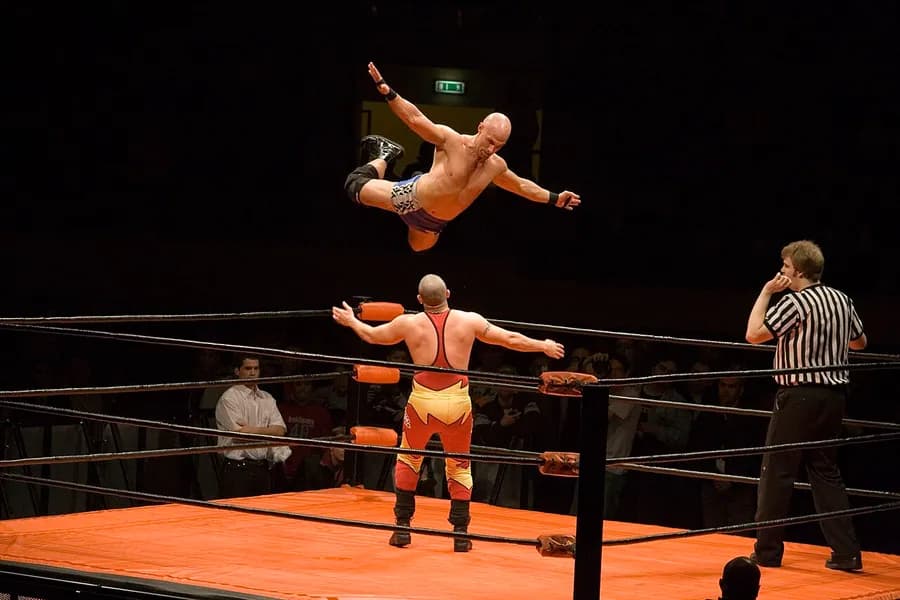
- Aerial work: High-flying moves off the ropes and turnbuckles, central to lucha libre and the modern style.
- Kayfabe and character: The maintained illusion and persona work that turn athletes into recognizable figures.
Modern Practice and Relevance
Pro wrestling's relationship to legitimate combat sport is real if indirect. Its catch-wrestling ancestry is the same root that feeds much of modern grappling, and the athleticism it demands, explosive power, body control, conditioning, the ability to perform under fatigue, is genuine. Several notable MMA fighters came from a pro-wrestling background, and the shoot-style Japanese scene was a direct tributary into the birth of mixed martial arts. Its clearest modern relevance, though, is as a performance discipline and a cultural force: a global entertainment industry that keeps real wrestling skill alive inside a theatrical frame, and that continues to funnel athletes, techniques, and showmanship into the wider combat-sports world.
Technical Deep Dive
Pro Wrestling is most effective when practitioners can control the transition moments between range, rhythm, and balance. Those transition moments are where technical identity becomes visible under pressure.
A useful way to study this style is to separate visible techniques from invisible skills. The visible layer includes strikes, entries, grips, and finishes; the invisible layer includes posture management, timing discipline, and recovery decisions after failed attempts.
In grappling-heavy contexts, the deepest competitive edge usually comes from connection quality rather than move count. Hand-fighting, shoulder pressure, and angle denial often decide outcomes before obvious scoring actions appear.
Strengths
- Throws, impacts, aerial maneuvers, and narrative-driven athletic entertainment
- Clear technical pathways that are easy to study and pressure-test
- Strong transfer into modern competition when timing and distance matter
- Reliable clinch and control structures that reward leverage over raw strength
Trade-offs
- Training quality varies widely between schools, so fundamentals matter more than labels
- Sport rules can sharpen some attributes while reducing others
- The style's original context may differ from how it is practiced today
- Ground-heavy systems can be harder to apply against strong anti-grappling or striking-heavy opponents without cross-training
Priority Focus
- Consistent drilling under light to medium pressure
- Testing fundamentals against resisting partners before advancing
- Building attributes from basic to complex
- Practice position control and transitions before submissions
Coaching Notes
- Progress from cooperative drills to constrained sparring before full resistance
- Prioritize repeatable combinations and transitions over isolated highlight techniques
- Use video review to compare tactical intent with actual round behavior
- Track conditioning in relation to technical quality, not only output volume
- Build positional chains first, then layer submissions once control is consistent