
Martial Arts Library
Pankration (Ancient Greek)
6/18/2026 · Kyle Brenner
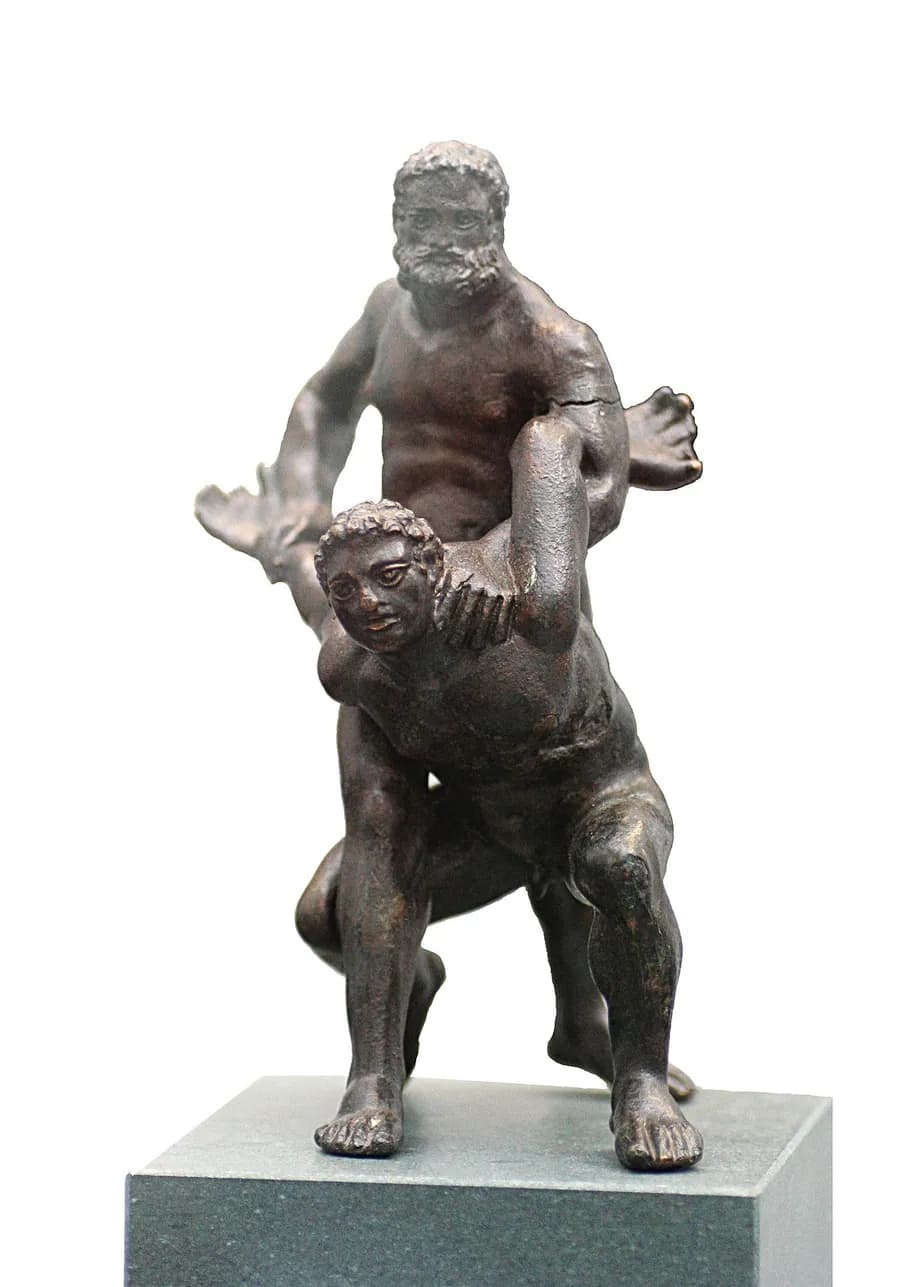
Origin
Ancient Greece, Olympic sport from 648 BCE with few rule restrictions
Primary Focus
Boxing, wrestling, grappling, and striking integration with minimal rule restrictions
What It Is
Pankration was an ancient Olympic fighting sport combining boxing, wrestling, and grappling with few restrictions, serving as an ancestor to modern combat sports.
History Snapshot
Ancient pankration entered the Olympic Games in 648 BC as a mixed-combat event that permitted almost every technique except biting and eye-gouging. It flourished for centuries across the Greek and Roman worlds before fading with the end of the classical games.
What It Is
Ancient pankration was the mixed martial art of the classical Greek world, a combat event that fused boxing and wrestling into one nearly unrestricted contest. The name translates roughly as "all power" or "all-encompassing strength," and the rules earned it: competitors could punch, kick, throw, grapple, choke, and lock joints, on their feet or on the ground. Only a couple of things were forbidden. This was the marquee heavy event of Greek athletics, prized above almost everything else, and it stands as the clearest ancient ancestor of what we now call MMA.
Origins and History
Pankration was added to the ancient Olympic program in 648 BC, during the archaic period when the Games at Olympia were expanding beyond simple footraces into a full festival of athletic contests. It joined already-established events like boxing and wrestling, filling a niche between them by combining the striking of the one with the grappling of the other. To the Greeks this was not a novelty but a natural synthesis, a test of a fighter who could do everything.
The rules, by later standards, were startlingly permissive. Essentially two techniques were outlawed: biting and gouging (attacking the eyes with fingers). Beyond that, almost anything was allowed. Fighters struck with fists and open hands, kicked, kneed, tripped, threw, and applied chokes and joint locks. Bouts had no rounds, no ring restrictions of the modern kind, and no weight classes, which favored larger, powerful men. A match ended when one competitor submitted, typically by raising a hand or tapping, or was rendered unable to continue. Referees carried switches or rods and used them to enforce the two prohibitions.
The mythology around the sport reinforced its status. The Greeks credited its invention to their heroes, telling stories that Theseus used pankration-like methods against the Minotaur and that Heracles employed it in his labors. Real champions became legends too. The most famous is Arrhichion of Phigalia, who, according to the traditional account, won the Olympic pankration while dying: caught in a chokehold, he broke his opponent's ankle or toe, forcing the man to submit in the same instant Arrhichion expired, and was crowned as a corpse. Whether embellished or not, the story captures how the culture viewed the event's demand for total commitment.
Development Over Time
Pankration spread across the Greek world and became a fixture not only at Olympia but at the other great Panhellenic games, at Delphi, Nemea, and the Isthmus, as well as countless local festivals. A boys' division was eventually added, showing how thoroughly the sport was woven into Greek athletic education and civic life. Training took place in the palaistra, the wrestling school, where young men learned grappling and striking as part of a rounded physical culture. The most successful pankratiasts achieved something close to celebrity, honored with statues and victory odes.
When Rome absorbed the Greek world, it absorbed pankration too, and the sport continued under Roman patronage, coexisting with the more spectacle-driven violence of gladiatorial games without being the same thing, since pankration remained an athletic competition rather than a fight to the death. Its long decline came with the broader end of the classical athletic tradition. As the ancient Olympic Games wound down in late antiquity, suppressed as pagan festivals under a Christianizing empire around the end of the fourth century AD, pankration lost the institutions that had sustained it and gradually disappeared as a formal, living sport.
Core Techniques and Concepts
- Two-rule freedom: Everything was legal except biting and eye-gouging, producing an exceptionally open contest.
- Striking: Punches, open-hand blows, and kicks, including targeting a downed opponent, formed the offensive core.
- Wrestling and throws: Takedowns and trips to dominate position, shared with the separate sport of Greek wrestling.
- Submissions: Chokes and joint locks finished many bouts, with victory by an opponent's surrender.
- Conditioning and toughness: No rounds or weight classes meant endurance and raw durability were decisive.
Modern Practice and Relevance
Ancient pankration no longer exists as a continuous practice, and everything we know comes from art, texts, and archaeology rather than a surviving school. Its importance today is historical and conceptual. For modern combat-sports fans it is the definitive proof that mixed fighting, striking blended with grappling under a light ruleset, is not a recent invention but a formalized athletic tradition more than two and a half millennia old. It anchors the whole lineage: when people describe MMA as something genuinely new, pankration is the counterexample. It also inspired a distinct modern revival movement that reclaims the name, and it remains a standard reference point whenever anyone traces where the idea of the complete fighter first took organized shape.
Technical Deep Dive
Pankration (Ancient Greek) is most effective when practitioners can control the transition moments between range, rhythm, and balance. Those transition moments are where technical identity becomes visible under pressure.
A useful way to study this style is to separate visible techniques from invisible skills. The visible layer includes strikes, entries, grips, and finishes; the invisible layer includes posture management, timing discipline, and recovery decisions after failed attempts.
In grappling-heavy contexts, the deepest competitive edge usually comes from connection quality rather than move count. Hand-fighting, shoulder pressure, and angle denial often decide outcomes before obvious scoring actions appear.
In striking-heavy contexts, this style rewards athletes who can maintain stance integrity while changing pace. Distance ownership, exit discipline, and defensive resets determine whether offensive output remains sustainable late in rounds.
In weapons-influenced systems, understanding line control and timing windows is as important as tool mechanics. Clean positioning and tactical patience often matter more than speed alone.
Strengths
- Boxing, wrestling, grappling, and striking integration with minimal rule restrictions
- Clear technical pathways that are easy to study and pressure-test
- Strong transfer into modern competition when timing and distance matter
- Reliable clinch and control structures that reward leverage over raw strength
- Useful footwork, tempo control, and scoring mechanics under pressure
Trade-offs
- Training quality varies widely between schools, so fundamentals matter more than labels
- Sport rules can sharpen some attributes while reducing others
- The style's original context may differ from how it is practiced today
- Ground-heavy systems can be harder to apply against strong anti-grappling or striking-heavy opponents without cross-training
- Pure striking systems may need clinch and takedown defense layers for mixed-rule environments
Priority Focus
- Consistent drilling under light to medium pressure
- Testing fundamentals against resisting partners before advancing
- Building attributes from basic to complex
- Develop footwork, head movement, and distance management
- Practice position control and transitions before submissions
Coaching Notes
- Progress from cooperative drills to constrained sparring before full resistance
- Prioritize repeatable combinations and transitions over isolated highlight techniques
- Use video review to compare tactical intent with actual round behavior
- Track conditioning in relation to technical quality, not only output volume
- Build positional chains first, then layer submissions once control is consistent
- Drill entries and exits as one unit so offense and defense stay connected