
Martial Arts Library
Pankration
6/17/2026 · Ray Coleman
Origin
Ancient Greece
Primary Focus
Integrated striking and grappling
What It Is
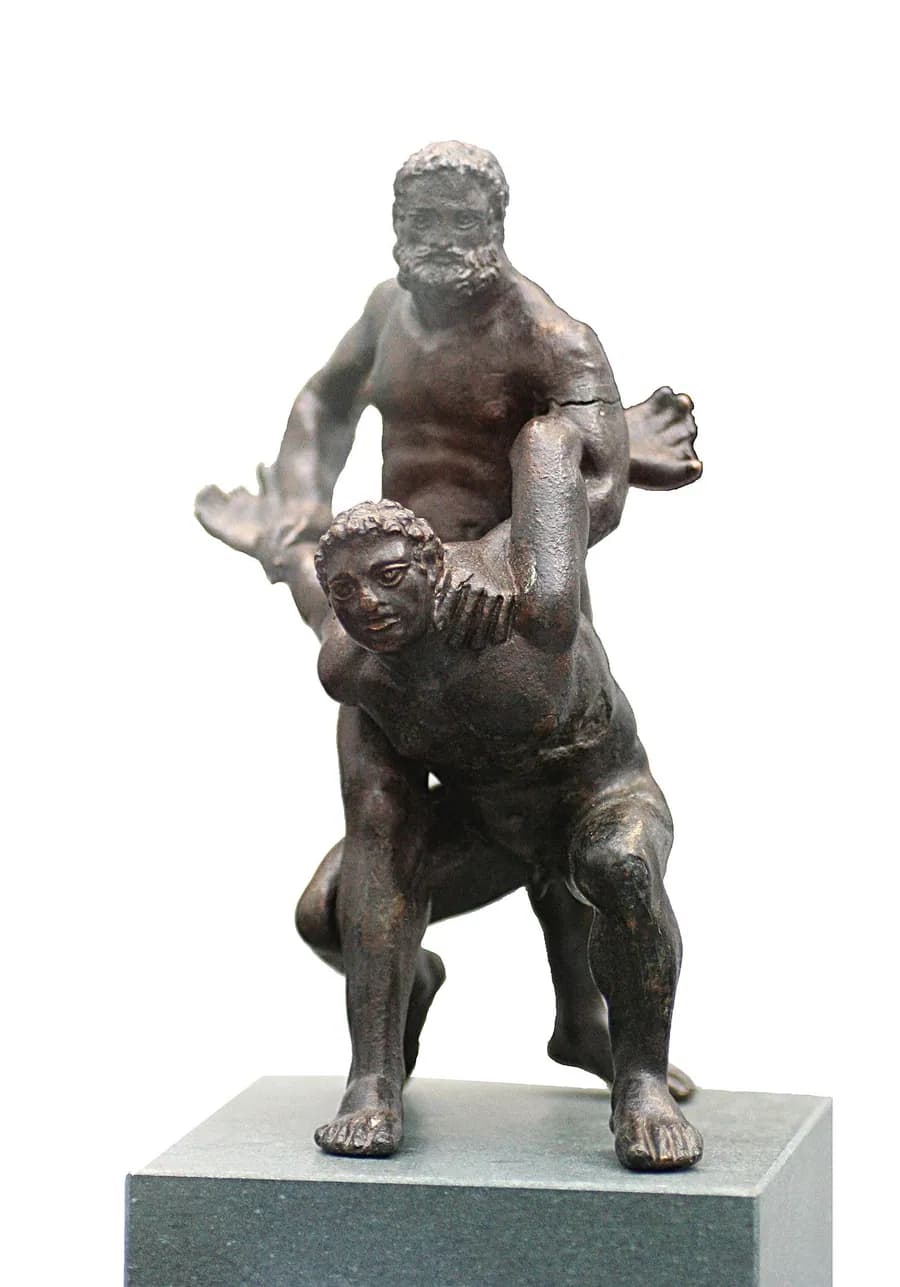
Pankration was an ancient Greek combat sport that combined boxing and wrestling elements into a broad mixed-fighting format.
History Snapshot
Modern Pankration is a twentieth- and twenty-first-century revival of the ancient Greek mixed-combat event, rebuilt as an organized amateur sport. It combines striking and grappling under contemporary safety rules while claiming one of the oldest names in combat history.
What It Is
Modern pankration is a contemporary combat sport that revives the concept, and the name, of the ancient Greek all-in fighting event. It blends striking and grappling into a single contest, which makes it a close cousin of amateur mixed martial arts, but it deliberately wears its classical heritage on its sleeve. Practitioners and organizers present it not as a brand-new invention but as the modern continuation of a fighting tradition that predates almost everything else in the sport world. In practice that means a full-range game, punches and kicks standing, takedowns, and submissions on the mat, governed by modern safety rules rather than the brutal minimalism of antiquity.
Origins and History
Here the history splits in two, and it is worth being precise. The ancient pankration was a genuine Olympic sport of the classical Greek world, introduced to the Games in the seventh century BC and contested for roughly a thousand years before fading with the decline of the old athletic festivals. That original sport is covered in its own right elsewhere. What we are talking about here is the modern pankration: a twentieth-century revival that reached back across that long gap to reconstruct something under the ancient name.
The revival is a reconstruction, not an unbroken lineage, and honesty requires saying so. When the ancient festivals ended, the living practice of pankration ended with them. What survived was documentary: vase paintings, sculpture, references in Greek literature, and descriptions of famous fighters. There was no continuous chain of teachers passing techniques hand to hand into the present. So when interest revived, particularly in the twentieth century and especially in Greece, where the sport is a point of cultural pride, organizers had to rebuild the activity from scratch. They borrowed the name and the spirit of open, mixed fighting and dressed them in a modern amateur ruleset drawn from wrestling, striking arts, and grappling.
That revival gathered real institutional momentum from the late twentieth century onward. National federations formed, amateur competition structures were set up, and international governing bodies began organizing pankration under a unified banner, often with tiered contact levels so that beginners, juniors, and full-contact adult competitors could all take part. The connection to Greece gave the movement both authenticity in branding and a natural home, though it spread well beyond Greek borders.
Development Over Time
As modern pankration matured, it drifted toward the amateur-MMA model, which is unsurprising given that both are trying to solve the same problem: how to let people compete safely across all ranges of fighting. Weight classes, timed rounds, protective equipment for lighter-contact divisions, and clear lists of legal and illegal techniques replaced the near-total permissiveness of the ancient contest. Different organizations settled on different rule sets, so a modern pankration match under one federation may look somewhat different from another, but the common thread is integrated striking and grappling scored toward a decision or finish. The sport has positioned itself partly as an amateur, structured, tradition-flavored pathway into mixed combat.
Core Techniques and Concepts
- Full-range integration: Legal striking and grappling combined in one contest, the defining principle inherited from the ancient sport.
- Stand-up striking: Punches and kicks delivered at range and in transition, governed by contact-level rules.
- Takedowns and control: Wrestling entries to bring the fight to the mat and establish position.
- Submissions: Joint locks and chokes as finishing tools within the modern rule limits.
- Tiered contact: Many federations run light- and full-contact divisions so the same framework serves juniors and elite competitors.
Modern Practice and Relevance
Modern pankration occupies an interesting middle ground. It functions as an amateur combat sport in its own right, with federations, tournaments, and a competitive ladder, and it also serves as a cultural and historical bridge, reminding today's fans that the logic of mixed fighting is ancient rather than a product of the pay-per-view era. Its relevance to contemporary combat sports is twofold: it offers a structured, often more accessible entry point into all-range fighting, and it supplies MMA with a deep-time origin story. When commentators say the UFC "reinvented" something the Greeks already knew, modern pankration is the living embodiment of that continuity, a sport that consciously connects the cage to the ancient stadium.
Technical Deep Dive
Pankration is most effective when practitioners can control the transition moments between range, rhythm, and balance. Those transition moments are where technical identity becomes visible under pressure.
A useful way to study this style is to separate visible techniques from invisible skills. The visible layer includes strikes, entries, grips, and finishes; the invisible layer includes posture management, timing discipline, and recovery decisions after failed attempts.
In grappling-heavy contexts, the deepest competitive edge usually comes from connection quality rather than move count. Hand-fighting, shoulder pressure, and angle denial often decide outcomes before obvious scoring actions appear.
In striking-heavy contexts, this style rewards athletes who can maintain stance integrity while changing pace. Distance ownership, exit discipline, and defensive resets determine whether offensive output remains sustainable late in rounds.
In weapons-influenced systems, understanding line control and timing windows is as important as tool mechanics. Clean positioning and tactical patience often matter more than speed alone.
Strengths
- Integrated striking and grappling
- Clear technical pathways that are easy to study and pressure-test
- Strong transfer into modern competition when timing and distance matter
- Reliable clinch and control structures that reward leverage over raw strength
- Useful footwork, tempo control, and scoring mechanics under pressure
Trade-offs
- Training quality varies widely between schools, so fundamentals matter more than labels
- Sport rules can sharpen some attributes while reducing others
- The style's original context may differ from how it is practiced today
- Ground-heavy systems can be harder to apply against strong anti-grappling or striking-heavy opponents without cross-training
- Pure striking systems may need clinch and takedown defense layers for mixed-rule environments
Priority Focus
- Consistent drilling under light to medium pressure
- Testing fundamentals against resisting partners before advancing
- Building attributes from basic to complex
- Develop footwork, head movement, and distance management
- Practice position control and transitions before submissions
Coaching Notes
- Progress from cooperative drills to constrained sparring before full resistance
- Prioritize repeatable combinations and transitions over isolated highlight techniques
- Use video review to compare tactical intent with actual round behavior
- Track conditioning in relation to technical quality, not only output volume
- Build positional chains first, then layer submissions once control is consistent
- Drill entries and exits as one unit so offense and defense stay connected