
Martial Arts Library
Muay Thai
6/17/2026 · Tunde Balogun
Origin
Thailand
Primary Focus
Stand-up striking with fists, elbows, knees, shins, and clinch work
What It Is
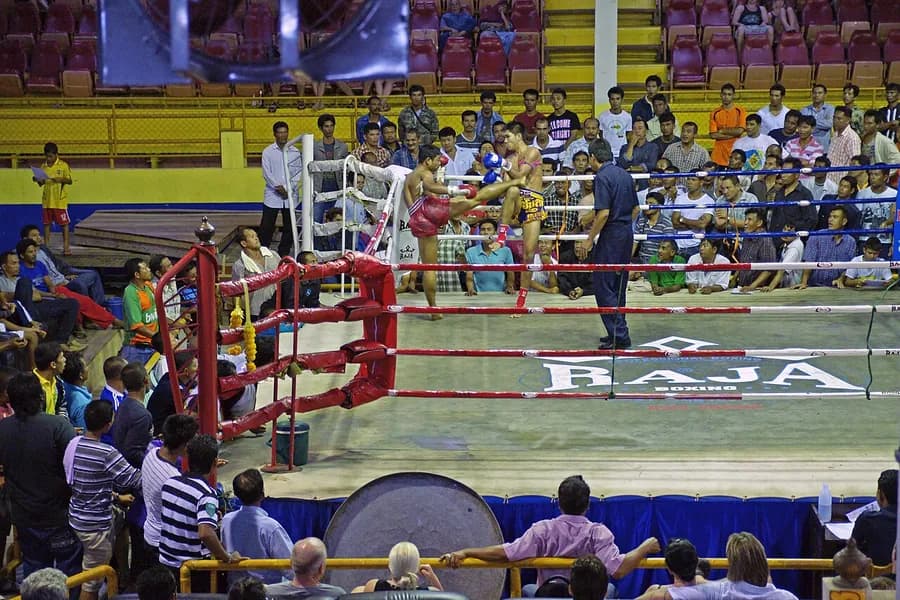
Muay Thai is Thailand's national striking art, known as the art of eight limbs for its use of punches, elbows, knees, and kicks, along with a dominant clinch game.
History Snapshot
Muay Thai descends from muay boran, the battlefield boxing of old Siam, and was long practiced as both a military skill and a festival spectacle. Through the twentieth century it standardized into a modern stadium sport with gloves, rings, and timed rounds while keeping its distinctive clinch and eight-limb arsenal.
What It Is
Muay Thai is called the art of eight limbs because it weaponizes the entire striking body: two fists, two elbows, two knees, and two shins, all deployed as legitimate scoring and finishing tools. What sets it apart from most stand-up sports is the clinch. Where boxing referees break fighters who tie up and many kickboxing rules limit close-range work, Muay Thai treats the clinch as a full phase of combat, a place to land knees and elbows, break an opponent's posture, and throw them off balance. The result is a striking art with unusual range: explosive at distance with kicks, devastating up close, and tactically rich in the grey area between.
Origins and History
Muay Thai's ancestor is muay boran, the "ancient boxing" of the Thai peoples, a battlefield and self-defense art that developed across the kingdoms of what was then Siam. In an era of frequent warfare, hand-to-hand fighting skill was a practical military necessity, and unarmed combat was trained alongside weapon arts such as krabi krabong. Over time this martial skill spilled into civilian life, becoming a popular contest at temple fairs, festivals, and royal celebrations, where local champions fought for honor and prizes before enthusiastic crowds.
Among the many stories that surround the art's early history, the most cherished is that of Nai Khanom Tom, a Siamese fighter said to have been a prisoner of the Burmese in the late eighteenth century. By tradition he was made to fight before his captors and defeated a succession of opponents, winning his freedom and immortalizing Thai boxing's reputation. Whether the details are exact or embellished, the legend is celebrated in Thailand to this day and captures how central the art is to national identity.
In its older form, fighters wrapped their hands and forearms in lengths of hemp rope, a method known as kaad chuek, which hardened the striking surface and could cut an opponent. Bouts of this kind persisted into the modern era. The art also enjoyed royal patronage across successive reigns, with several Thai kings noted as enthusiasts and promoters, which helped raise boxing from village pastime toward organized national sport.
Development Over Time
The transformation into the Muay Thai we recognize today happened largely in the early-to-mid twentieth century, under the influence of Western boxing. Rope-bound hands gave way to padded gloves, fights moved into a roped ring, and promoters introduced timed rounds, weight classes, and a formal points-scoring system administered by judges. The building of Bangkok's great stadiums, above all Rajadamnern in the 1940s and Lumpinee in the 1950s, gave the sport permanent cathedrals and a professional circuit whose titles became the ultimate prize for Thai fighters.
Around this modern competitive core, the tradition kept its ceremony. Fighters still perform the pre-bout ritual dance, the wai kru ram muay, to honor their teachers, and still wear the sacred headband and armbands associated with the art's spiritual heritage. The stadium era also refined a distinctly Thai scoring aesthetic that rewards balance, dominance, and clean, powerful strikes, especially kicks and knees, shaping the patient, rhythmic style seen at the highest domestic level.
Core Techniques and Concepts
- The clinch — controlling the head, arms, and posture to land knees and elbows and to off-balance an opponent.
- Roundhouse kicks — thrown with the shin and the full rotation of the hips, aimed at legs, body, and head.
- Elbows and knees — short, fight-ending weapons that make close range genuinely dangerous.
- Checks and counters — blocking kicks with the shin and immediately answering with offense.
- Ring craft and composure — controlling tempo and posture, which weigh heavily in traditional judging.
Modern Practice and Relevance
Muay Thai is now practiced worldwide, both as a combat sport in its own right and as one of the foundational striking systems for mixed martial arts. Its influence on MMA is enormous: the low kick, the plum clinch with its knees and elbows, the shin-check, and the emphasis on body attacks all flowed into the cage from Thai boxing, and many of the best strikers in MMA carry a clear Muay Thai imprint. Modern global promotions have taken the sport to new international audiences, while the stadium scene in Thailand remains its beating heart. Few striking arts blend living tradition and proven effectiveness as completely, which is why Muay Thai remains a cornerstone of any serious stand-up fighter's education.
Technical Deep Dive
Muay Thai is most effective when practitioners can control the transition moments between range, rhythm, and balance. Those transition moments are where technical identity becomes visible under pressure.
A useful way to study this style is to separate visible techniques from invisible skills. The visible layer includes strikes, entries, grips, and finishes; the invisible layer includes posture management, timing discipline, and recovery decisions after failed attempts.
In striking-heavy contexts, this style rewards athletes who can maintain stance integrity while changing pace. Distance ownership, exit discipline, and defensive resets determine whether offensive output remains sustainable late in rounds.
In weapons-influenced systems, understanding line control and timing windows is as important as tool mechanics. Clean positioning and tactical patience often matter more than speed alone.
Strengths
- Stand-up striking with fists, elbows, knees, shins, and clinch work
- Clear technical pathways that are easy to study and pressure-test
- Strong transfer into modern competition when timing and distance matter
- Useful footwork, tempo control, and scoring mechanics under pressure
Trade-offs
- Training quality varies widely between schools, so fundamentals matter more than labels
- Sport rules can sharpen some attributes while reducing others
- The style's original context may differ from how it is practiced today
- Pure striking systems may need clinch and takedown defense layers for mixed-rule environments
Priority Focus
- Consistent drilling under light to medium pressure
- Testing fundamentals against resisting partners before advancing
- Building attributes from basic to complex
- Develop footwork, head movement, and distance management
Coaching Notes
- Progress from cooperative drills to constrained sparring before full resistance
- Prioritize repeatable combinations and transitions over isolated highlight techniques
- Use video review to compare tactical intent with actual round behavior
- Track conditioning in relation to technical quality, not only output volume
- Drill entries and exits as one unit so offense and defense stay connected