
Martial Arts Library
MMA (Mixed Martial Arts)
6/18/2026 · Sofia Marchetti
Origin
Brazilian vale tudo roots; modern sport commercialized in the United States from 1993
Primary Focus
Striking, grappling, takedowns, and submissions across all ranges of combat
What It Is
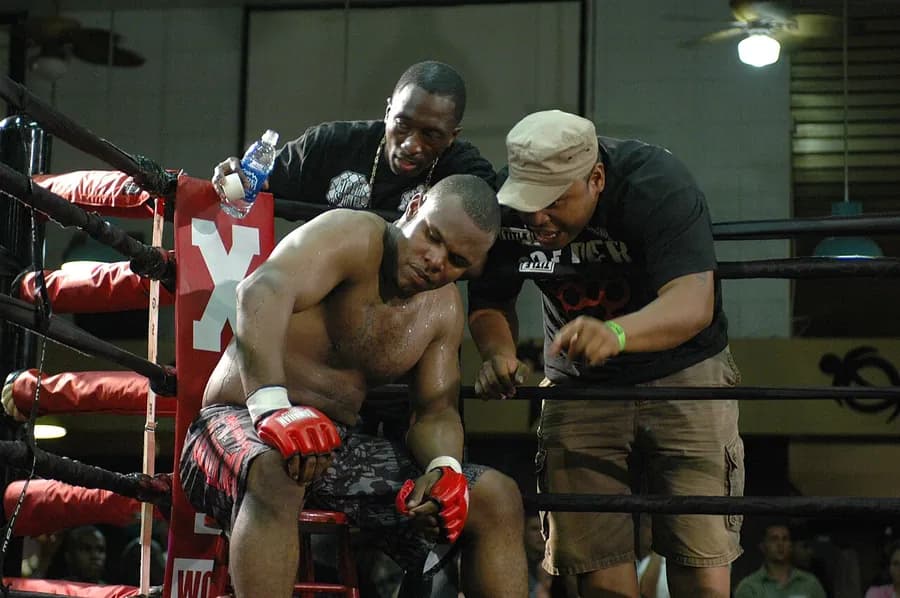
MMA is a full-contact combat sport that allows striking and grappling, standing and on the ground, under a unified competitive ruleset.
History Snapshot
Modern MMA grew from Brazilian vale tudo and the style-versus-style experiment of the first UFC in 1993, when minimal rules pitted disciplines against one another. Over the following decades it matured through the Unified Rules, weight classes, and safety reforms into the world's fastest-growing combat sport.
What It Is
Mixed martial arts is the sport that refuses to specialize. A fighter can punch, kick, knee, and elbow standing up, wrestle for takedowns, and hunt for chokes and joint locks on the ground, all within a single bout. Because so few tools are off-limits, MMA rewards completeness above all else. A brilliant striker who cannot defend a takedown, or a world-class grappler who cannot close the distance without getting knocked out, will eventually be found out. That demand for range-to-range competence is what makes MMA both the broadest and, arguably, the most demanding of the combat sports.
Origins and History
The idea behind MMA, pitting different fighting styles against one another to see which prevails, is old, but the modern sport has a clear lineage. Its most direct ancestor is vale tudo, Portuguese for "anything goes," the no-holds-barred fighting that flourished in Brazil through the twentieth century. There the Gracie family, architects of Brazilian jiu-jitsu, built their reputation on open challenge matches, proving that a skilled grappler could defeat larger opponents from other disciplines. That tradition of the "Gracie challenge" became the template for what came next.
In parallel, Japan developed its own hybrid-fighting scene in the early 1990s, with shoot-style promotions such as Shooto and Pancrase blending catch wrestling and striking into early professional mixed competition. But the moment that lit the fuse worldwide came in the United States. On November 12, 1993, in Denver, the first Ultimate Fighting Championship staged an eight-man tournament designed as a raw experiment: boxer against wrestler, karateka against sumo, style against style, with almost no rules. The slight jiu-jitsu specialist Royce Gracie won the night by submitting a series of larger men, and the message landed hard. Grappling, and the ground game in particular, could no longer be ignored by anyone serious about fighting.
Those early events were marketed on shock value, promoted as having no rules at all, and the backlash was fierce. Critics, including prominent politicians who called it "human cockfighting," campaigned against the sport, and it was banned or pushed off mainstream television in much of the United States through the late 1990s. Survival forced evolution.
Development Over Time
To become legitimate, the sport had to become a sport. Regulators and promoters introduced weight classes, timed rounds, judging criteria, mandatory gloves, medical oversight, and a list of fouls. This effort crystallized around the Unified Rules of Mixed Martial Arts, developed with athletic-commission input around the turn of the millennium, which gave MMA a consistent framework that most of the world eventually adopted. Meanwhile, in Japan, the PRIDE Fighting Championships ran spectacular, big-arena events from the late 1990s into the 2000s, developing many of the sport's early legends under a slightly different ruleset.
The commercial turning point came in 2001, when new ownership bought the struggling UFC and set about rebuilding it as a regulated, television-friendly product. A reality-show competition in the mid-2000s introduced the sport to a mass audience and rescued the promotion's finances, and from there growth was explosive. The talent pool globalized, training evolved from single-style fighters into genuine mixed martial artists who cross-trained wrestling, jiu-jitsu, and striking from day one, and the sport added a women's division that produced some of its biggest stars. What began as a novelty tournament had become a mainstream global enterprise.
Core Techniques and Concepts
- Range management — controlling the transitions between striking distance, the clinch, and the ground is the central strategic problem.
- Takedown offense and defense — the ability to force or stop a change of level shapes almost every exchange.
- Positional hierarchy — dominant ground positions such as mount and back control confer decisive advantages.
- Submission awareness — chokes and joint locks mean no position on the ground is ever fully safe.
- Transitional fluency — the best fighters flow seamlessly between phases, using the threat of one to open another.
- Ground-and-pound — striking from top position blends the grappling and striking games into a single weapon.
Modern Practice and Relevance
MMA is now the definitive proving ground of combat sports, a place where the practical value of any technique is measured against every kind of opponent. Its rise reshaped the entire martial-arts landscape: wrestling, jiu-jitsu, and Muay Thai gained new global audiences precisely because they proved themselves in the cage, and the old idea of loyalty to a single "best" style has largely given way to relentless cross-training. Beyond the elite promotions, MMA has become a widespread amateur and fitness pursuit, and its analytical, evidence-first culture, the habit of asking simply whether something works under pressure, has quietly influenced how people think about fighting everywhere.
Technical Deep Dive
MMA (Mixed Martial Arts) is most effective when practitioners can control the transition moments between range, rhythm, and balance. Those transition moments are where technical identity becomes visible under pressure.
A useful way to study this style is to separate visible techniques from invisible skills. The visible layer includes strikes, entries, grips, and finishes; the invisible layer includes posture management, timing discipline, and recovery decisions after failed attempts.
In grappling-heavy contexts, the deepest competitive edge usually comes from connection quality rather than move count. Hand-fighting, shoulder pressure, and angle denial often decide outcomes before obvious scoring actions appear.
In striking-heavy contexts, this style rewards athletes who can maintain stance integrity while changing pace. Distance ownership, exit discipline, and defensive resets determine whether offensive output remains sustainable late in rounds.
Strengths
- Striking, grappling, takedowns, and submissions across all ranges of combat
- Clear technical pathways that are easy to study and pressure-test
- Strong transfer into modern competition when timing and distance matter
- Reliable clinch and control structures that reward leverage over raw strength
Trade-offs
- Training quality varies widely between schools, so fundamentals matter more than labels
- Sport rules can sharpen some attributes while reducing others
- The style's original context may differ from how it is practiced today
- Ground-heavy systems can be harder to apply against strong anti-grappling or striking-heavy opponents without cross-training
Priority Focus
- Consistent drilling under light to medium pressure
- Testing fundamentals against resisting partners before advancing
- Building attributes from basic to complex
- Develop footwork, head movement, and distance management
- Practice position control and transitions before submissions
Coaching Notes
- Progress from cooperative drills to constrained sparring before full resistance
- Prioritize repeatable combinations and transitions over isolated highlight techniques
- Use video review to compare tactical intent with actual round behavior
- Track conditioning in relation to technical quality, not only output volume
- Build positional chains first, then layer submissions once control is consistent
- Drill entries and exits as one unit so offense and defense stay connected