
Martial Arts Library
Malla Yuddha
6/17/2026 · Kyle Brenner
Origin
Indian subcontinent (South Asia)
Primary Focus
Traditional wrestling, throws, control, and physical conditioning
What It Is
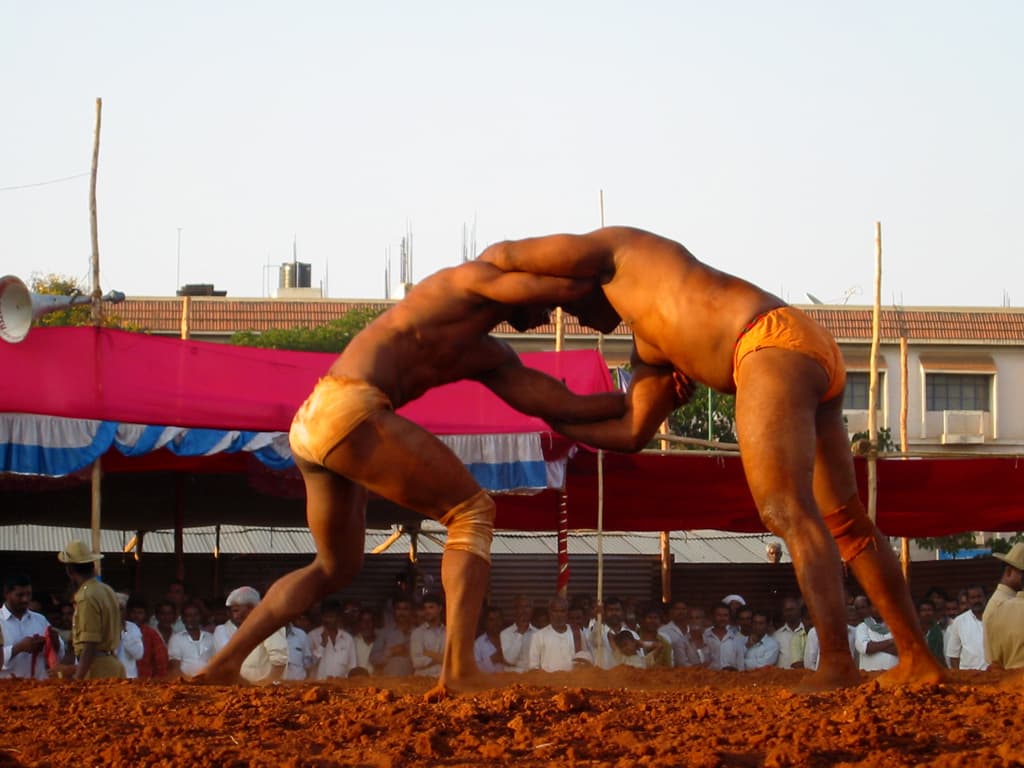
Malla Yuddha is the classical combat wrestling of the Indian subcontinent, a grappling tradition emphasizing throws, holds, and disciplined physical culture.
History Snapshot
Malla Yuddha is generally traced to the ancient wrestling traditions of South Asia, appearing in epic literature and classical texts as the combat art of strongmen and heroes. Over many centuries it fed into regional wrestling styles and is closely linked to the later development of pehlwani, the wrestling of the akhara.
What It Is
Malla Yuddha is, at its simplest, the traditional wrestling of the Indian subcontinent, its name combining the Sanskrit words for a wrestler or strongman, malla, and combat, yuddha. It refers less to a single codified sport than to a broad grappling tradition that runs through South Asian culture, encompassing throws, takedowns, holds, and, in its rougher combat forms, joint attacks and blows. What ties it together is an ideal shared with wrestling cultures the world over: that the grappler's body and character are built together, through disciplined training, controlled living, and long apprenticeship under a teacher.
Origins and History
Because Malla Yuddha reaches so far back, its early history is best understood as a blend of literary tradition and long-standing practice rather than a documented timeline, and it is sensible to hedge on specifics. Wrestling is generally regarded as one of the oldest sports of the Indian subcontinent, and references to grappling contests appear in the region's ancient epic and religious literature. The great Sanskrit epics, in particular, are rich with wrestling imagery: heroes and demigods settle scores in prolonged grappling duels, and such episodes were clearly meant to resonate with audiences who knew wrestling as a familiar and prestigious pursuit. Whether these accounts describe a formal system or simply celebrate a widespread custom, they establish that combat wrestling was woven into South Asian life from a very early period.
Later classical sources are usually said to have distinguished several categories of malla contest, ranging from playful or purely sporting bouts to earnest fights meant to injure or kill, reflecting wrestling's dual role as both entertainment and battlefield-adjacent skill. Traditional texts associated with wrestling communities also survive, most famously a treatise linked to a hereditary wrestler caste in western India that is generally dated to the medieval period and that discusses training, diet, and the organization of the wrestler's life. Sources of this kind suggest a mature physical culture with its own institutions, even if we should be cautious about reading precise rules or lineages back into the distant past.
Patronage mattered greatly to this tradition. Wrestling flourished under the support of local rulers and courts, who kept champion grapplers, sponsored contests, and treated wrestling prowess as a mark of martial vigor. Through such patronage the art was sustained and transmitted across generations, passing from master to student within dedicated training grounds.
Development Over Time
The most consequential later development came through cultural exchange. During the era of Persian and Central Asian influence on the subcontinent, indigenous Malla Yuddha traditions blended with imported wrestling styles, and out of that fusion grew pehlwani, or kushti, the wrestling most associated with the South Asian akhara, the earthen training pit. In pehlwani the classical inheritance of Malla Yuddha continued in a new synthesis, complete with its own regimen of grip strength, calisthenics, controlled diet, and communal, almost devotional gym life. In this sense Malla Yuddha did not so much disappear as flow into the living wrestling culture that persists across India, Pakistan, and neighboring countries today.
Regional variations and related grappling and striking arts also branched from the wider tradition, and cultural connections have been drawn between South Asian wrestling and grappling forms found further across Asia, a reminder of how mobile these fighting customs have always been.
Core Techniques and Concepts
- Throws and takedowns — putting an opponent to the ground with leverage, trips, and lifts sits at the heart of the art.
- Grips and control — securing dominant holds and controlling the body underpins both scoring and finishing.
- Base and posture — a strong, low, balanced stance is prized as the foundation of all wrestling exchanges.
- Physical culture — strength work, conditioning, and disciplined diet are treated as inseparable from technique.
- Teacher-led transmission — knowledge passes through long apprenticeship in a communal training ground under a master.
Modern Practice and Relevance
As a named historical system, Malla Yuddha is encountered today mostly through its living descendants and through the classical heritage it represents, rather than as a widely contested standalone sport. Its influence, though, is very much alive: the akhara wrestling of the subcontinent, and by extension the strong tradition of South Asian success in international freestyle wrestling, draws on physical culture and values that trace back to this ancient lineage. For the combat-sports fan, Malla Yuddha is valuable context, a reminder that the grappling map is far older and wider than the modern Olympic and MMA circuits, and that some of the world's deepest wrestling roots run through the epics and training pits of South Asia.
Technical Deep Dive
Malla Yuddha is most effective when practitioners can control the transition moments between range, rhythm, and balance. Those transition moments are where technical identity becomes visible under pressure.
A useful way to study this style is to separate visible techniques from invisible skills. The visible layer includes strikes, entries, grips, and finishes; the invisible layer includes posture management, timing discipline, and recovery decisions after failed attempts.
In grappling-heavy contexts, the deepest competitive edge usually comes from connection quality rather than move count. Hand-fighting, shoulder pressure, and angle denial often decide outcomes before obvious scoring actions appear.
Strengths
- Traditional wrestling, throws, control, and physical conditioning
- Clear technical pathways that are easy to study and pressure-test
- Strong transfer into modern competition when timing and distance matter
- Reliable clinch and control structures that reward leverage over raw strength
Trade-offs
- Training quality varies widely between schools, so fundamentals matter more than labels
- Sport rules can sharpen some attributes while reducing others
- The style's original context may differ from how it is practiced today
- Ground-heavy systems can be harder to apply against strong anti-grappling or striking-heavy opponents without cross-training
Priority Focus
- Consistent drilling under light to medium pressure
- Testing fundamentals against resisting partners before advancing
- Building attributes from basic to complex
- Practice position control and transitions before submissions
Coaching Notes
- Progress from cooperative drills to constrained sparring before full resistance
- Prioritize repeatable combinations and transitions over isolated highlight techniques
- Use video review to compare tactical intent with actual round behavior
- Track conditioning in relation to technical quality, not only output volume
- Build positional chains first, then layer submissions once control is consistent