
Martial Arts Library
Luta Livre Esportiva
6/17/2026 · Priya Nair
Origin
Brazil
Primary Focus
No-gi grappling, submissions, and leg-lock specialization
What It Is
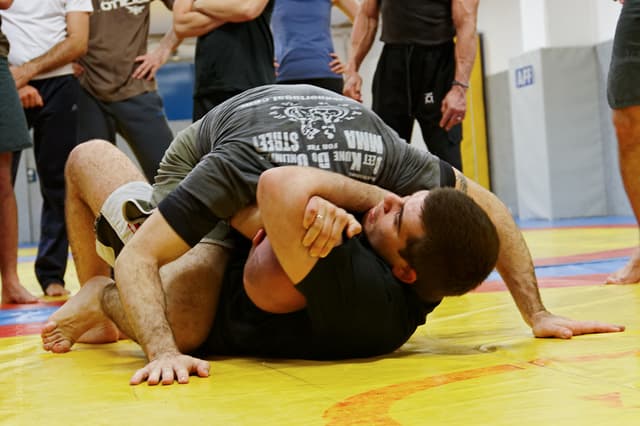
Luta Livre Esportiva is the sport branch of Brazilian Luta Livre, a no-gi submission grappling system with a strong tradition of leg locks and catch-wrestling roots.
History Snapshot
Luta Livre emerged in early twentieth-century Brazil from catch wrestling, developing without the gi as a rival to Gracie jiu-jitsu. Its sport form, Luta Livre Esportiva, refined a distinctive submission game and left a lasting mark on modern no-gi grappling and MMA.
What It Is
Luta Livre Esportiva is the competition-focused branch of Brazilian Luta Livre, a submission grappling art whose name translates simply as "free fighting." Its defining feature is that it is fought entirely without the gi, so there are no lapels or sleeves to grip and control comes from underhooks, wrist and neck ties, and body pressure. That constraint pushed Luta Livre toward a fast, sweat-slick style with a particular love of attacking the legs. For much of its history it developed in parallel with, and in open opposition to, Brazilian jiu-jitsu, and that rivalry did as much to shape its identity as any single technique.
Origins and History
Luta Livre's story begins in Brazil in the early decades of the twentieth century, during the same wave of imported combat sports that brought Japanese jiu-jitsu and judo to the country. Catch-as-catch-can wrestling, the pinning-and-submission style that traveled the world with carnival and music-hall strongmen, took root in Rio de Janeiro, and it is from this catch-wrestling seed that Luta Livre grew. The figure most often credited as a foundational pioneer is Euclydes "Tatu" Hatem, a Rio grappler of the 1920s and 1930s who adapted catch wrestling into a no-gi system and, by tradition, tested it successfully against gi-based rivals.
From the start, Luta Livre carried a social edge. Where the Gracie family's jiu-jitsu came to be associated with Rio's more affluent circles and academies, Luta Livre developed a reputation as the grappling of working-class fighters who could not afford, or simply rejected, the gi. That class dimension gave the technical disagreement about gi versus no-gi a sharper emotional charge, and the two camps spent decades trading challenges. The rivalry produced some genuinely notorious moments in Brazilian fight history, including gym challenge matches and, most infamously, a chaotic vale tudo event in the 1990s that ended in a riot when a Gracie fighter met a leading Luta Livre representative. These confrontations, ugly as some of them were, kept both arts honest and constantly refining their answers to one another.
Key to Luta Livre's technical development was a second generation of teachers who systematized what Hatem had begun. Coaches such as Roberto Leitão, an engineer by training who brought an analytical eye to leverage and mechanics, helped organize the art into something teachable and repeatable, and a lineage of instructors carried it into gyms across Rio and beyond.
Development Over Time
As the twentieth century went on, Luta Livre branched into two related pursuits. Luta Livre Esportiva became the pure sport-grappling form, contested under submission rules, while a vale tudo, or anything-goes, strand fed directly into Brazil's no-holds-barred fighting scene. That second strand mattered enormously when mixed martial arts went global. Luta Livre stylists such as Marco Ruas, who won an early UFC tournament, and others including Hugo Duarte and the heavyweight striker-grappler Pedro Rizzo, demonstrated that a no-gi Brazilian base could compete at the highest level, and their success helped seed no-gi grappling and leg-lock know-how into the wider MMA world.
Because it had always trained without the gi, Luta Livre was in some respects ahead of its time. The no-gi grappling boom and the explosion of interest in leg locks that reshaped submission sport in the twenty-first century arrived at conclusions Luta Livre practitioners had been exploring for generations, and the art is now frequently cited as an important tributary to that modern current.
Core Techniques and Concepts
- Leg locks — heel hooks, kneebars, and footlocks are a signature strength, treated as primary weapons rather than desperation moves.
- No-gi control — with no cloth to grip, dominance comes from underhooks, overhooks, head control, and pressure.
- Catch-wrestling heritage — pinning, riding, and aggressive top pressure trace back to the art's catch roots.
- Submission chaining — flowing between attacks on the legs, neck, and arms to keep an opponent constantly defending.
- Scrambles and pace — a slick, high-tempo style suited to the friction-free reality of grappling without a jacket.
Modern Practice and Relevance
Luta Livre Esportiva is still taught in Brazil and by a growing network of instructors abroad, and its stock has arguably never been higher, thanks to the sport-wide obsession with leg locks and no-gi competition that defines contemporary grappling. Its historical significance is twofold. It stands as proof that world-class submission grappling did not have to come dressed in a gi, and it supplied a meaningful share of the leg-lock vocabulary that fighters and grapplers now consider essential. For anyone tracing how the modern no-gi game came together, the catch-wrestling-to-Luta Livre pipeline is a crucial and often underappreciated part of the map.
Technical Deep Dive
Luta Livre Esportiva is most effective when practitioners can control the transition moments between range, rhythm, and balance. Those transition moments are where technical identity becomes visible under pressure.
A useful way to study this style is to separate visible techniques from invisible skills. The visible layer includes strikes, entries, grips, and finishes; the invisible layer includes posture management, timing discipline, and recovery decisions after failed attempts.
In grappling-heavy contexts, the deepest competitive edge usually comes from connection quality rather than move count. Hand-fighting, shoulder pressure, and angle denial often decide outcomes before obvious scoring actions appear.
Strengths
- No-gi grappling, submissions, and leg-lock specialization
- Clear technical pathways that are easy to study and pressure-test
- Strong transfer into modern competition when timing and distance matter
- Reliable clinch and control structures that reward leverage over raw strength
Trade-offs
- Training quality varies widely between schools, so fundamentals matter more than labels
- Sport rules can sharpen some attributes while reducing others
- The style's original context may differ from how it is practiced today
- Ground-heavy systems can be harder to apply against strong anti-grappling or striking-heavy opponents without cross-training
Priority Focus
- Consistent drilling under light to medium pressure
- Testing fundamentals against resisting partners before advancing
- Building attributes from basic to complex
- Practice position control and transitions before submissions
Coaching Notes
- Progress from cooperative drills to constrained sparring before full resistance
- Prioritize repeatable combinations and transitions over isolated highlight techniques
- Use video review to compare tactical intent with actual round behavior
- Track conditioning in relation to technical quality, not only output volume
- Build positional chains first, then layer submissions once control is consistent