
Martial Arts Library
Laamb
6/17/2026 · Tunde Balogun
Origin
Senegal
Primary Focus
Standing wrestling, explosive takedowns, and, in its striking form, bare-fisted blows
What It Is
Laamb is the Senegalese wrestling tradition, contested in a sand arena, where a bout is won by putting the opponent to the ground and, in its most popular form, permits open-handed and bare-fisted strikes.
History Snapshot
Laamb descends from folk wrestling practiced in Senegalese farming villages, tied to harvests, festivals, and rites of passage. Over the twentieth century it professionalized into a stadium sport that now rivals football in national popularity.
What It Is
Laamb is wrestling turned into national theater. At its simplest it is a contest to throw your opponent onto the sand, with a win awarded when a wrestler is put on his back, or when his hands and knees touch the ground together. But the version that fills Senegal's biggest arenas, known as laamb proper or "wrestling with blows," also allows bare-fisted and open-handed strikes, which gives the standing exchanges the tension of a boxing match layered over the grappling. Add the drumming, the chanting, the amulets, and the hours of ritual that precede a headline bout, and you have something that is as much cultural event as athletic contest.
Origins and History
Wrestling runs deep in the cultures of the Senegambian region, and Laamb is generally traced to the folk grappling of Serer, Wolof, and other communities across what is now Senegal. In its oldest forms it was a village affair, bound up with the rhythm of agricultural life. Contests were commonly held after the harvest, when young men from neighboring villages would test their strength, court prestige, and prove themselves before their communities. Historians and cultural writers generally connect it to rites of passage and seasonal celebration rather than to any single founding moment, and that agrarian, ceremonial background is the key to understanding it.
The traditional form, often referred to by names such as mbappat, was pure wrestling, a matter of grips, trips, and throws in the sand. Winning brought honor to a wrestler's family and village, and champions became local heroes. Alongside the physical contest grew a rich body of ritual that remains central to this day. Fighters prepare with the help of spiritual guides, wear protective charms known as gris-gris, pour libations, and perform boastful praise chants, all meant to summon strength and unsettle an opponent as much as to entertain the crowd. These practices are woven so tightly into the sport that a modern Laamb card can spend as long on ceremony as on wrestling.
The move from village green to commercial arena unfolded across the twentieth century. As people migrated toward cities such as Dakar, wrestling followed them, and promoters began organizing matches for paying spectators. What had been a communal pastime slowly acquired the trappings of professional sport: recognizable stars, purses, and a public hungry for big bouts.
Development Over Time
By the later twentieth and into the twenty-first century, Laamb had become a genuine industry. Marquee wrestlers draw enormous crowds to stadiums in Dakar, and the top bouts are broadcast, sponsored, and dissected in the press with the intensity Senegal otherwise reserves for football. A generation of celebrated champions, competing under vivid ring names, turned wrestling into a route to national fame and serious money, and the biggest matchups can command the kind of build-up and payouts that put Laamb among the most lucrative sports in the country.
The striking variant is the box-office draw, because the permission to punch adds knockout danger to the grappling and shortens the path to a dramatic finish. Yet the grappling foundation still decides most contests, and the ritual side has, if anything, grown more elaborate under the television lights. The sport has also become a point of pan-African and diaspora pride, celebrated as a distinctly Senegalese institution rather than an imitation of foreign combat sports.
Core Techniques and Concepts
- Standing grips and clinch — control of the collar, arms, and body sets up every attack in the sand.
- Explosive takedowns — bouts often turn on a single committed throw or trip that dumps the opponent to the ground.
- Bare-fisted striking — in the popular form, punches and open-hand blows soften up an opponent and create grappling openings.
- Physical conditioning — enormous emphasis is placed on strength, size, and power, and elite wrestlers train and eat to build imposing frames.
- Ritual preparation — pre-fight ceremony, charms, and praise chants are treated as inseparable from competitive performance.
Modern Practice and Relevance
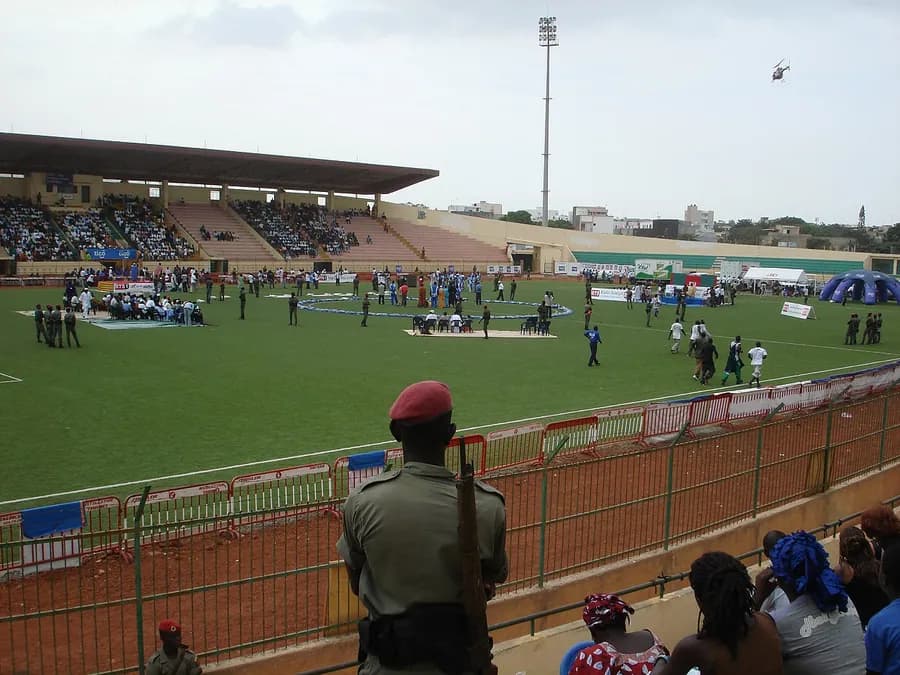
Laamb today is one of the most visible combat traditions in West Africa and a genuine mass-audience sport, filling arenas such as the large modern wrestling stadium in Dakar. For fans of global fighting it is a valuable corrective to a narrow view of elite grappling, proof that world-class wrestling cultures thrive well outside the judo-and-freestyle mainstream that dominates international broadcasts. A handful of Senegalese athletes have carried that grappling base and athleticism into mixed martial arts, hinting at a crossover potential that is still largely untapped. Above all, Laamb shows how a fighting art can remain rooted in ceremony and community identity while operating at the scale of a modern professional sport.
Technical Deep Dive
Laamb is most effective when practitioners can control the transition moments between range, rhythm, and balance. Those transition moments are where technical identity becomes visible under pressure.
A useful way to study this style is to separate visible techniques from invisible skills. The visible layer includes strikes, entries, grips, and finishes; the invisible layer includes posture management, timing discipline, and recovery decisions after failed attempts.
In grappling-heavy contexts, the deepest competitive edge usually comes from connection quality rather than move count. Hand-fighting, shoulder pressure, and angle denial often decide outcomes before obvious scoring actions appear.
In striking-heavy contexts, this style rewards athletes who can maintain stance integrity while changing pace. Distance ownership, exit discipline, and defensive resets determine whether offensive output remains sustainable late in rounds.
In weapons-influenced systems, understanding line control and timing windows is as important as tool mechanics. Clean positioning and tactical patience often matter more than speed alone.
Strengths
- Standing wrestling, explosive takedowns, and, in its striking form, bare-fisted blows
- Clear technical pathways that are easy to study and pressure-test
- Strong transfer into modern competition when timing and distance matter
- Reliable clinch and control structures that reward leverage over raw strength
- Useful footwork, tempo control, and scoring mechanics under pressure
Trade-offs
- Training quality varies widely between schools, so fundamentals matter more than labels
- Sport rules can sharpen some attributes while reducing others
- The style's original context may differ from how it is practiced today
- Ground-heavy systems can be harder to apply against strong anti-grappling or striking-heavy opponents without cross-training
- Pure striking systems may need clinch and takedown defense layers for mixed-rule environments
Priority Focus
- Consistent drilling under light to medium pressure
- Testing fundamentals against resisting partners before advancing
- Building attributes from basic to complex
- Develop footwork, head movement, and distance management
- Practice position control and transitions before submissions
Coaching Notes
- Progress from cooperative drills to constrained sparring before full resistance
- Prioritize repeatable combinations and transitions over isolated highlight techniques
- Use video review to compare tactical intent with actual round behavior
- Track conditioning in relation to technical quality, not only output volume
- Build positional chains first, then layer submissions once control is consistent
- Drill entries and exits as one unit so offense and defense stay connected