
Martial Arts Library
Kurash
6/17/2026 · Kyle Brenner
Origin
Uzbekistan and the wider Central Asian steppe
Primary Focus
Upright jacket grappling, grip fighting, and decisive standing throws
What It Is
Kurash is a standing jacket-wrestling art in which grapplers score by throwing an opponent to the ground without any groundwork or leg-grabbing.
History Snapshot
Kurash grew out of centuries-old wrestling customs across Central Asia and was long practiced at festivals and celebrations. In the 1990s the Uzbek coach Komil Yusupov codified a modern ruleset and built the international competition circuit that carries the sport today.
What It Is
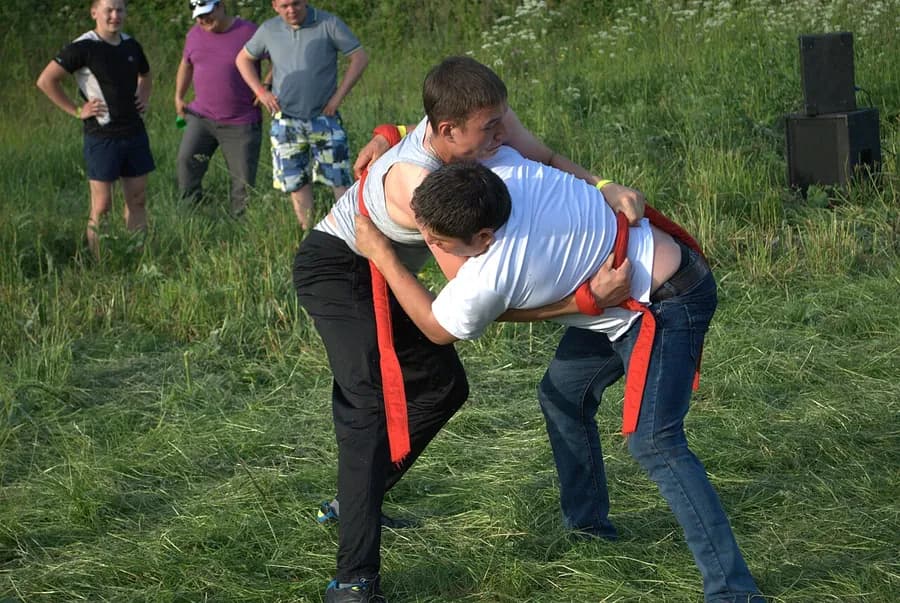
Kurash is a wrestling sport that never leaves its feet. Two grapplers, each wearing a stiff jacket cinched with a cloth belt, take hold of one another and try to put the opponent on the ground with a throw. There is no scramble on the mat, no pinning, no chase for a submission. The instant the action hits the floor, the referee resets it. That single rule shapes everything: Kurash rewards balance, grip timing, and the courage to commit fully to a throw, because a wrestler only has a handful of clean chances before a bout is over.
The word itself comes from the Turkic languages of the region and translates loosely as "wrestling" or "reaching a goal." For most of its life it was less a sport than a fixture of communal life, the thing men did at weddings, harvest gatherings, and holiday festivals while a crowd formed a ring around them.
Origins and History
Kurash belongs to the broad family of folk wrestling styles that stretch across the Central Asian steppe, and its exact beginnings are impossible to pin to a date. What is generally understood is that upright jacket wrestling has been practiced in the lands that are now Uzbekistan, Tajikistan, and the surrounding region for a very long time, likely for many centuries and by some traditional accounts far longer. Nomadic and settled peoples alike kept versions of it, and jacket-and-belt grappling of this kind appears again and again in the cultures that ringed the old Silk Road.
Because it was passed down through practice rather than paperwork, much of its early story survives as tradition and folklore. Popular Uzbek histories link Kurash to the great cities of Samarkand and Bukhara and even to figures such as the medieval scholar Avicenna, who is said to have praised wrestling as healthful, and to the conqueror Amir Timur, whose armies are sometimes credited with using it as physical training. These connections are cherished culturally, but they are best treated as heritage rather than documented sports history. The reliable point is simpler: Kurash was woven into the everyday and ceremonial life of the region long before anyone thought to write down its rules.
The decisive modern chapter belongs to one man. In the early 1990s, as Uzbekistan emerged as an independent state, the wrestler and coach Komil Yusupov set out to turn this scattered folk tradition into a standardized international sport. He studied the local styles alongside judo and sambo, drew up a unified ruleset, agreed on a common set of terms, and in 1998 helped found the International Kurash Association in Tashkent. The first World Championships followed in 1999. Almost overnight, a village pastime had a rulebook, referees, weight classes, and a path onto the world stage.
Development Over Time
Once codified, Kurash spread quickly through the sporting networks of Asia and beyond. It was adopted into the Asian Games program, appearing as a medal sport in Jakarta in 2018, and it gained footholds in dozens of national federations. The modern rules borrowed the vocabulary of scoring familiar to judo watchers: a perfect, bout-ending throw is the highest award, with lesser scores for throws that land an opponent down with less control. Matches are fought in a bordered area, contested standing, and won either by a decisive throw or on accumulated scores.
Crucially, the modernizers kept the features that made the style distinct. Leg grabs are forbidden, so wrestlers cannot dive at the hips the way a freestyle wrestler would. Groundwork is absent entirely. The result is a sport that looks related to judo but plays very differently, staying vertical and explosive from the first grip to the last.
Core Techniques and Concepts
- Jacket and belt grips — control begins at the collar, sleeve, and belt, and grip fighting sets up every attack.
- Upright posture — wrestlers stay tall and mobile, since a bent, defensive stance surrenders the balance a throw depends on.
- Off-balancing (kuzushi in spirit) — breaking an opponent's base with pulls and direction changes precedes the throw itself.
- Overhead and hip throws — big, committed rotational throws are the bread and butter of scoring.
- No leg grabs, no groundwork — the defining restrictions that keep contests standing and decisive.
Modern Practice and Relevance
Today Kurash occupies an interesting niche. It is a source of enormous national pride in Uzbekistan and neighboring countries, a genuine international competition sport with continental medals on the line, and a living link to steppe wrestling culture all at once. For the wider combat-sports world its value is in the details it preserves. A grappler steeped in Kurash learns to fight for grips, break balance, and finish throws under pressure without the safety net of a follow-up on the ground, a skill set that translates neatly into the clinch phases of judo, wrestling, and even mixed martial arts. In an era where athletes borrow freely across disciplines, Kurash is a reminder that some of the most refined throwing knowledge lives in traditions that rarely make the global broadcast schedule.
Technical Deep Dive
Kurash is most effective when practitioners can control the transition moments between range, rhythm, and balance. Those transition moments are where technical identity becomes visible under pressure.
A useful way to study this style is to separate visible techniques from invisible skills. The visible layer includes strikes, entries, grips, and finishes; the invisible layer includes posture management, timing discipline, and recovery decisions after failed attempts.
In grappling-heavy contexts, the deepest competitive edge usually comes from connection quality rather than move count. Hand-fighting, shoulder pressure, and angle denial often decide outcomes before obvious scoring actions appear.
Strengths
- Upright jacket grappling, grip fighting, and decisive standing throws
- Clear technical pathways that are easy to study and pressure-test
- Strong transfer into modern competition when timing and distance matter
- Reliable clinch and control structures that reward leverage over raw strength
Trade-offs
- Training quality varies widely between schools, so fundamentals matter more than labels
- Sport rules can sharpen some attributes while reducing others
- The style's original context may differ from how it is practiced today
- Ground-heavy systems can be harder to apply against strong anti-grappling or striking-heavy opponents without cross-training
Priority Focus
- Consistent drilling under light to medium pressure
- Testing fundamentals against resisting partners before advancing
- Building attributes from basic to complex
- Practice position control and transitions before submissions
Coaching Notes
- Progress from cooperative drills to constrained sparring before full resistance
- Prioritize repeatable combinations and transitions over isolated highlight techniques
- Use video review to compare tactical intent with actual round behavior
- Track conditioning in relation to technical quality, not only output volume
- Build positional chains first, then layer submissions once control is consistent