
Martial Arts Library
Kickboxing
6/18/2026 · Tunde Balogun
Origin
Developed in 1960s Netherlands by blending American professional boxing with Muay Thai leg kicks
Primary Focus
Punches, kicks, footwork, and adaptive range management
What It Is
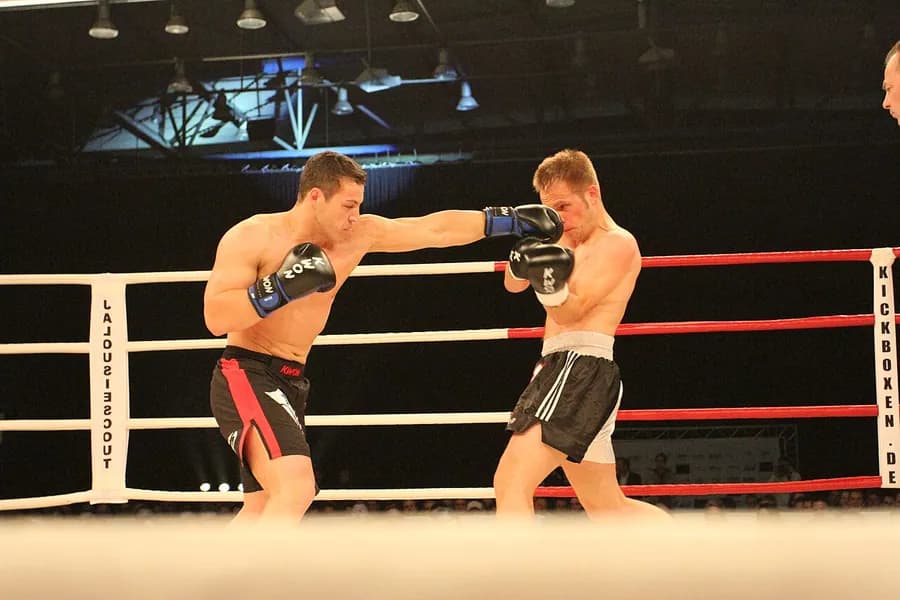
Kickboxing is a striking system that emphasizes both punching combinations and powerful kicks while maintaining sharp defensive movement and positional control.
History Snapshot
Kickboxing emerged in the 1960s and 1970s as several countries independently blended punching from boxing with kicks drawn from karate and Muay Thai. Japanese promoters coined the term, American full-contact karate created a competing format, and Dutch gyms later forged the aggressive combination-heavy style that dominated the sport through the K-1 tournament era.
What It Is
Kickboxing is the broad name for combat sports that combine boxing-style punches with kicks, contested in a ring under gloved, full-contact rules. That definition sounds simple, but it covers a surprising spread of formats, from American versions that limit kicks to above the waist, to Japanese and Dutch styles that welcome brutal low kicks, knees, and, in some rulesets, limited clinch work. What ties them together is the fusion at the heart of the sport: the crisp hands and head movement of Western boxing married to the kicking arsenal of Asian martial arts, all delivered at a fast, aggressive, forward-pressing pace.
Origins and History
Kickboxing does not have a single tidy birthplace, and honest history has to acknowledge that it arose in several places at once. The most important thing to understand is that in the 1960s and 1970s, martial artists on multiple continents were independently asking the same question: what happens if you let karate-style kickers and boxers actually punch and kick each other, full contact, in a ring?
In Japan, a promoter named Osamu Noguchi is generally credited with coining the term "kickboxing" in the 1960s, creating a hybrid contest that borrowed heavily from Muay Thai, which Japanese fighters had encountered in Thailand, and grafted it onto karate and boxing. This Japanese kickboxing scene grew popular quickly and established many of the sport's early stars and conventions.
In the United States, a parallel movement grew out of frustration with the light-contact, point-stopping rules of tournament karate. Practitioners wanted to know who would win if strikes were thrown with real force and fights were allowed to continue. This produced "full-contact karate," which by the 1970s had effectively become American kickboxing, contested with boxing gloves and kicks kept above the waist. It built its own circuits, champions, and television presence.
The most influential chapter, though, was written in the Netherlands. Dutch trainers absorbed Japanese kickboxing and Muay Thai, then filtered them through a strong national boxing culture. The result was a distinctive style built on heavy, flowing punch combinations that set up and disguised thudding low kicks, drilled with famously hard, high-volume training. Dutch gyms produced a conveyor belt of formidable fighters and a template that much of the world would eventually copy.
Development Over Time
The event that fused these strands into a global spectacle was the rise of Japan's K-1 promotion in the 1990s. K-1 gathered heavyweight strikers from kickboxing, Muay Thai, karate, and beyond under a unified ruleset and staged them in flashy, big-money tournaments. It turned kickboxing into genuine mainstream entertainment across Asia and Europe and gave the Dutch style, in particular, a stage to prove its dominance.
Since then, kickboxing has continued to organize and reorganize under a shifting map of promotions and sanctioning bodies, each with slightly different rules about low kicks, knees, and clinching. The lack of one universal governing standard has kept the sport fragmented, but it has also kept it vibrant, with the modern era seeing well-produced promotions carry the tradition forward for a new generation of fans.
Core Techniques and Concepts
- Boxing-based hands: Jabs, crosses, hooks, and uppercuts thrown in combination as the backbone of offense.
- The low kick: Round kicks to the thigh that erode an opponent's mobility and power over time.
- Checking: Lifting the shin to block incoming leg kicks rather than absorbing them flush.
- Combination flow: The Dutch hallmark of long, punishing punch-into-kick sequences.
- Footwork and pressure: Constant forward movement that denies opponents room to reset.
- Angles in and out: Entering behind combinations and exiting off-line to avoid the return fire.
Modern Practice and Relevance
Kickboxing remains one of the world's premier stand-up combat sports, with healthy professional scenes across Europe, Asia, and increasingly elsewhere, plus a massive base of recreational practitioners who train it for fitness and skill.
Its influence on mixed martial arts is enormous and easy to see. The Dutch combination style, in particular, became a core striking blueprint for MMA, and countless fighters have built their standup on kickboxing fundamentals: the low kick as a fight-changing weapon, the seamless linking of hands and legs, and the conditioning to throw hard combinations deep into a fight. When a clinch-savvy fighter can keep the bout standing, kickboxing skills translate almost directly, which is why it remains one of the most valuable striking foundations a modern combat athlete can build.
Technical Deep Dive
Kickboxing is most effective when practitioners can control the transition moments between range, rhythm, and balance. Those transition moments are where technical identity becomes visible under pressure.
A useful way to study this style is to separate visible techniques from invisible skills. The visible layer includes strikes, entries, grips, and finishes; the invisible layer includes posture management, timing discipline, and recovery decisions after failed attempts.
In striking-heavy contexts, this style rewards athletes who can maintain stance integrity while changing pace. Distance ownership, exit discipline, and defensive resets determine whether offensive output remains sustainable late in rounds.
In weapons-influenced systems, understanding line control and timing windows is as important as tool mechanics. Clean positioning and tactical patience often matter more than speed alone.
Strengths
- Punches, kicks, footwork, and adaptive range management
- Clear technical pathways that are easy to study and pressure-test
- Strong transfer into modern competition when timing and distance matter
- Useful footwork, tempo control, and scoring mechanics under pressure
Trade-offs
- Training quality varies widely between schools, so fundamentals matter more than labels
- Sport rules can sharpen some attributes while reducing others
- The style's original context may differ from how it is practiced today
- Pure striking systems may need clinch and takedown defense layers for mixed-rule environments
Priority Focus
- Consistent drilling under light to medium pressure
- Testing fundamentals against resisting partners before advancing
- Building attributes from basic to complex
- Develop footwork, head movement, and distance management
Coaching Notes
- Progress from cooperative drills to constrained sparring before full resistance
- Prioritize repeatable combinations and transitions over isolated highlight techniques
- Use video review to compare tactical intent with actual round behavior
- Track conditioning in relation to technical quality, not only output volume
- Drill entries and exits as one unit so offense and defense stay connected