
Martial Arts Library
Kalaripayattu
6/17/2026 · Priya Nair
Origin
India
Primary Focus
Integrated body training, weapon work, and traditional combat movement
What It Is
Kalaripayattu is an Indian martial art known for dynamic movement, weapons progression, and traditional training structures.
History Snapshot
Kalaripayattu developed in the region of present-day Kerala in southern India, where it was tied to warrior clans, temple life, and Ayurvedic healing over many centuries. It survived a colonial-era ban under British rule and was revived in the 20th century as both a living combat tradition and a cultural art form.
What It Is
Kalaripayattu is a traditional martial art of southern India, most closely associated with the state of Kerala along the country's southwest coast. The name joins kalari, the training arena or school where practice takes place, with payattu, meaning training or practice. Watch a session and the first thing that strikes you is the movement: deep lunging stances, high sweeping kicks, twisting jumps, and long fluid sequences that look almost like a dance until you notice the weapons flashing through the same lines. It is a complete system that runs from bare-handed combat all the way to swords and shields, and it traditionally sits alongside a body of healing knowledge rooted in Ayurveda.
Origins and History
Kalaripayattu's origins reach far back into the martial culture of the Indian subcontinent, and precise dates are genuinely uncertain. What can be said with confidence is that a mature warrior tradition existed in the Kerala region for many centuries, cultivated by martial families and communities who supplied fighters to local rulers. Legend, as it so often does in India, credits the sage Parashurama with founding the land of Kerala and establishing the first kalaris, and links the art's deeper knowledge to the wandering ascetic traditions. These stories are cultural memory rather than documented history, and honest accounts treat them as such.
By the medieval period the art was clearly woven into the fabric of Kerala society. It was connected to the temple, to caste-based warrior duty, and to a code of honor among the fighting clans. Chieftains maintained trained soldiers, and disputes were sometimes settled by champions who had spent years inside a kalari. The training space itself was, and remains, semi-sacred: a pit dug into the earth, oriented to the cardinal directions, with a shrine to the guardian deities and a strict etiquette of respect toward the teacher, the gurukkal.
The turning point in the art's fortunes came with colonial rule. As British authority tightened across India, and especially after uprisings in the 19th century, the colonial administration moved to suppress indigenous martial practice and the carrying of traditional weapons. Kalaripayattu was effectively driven underground, surviving in pockets where dedicated teachers kept the lineages alive out of public view. This period of prohibition nearly severed the tradition, and much of what was later recovered depended on a relatively small number of masters who refused to let it die.
Development Over Time
The 20th century brought revival. Amid a broader wave of Indian cultural nationalism and pride in indigenous heritage, interest in Kalaripayattu returned. Teachers began opening kalaris publicly again, students sought out surviving masters, and the art gradually re-established itself as a visible part of Kerala's identity. Alongside the combat curriculum, its dramatic, expressive movement found a natural home in the region's performing arts, and it is often cited as an influence on classical Keralan theatre and dance forms such as Kathakali.
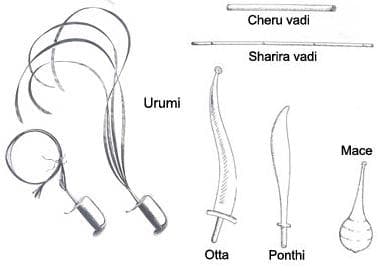
Training in a traditional kalari follows a recognized progression through stages. Beginners spend a long time on meithari, the solo body-conditioning sequences of stances, kicks, twists, and jumps that build the flexibility and control the art is famous for. Only later do students move to kolthari, training with wooden weapons like the long staff and the short stick, then to ankathari, work with metal weapons including the sword and shield, the dagger, and the flexible sword. Weaving through all of it is the massage and healing tradition, where advanced practitioners learn the pressure points and Ayurvedic therapies that treat injuries and, in the darker branches of the lore, could theoretically be turned into targets.
Core Techniques and Concepts
- Meithari (body sequences): Foundational solo drills that build flexibility, balance, and the signature flowing footwork.
- Kolthari (wooden weapons): Staff and stick work that develops timing, distance, and coordination.
- Ankathari (metal weapons): Sword and shield, dagger, and the flexible urumi for advanced practitioners.
- Marma knowledge: Study of vital points, shared with Ayurvedic healing and traditional massage.
- Deep, mobile stances: Low animal-inspired postures that generate power and allow rapid direction changes.
- Gurukkal lineage: Transmission through a master within a specific kalari, preserving distinct regional styles.
Modern Practice and Relevance
Kalaripayattu today lives several lives at once. It is a genuine martial tradition, a cultural performance art, a conditioning method admired for the athleticism and flexibility it produces, and increasingly a draw for international students and film choreographers who prize its cinematic movement. You are more likely to encounter it in a demonstration or a wellness setting than in a cage, and its weapon-heavy curriculum belongs to a different world than modern combat sport.
Yet its relevance to today's fighters is real if indirect. The art's obsession with mobility, hip flexibility, balance under load, and body awareness produces exactly the kind of physical literacy that transfers to any striking or grappling discipline. For the combat-sports fan, Kalaripayattu is also a valuable reminder that the impulse to build complete, integrated fighting systems is not a modern invention. Long before anyone spoke of mixed martial arts, the kalaris of Kerala were training warriors in striking, weapons, and healing as a single, unbroken curriculum.
Technical Deep Dive
Kalaripayattu is most effective when practitioners can control the transition moments between range, rhythm, and balance. Those transition moments are where technical identity becomes visible under pressure.
A useful way to study this style is to separate visible techniques from invisible skills. The visible layer includes strikes, entries, grips, and finishes; the invisible layer includes posture management, timing discipline, and recovery decisions after failed attempts.
In weapons-influenced systems, understanding line control and timing windows is as important as tool mechanics. Clean positioning and tactical patience often matter more than speed alone.
Strengths
- Integrated body training, weapon work, and traditional combat movement
- Clear technical pathways that are easy to study and pressure-test
- Strong transfer into modern competition when timing and distance matter
- Strong awareness of range, line selection, and tool-to-body integration
Trade-offs
- Training quality varies widely between schools, so fundamentals matter more than labels
- Sport rules can sharpen some attributes while reducing others
- The style's original context may differ from how it is practiced today
- Weapons-based training often needs careful adaptation before it translates into sporting or self-defense contexts
Priority Focus
- Consistent drilling under light to medium pressure
- Testing fundamentals against resisting partners before advancing
- Building attributes from basic to complex
Coaching Notes
- Progress from cooperative drills to constrained sparring before full resistance
- Prioritize repeatable combinations and transitions over isolated highlight techniques
- Use video review to compare tactical intent with actual round behavior
- Track conditioning in relation to technical quality, not only output volume