
Martial Arts Library
Judo
6/17/2026 · Kenji Watanabe
Origin
Japan (1882)
Primary Focus
Throws, balance disruption, pins, and submissions
What It Is
Judo is a grappling art centered on throwing mechanics, control, and the efficient use of force to unbalance and pin an opponent.
History Snapshot
Founded by Jigoro Kano at the Kodokan in 1882, judo refined older jujutsu into a safe, teachable system that grew into a global educational method and an Olympic sport in 1964.
What Judo Is
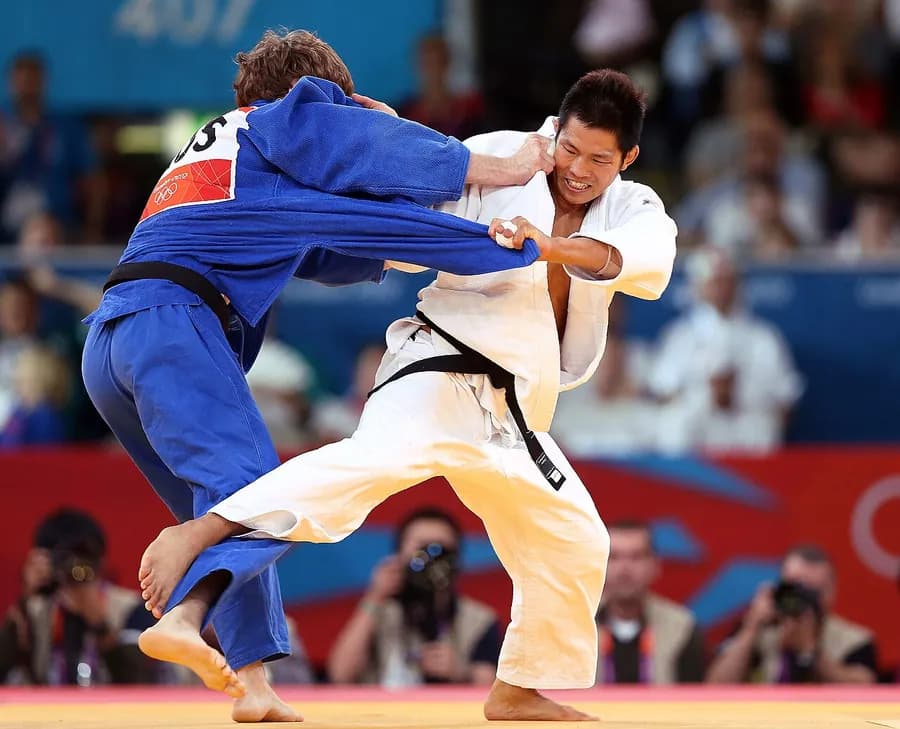
Judo is the art of making a bigger, stronger person fall down. Strip away the belts and the ceremony and that is the whole promise: if you can feel where an opponent's weight is going and get there first, you can put them on the ground without matching them muscle for muscle. Matches are fought from standing grips, and the fastest way to win is a clean throw — an opponent dropped flat on their back scores ippon and ends the contest instantly. When nobody lands the perfect throw, the fight continues on the mat, where judoka hunt for pins, strangles, and armlocks.
That combination of standing and ground work is what has kept judo relevant far beyond its own competition circuit. It teaches you how to close distance, take a grip, and finish the takedown with the person underneath you rather than on top — a skill set that translates almost directly into wrestling, sambo, jiu-jitsu, and mixed martial arts.
Roots in Old Jujutsu
Judo did not appear out of nowhere. It grew out of jujutsu, the loose family of unarmed and lightly armed fighting methods developed by Japan's samurai class over centuries of warfare. Jujutsu schools taught a battlefield-minded mix of throws, joint attacks, chokes, and strikes, meant for a warrior who had lost or set aside his weapons. By the second half of the nineteenth century, though, the world those schools were built for was disappearing.
When the Meiji government began modernizing Japan in the 1860s and 1870s, the samurai lost their official status, and the old combat arts lost their obvious purpose. Many jujutsu lines faded, their teachers scattered, and their reputation suffered — some surviving schools were associated more with street toughs and prizefighting than with disciplined instruction. This is the moment a young, frequently bullied student named Jigoro Kano stepped in.
Kano and the Birth of the Kodokan
Kano was small, bookish, and tired of being pushed around. He sought out surviving jujutsu masters, studying schools such as Tenjin Shin'yo-ryu and Kito-ryu, and absorbed their throwing and grappling knowledge firsthand. But he was also a modern educator, and he saw two problems with what he inherited: much of it was dangerous to practice at full speed, and none of it was organized into a coherent, teachable curriculum.
In 1882 he opened his own school, the Kodokan, in a set of borrowed rooms at a Tokyo temple, with a handful of students. He called his method judo — "the gentle way" — to distinguish it from the arts he had learned. His crucial reform was to separate the techniques that could be trained safely and at full resistance from those that could not. Strikes and the most damaging joint locks were pulled out of everyday sparring and preserved only in formal kata, while throws, pins, and chokes became the material of randori, live free practice against a fully resisting partner.
That single decision — that you should be able to go hard, often, against someone genuinely trying to stop you — is why judo works. It let students accumulate real fighting experience without breaking each other, and it gave Kano a way to prove his system in public.
The Contests That Made Judo's Name
Kano's method was tested quickly and dramatically. In the 1880s the Tokyo police wanted to standardize the grappling they taught their officers and reportedly staged contests between the Kodokan and established jujutsu schools. Kano's students, drilled through constant randori, won convincingly. The victories turned judo from one school among many into the grappling art of modern Japan, adopted into police and school programs and spread by Kano's disciples.
Kano was also a tireless institution builder. He became a leading figure in Japanese education, served on the International Olympic Committee, and sent students abroad to teach. Those travelling instructors seeded judo — and, indirectly, much of the grappling world — across Europe, the Americas, and Asia in the early twentieth century.
From Educational Method to Olympic Sport
Kano always insisted judo was more than a sport; he framed it as physical education and a vehicle for the principles of "maximum efficiency" and "mutual welfare and benefit." But competition drove its global growth. National federations formed, rules were standardized, and in 1964, at the Tokyo Games, men's judo became an Olympic sport. Women's judo followed as a full Olympic event in 1992.
Olympic exposure made judo one of the most widely practiced martial arts on earth, with millions of members across national federations. It also, over the decades, reshaped the art: rule changes gradually restricted leg grabs and rewarded explosive throwing, nudging sport judo toward a fast, upright, grip-fighting game distinct from the broader grappling Kano originally taught.
The Ground Game and the Jiu-Jitsu Connection
One of the most consequential threads in judo's history runs through its ground fighting. In the early twentieth century a Kodokan expert named Mitsuyo Maeda travelled the world taking on all comers in prizefights and demonstrations. He eventually settled in Brazil, where he taught members of the Gracie family. What they built from that foundation — refining and specializing the ground game — became Brazilian jiu-jitsu. In other words, the art that would later dominate the early UFC traces a direct line back to Kano's Kodokan.
Inside Japan, a parallel emphasis on mat work developed in the collegiate "Kosen" judo scene, which allowed far more ground fighting than mainstream rules and prized submissions and positional control. That lineage is a spiritual ancestor of the modern submission-grappling mindset.
Core Technical Ideas
- Kuzushi (breaking balance): No throw works against a balanced, rooted opponent. The real skill is the setup — the pull, the push, the timing of a step — that puts their weight over the edge before the technique even begins.
- Timing over force: Judo is designed to let you borrow the opponent's motion. Catch someone as they step forward or resist your pull, and their own momentum does most of the work.
- Grip fighting (kumi-kata): Whoever controls the grips controls the exchange. Elite judoka spend enormous energy winning the sleeve and lapel before they ever attack.
- Throw-to-control transition: A throw is not the end. The instant a body hits the mat, the judoka is already chasing the pin or the submission, converting the fall into control.
Why Judo Still Matters in Combat Sports
Watch modern MMA and you will see judo everywhere, even when nobody names it: body-lock takedowns against the fence, foot sweeps that drop a striker mid-combination, hip throws out of the clinch, and the ability to land already in a dominant position. Fighters from Ronda Rousey to Khabib Nurmagomedov (a sambo and judo-influenced grappler) have shown how devastating throwing entries can be when a striker is forced to grapple.
More than a century after a small, bullied student decided there had to be a better way to train, judo remains one of the clearest answers to a simple question every fighter faces: how do you take control of someone who does not want to be controlled?
Technical Deep Dive
Judo is most effective when practitioners can control the transition moments between range, rhythm, and balance. Those transition moments are where technical identity becomes visible under pressure.
A useful way to study this style is to separate visible techniques from invisible skills. The visible layer includes strikes, entries, grips, and finishes; the invisible layer includes posture management, timing discipline, and recovery decisions after failed attempts.
In grappling-heavy contexts, the deepest competitive edge usually comes from connection quality rather than move count. Hand-fighting, shoulder pressure, and angle denial often decide outcomes before obvious scoring actions appear.
Strengths
- Throws, balance disruption, pins, and submissions
- Clear technical pathways that are easy to study and pressure-test
- Strong transfer into modern competition when timing and distance matter
- Reliable clinch and control structures that reward leverage over raw strength
Trade-offs
- Training quality varies widely between schools, so fundamentals matter more than labels
- Sport rules can sharpen some attributes while reducing others
- The style's original context may differ from how it is practiced today
- Ground-heavy systems can be harder to apply against strong anti-grappling or striking-heavy opponents without cross-training
Priority Focus
- Consistent drilling under light to medium pressure
- Testing fundamentals against resisting partners before advancing
- Building attributes from basic to complex
- Practice position control and transitions before submissions
Coaching Notes
- Progress from cooperative drills to constrained sparring before full resistance
- Prioritize repeatable combinations and transitions over isolated highlight techniques
- Use video review to compare tactical intent with actual round behavior
- Track conditioning in relation to technical quality, not only output volume
- Build positional chains first, then layer submissions once control is consistent