
Martial Arts Library
Hapkido
6/17/2026 · Priya Nair
Origin
Korea
Primary Focus
Joint manipulation, throws, striking, and self-defense response
What It Is
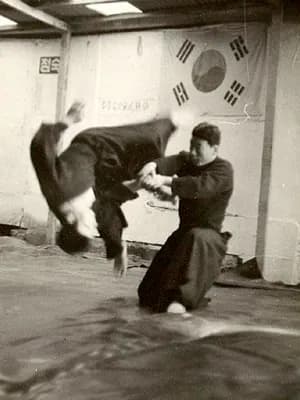
Hapkido is a Korean self-defense art that blends joint locks, circular throws, kicks, and strikes, built on redirecting an attacker's force rather than meeting it head-on.
History Snapshot
Hapkido took shape in South Korea in the years after the Second World War, drawing heavily on the Japanese jujutsu that Korean founder Choi Yong-sool is said to have studied in Japan, then blending it with native Korean kicking and striking. It grew rapidly through a network of influential instructors into one of Korea's best-known martial arts.
What It Is
Hapkido is a Korean martial art with an unusually wide toolkit. Its name is often translated as the way of coordinated power, and that phrase captures its aim: to harmonize with and redirect an attacker's force rather than clash against it. Where many arts specialize, Hapkido spreads out. It teaches joint locks and wrist controls, circular throws and takedowns, a large arsenal of kicks, hand strikes, and in many schools weapons and pressure-point work as well. The organizing logic is self-defense rather than sport. A Hapkido curriculum is built around answering realistic problems, grabs, pushes, punches, and holds, with whatever tool the situation calls for, and its movements tend to flow in circles, blending with an opponent's momentum before turning it against them.
Origins and History
Hapkido is a 20th-century Korean art, and its origins sit at the crossroads of Korean and Japanese martial culture, a legacy of the decades when Korea was under Japanese rule. The central figure in the traditional account is Choi Yong-sool. Born in Korea around the start of the century, he is said to have lived in Japan for many years during the occupation period and to have studied Daito-ryu, a sophisticated Japanese jujutsu tradition centered on joint locks and throws. The precise details of his training in Japan are debated by historians and not fully documented, but the strong technical resemblance between early Hapkido and Daito-ryu jujutsu is widely acknowledged and forms the backbone of the standard origin story.
After the Second World War and Korea's liberation, Choi returned home and began teaching. From his instruction grew a first generation of influential students who would shape the art and spread it, and it is really through them that Hapkido as we know it came together. Over the late 1940s and 1950s, the jujutsu-derived locking and throwing material was progressively blended with Korean striking sensibilities, most visibly a rich repertoire of kicks, including high and spinning techniques characteristic of Korean martial arts. The name Hapkido itself settled into use during this formative period, distinguishing the emerging Korean system from its Japanese antecedent.
Several of Choi's early students became major figures who founded their own schools and organizations, and some carried the art abroad, planting it in the United States and elsewhere from the 1960s onward. This dispersal is why Hapkido today is less a single unified style than a family of related lineages. Different founders emphasized different things, one branch leaning harder into kicking, another into locks and control, another into weapons, and the organizations they built sometimes diverged sharply in curriculum and philosophy while sharing the same core principles.
Development Over Time
As Hapkido spread, it diversified. Because it was carried by many strong personalities rather than governed by one central authority, it produced numerous branches and offshoots, some of which took on distinct names of their own. Cross-pollination with other Korean arts was common, and the boundaries between Hapkido and neighbors such as taekwondo were sometimes porous, especially in the striking material. Through the second half of the 20th century the art established itself internationally, taught widely as a practical self-defense system and adopted in some professional and security contexts for its control-oriented techniques. Unlike many of its peers, Hapkido never fully converted itself into a mainstream competitive sport; its identity stayed anchored in self-defense, which both preserved its broad toolkit and kept it somewhat outside the tournament spotlight.
Core Techniques and Concepts
- Circular redirection: Blending with and turning an attacker's force in curved paths rather than blocking it head-on.
- Joint locks and wrist control: Manipulations of the wrist, elbow, and shoulder to control or subdue, inherited from its jujutsu roots.
- Throws and takedowns: Circular throws and sweeps that flow out of an opponent's own momentum.
- Kicking arsenal: A wide range of kicks, including high and turning techniques drawn from Korean striking tradition.
- Hand strikes: Punches and open-hand strikes integrated with the grappling rather than kept separate.
- Adaptive self-defense: Techniques chosen to answer specific attacks, prioritizing versatility over ring-specific tactics.
Modern Practice and Relevance
Hapkido remains one of the most widely practiced Korean martial arts, taught around the world both as traditional self-defense and, in some schools, with a fitness or discipline focus. Its relationship to modern combat sports is instructive precisely because it is not a ring art. Hapkido optimizes for different outcomes than a cage fighter does, managing grabs and sudden assaults, controlling rather than merely out-pointing, keeping options open across striking and grappling, and that difference makes it a valuable contrast case. At the same time, its joint-lock and circular-throw material overlaps meaningfully with the standing grappling and wrist controls seen in judo, jujutsu, and MMA, and practitioners who cross-train often find that its principle of redirecting force translates cleanly into any fighter's clinch and control game.
Technical Deep Dive
Hapkido is most effective when practitioners can control the transition moments between range, rhythm, and balance. Those transition moments are where technical identity becomes visible under pressure.
A useful way to study this style is to separate visible techniques from invisible skills. The visible layer includes strikes, entries, grips, and finishes; the invisible layer includes posture management, timing discipline, and recovery decisions after failed attempts.
In striking-heavy contexts, this style rewards athletes who can maintain stance integrity while changing pace. Distance ownership, exit discipline, and defensive resets determine whether offensive output remains sustainable late in rounds.
Strengths
- Joint manipulation, throws, striking, and self-defense response
- Clear technical pathways that are easy to study and pressure-test
- Strong transfer into modern competition when timing and distance matter
- Useful footwork, tempo control, and scoring mechanics under pressure
Trade-offs
- Training quality varies widely between schools, so fundamentals matter more than labels
- Sport rules can sharpen some attributes while reducing others
- The style's original context may differ from how it is practiced today
- Pure striking systems may need clinch and takedown defense layers for mixed-rule environments
Priority Focus
- Consistent drilling under light to medium pressure
- Testing fundamentals against resisting partners before advancing
- Building attributes from basic to complex
- Develop footwork, head movement, and distance management
Coaching Notes
- Progress from cooperative drills to constrained sparring before full resistance
- Prioritize repeatable combinations and transitions over isolated highlight techniques
- Use video review to compare tactical intent with actual round behavior
- Track conditioning in relation to technical quality, not only output volume
- Drill entries and exits as one unit so offense and defense stay connected