
Martial Arts Library
Gouren
6/17/2026 · Kenji Watanabe
Origin
Brittany, France
Primary Focus
Jacket wrestling, standing clinch control, and throw execution
What It Is
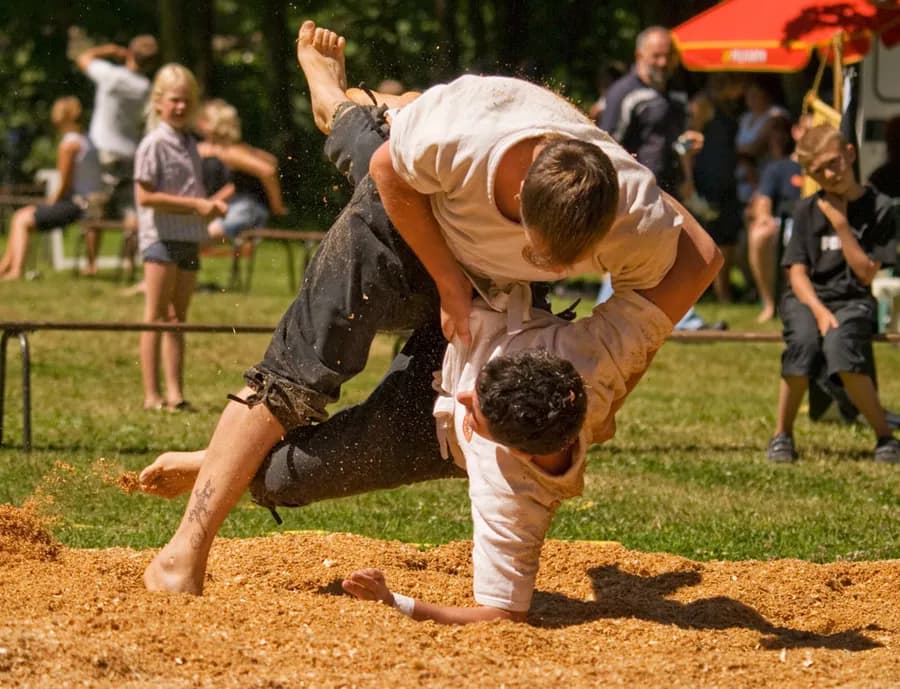
Gouren is a traditional Breton jacket-wrestling style contested from a standing clinch, where the goal is to throw an opponent cleanly onto both shoulder blades.
History Snapshot
Gouren is generally traced to the wider Celtic wrestling family of western Europe and has been a fixture of Breton village and festival life for centuries, with references to Breton wrestling reaching back into the medieval period. It was organized into a modern regulated sport in the early 20th century as part of a broader revival of Breton culture.
What It Is
Gouren is the traditional wrestling of Brittany, the Celtic region on the northwestern tip of France. It belongs to the family of jacket-wrestling styles: both competitors wear a stout linen or canvas jacket, take grips on it, and contest from an upright standing position. The aim is emphatically not to grind an opponent down or pin them through a scramble but to throw them cleanly so that both shoulder blades strike the ground at once, a decisive result known in the tradition as a lamm. That single-throw objective gives Gouren its character. Matches are contests of grip, posture, and timing, fought standing, with a premium on the explosive moment when balance breaks and a throw lands flush.
Origins and History
Gouren's roots run into the broad Celtic wrestling tradition that once stretched across the Atlantic fringe of Europe, with cousins in Cornwall, Wales, Ireland, and beyond. Wrestling of this upright, jacketed kind appears to have been a common feature of rural life across these lands, and Brittany developed its own distinct version. Reliable specifics from the distant past are scarce, as is usual with folk sports carried by custom rather than written record, but references to wrestling in Brittany reach back into the medieval period, and the practice is traditionally associated with village gatherings, religious festivals, and the seasonal fairs that structured the rural calendar.
For most of its long life Gouren was exactly that kind of communal event. A match at a country festival, or pardon, was both entertainment and a test of local pride, with champions known across their district. The wrestlers competed on grass or sawdust, and the culture around the sport carried its own etiquette, including an oath of fair play that competitors were expected to swear, a tradition that survives in ceremonial form today. Because it lived in this popular, festival setting, Gouren accumulated deep regional meaning: it was not merely a game but a marker of Breton identity, tied to the language, music, and customs of the region.
The decisive modern turning point came in the early 20th century. Like several European peoples during that era of cultural revival, the Bretons undertook a deliberate effort to preserve and formalize their distinctive traditions. In the first decades of the 1900s, enthusiasts organized Gouren into a codified sport, establishing rules, weight considerations, standardized jackets, and a governing structure to run competitions. This revival rescued the art from the decline that industrialization and changing rural life might otherwise have brought, and it recast Gouren as an organized sport while keeping its festival soul intact.
Development Over Time
Through the 20th century and into the present, Gouren settled into a dual existence. On one side it functions as a regulated competitive sport, with clubs, weight categories, ranked levels of achievement, and formal championships held across Brittany. On the other it remains a proud cultural emblem, performed and celebrated at Breton festivals alongside traditional dance and music. The clean-throw scoring has been preserved as the heart of the rules, keeping the emphasis on decisive standing technique rather than defensive stalling. Modern organizers have also fostered ties with related Celtic wrestling styles elsewhere, and Breton wrestlers have taken part in gatherings that celebrate the shared roots of these Atlantic traditions.
Core Techniques and Concepts
- The jacket grip: Grips are taken on the canvas jacket, making the hold on the fabric the platform for every attack and defense.
- Upright standing contest: Wrestling is fought from a standing clinch, with no ground grappling phase to fall back on.
- The clean throw (lamm): A decisive win requires putting an opponent onto both shoulder blades simultaneously.
- Balance disruption: Throws are set up by breaking an opponent's posture and stealing their base at the right instant.
- Trips and hip throws: Leg trips, sweeps, and hip-driven throws convert a moment of lost balance into a score.
- Fair-play oath: A traditional pledge of honest conduct frames the contest as a matter of honor.
Modern Practice and Relevance
Today Gouren is a living regional sport, practiced in clubs across Brittany and kept vivid at the festivals that anchor Breton cultural life. It is not a pipeline into professional fighting, and its jacket-grip, single-throw rules make it a specialist tradition rather than a general combat method. Yet for anyone who follows grappling, it fits neatly into a larger picture. Gouren is another node in the worldwide network of folk jacket-wrestling styles, the same broad family that includes judo's ancestral cousins and the belted wrestling of many cultures, and comparing them shows how rule sets shape technique. Its lesson is one every wrestler recognizes: control the grip and the balance, and the throw takes care of itself.
Technical Deep Dive
Gouren is most effective when practitioners can control the transition moments between range, rhythm, and balance. Those transition moments are where technical identity becomes visible under pressure.
A useful way to study this style is to separate visible techniques from invisible skills. The visible layer includes strikes, entries, grips, and finishes; the invisible layer includes posture management, timing discipline, and recovery decisions after failed attempts.
In grappling-heavy contexts, the deepest competitive edge usually comes from connection quality rather than move count. Hand-fighting, shoulder pressure, and angle denial often decide outcomes before obvious scoring actions appear.
In weapons-influenced systems, understanding line control and timing windows is as important as tool mechanics. Clean positioning and tactical patience often matter more than speed alone.
Strengths
- Jacket wrestling, standing clinch control, and throw execution
- Clear technical pathways that are easy to study and pressure-test
- Strong transfer into modern competition when timing and distance matter
- Reliable clinch and control structures that reward leverage over raw strength
Trade-offs
- Training quality varies widely between schools, so fundamentals matter more than labels
- Sport rules can sharpen some attributes while reducing others
- The style's original context may differ from how it is practiced today
- Ground-heavy systems can be harder to apply against strong anti-grappling or striking-heavy opponents without cross-training
Priority Focus
- Consistent drilling under light to medium pressure
- Testing fundamentals against resisting partners before advancing
- Building attributes from basic to complex
- Practice position control and transitions before submissions
Coaching Notes
- Progress from cooperative drills to constrained sparring before full resistance
- Prioritize repeatable combinations and transitions over isolated highlight techniques
- Use video review to compare tactical intent with actual round behavior
- Track conditioning in relation to technical quality, not only output volume
- Build positional chains first, then layer submissions once control is consistent