
Martial Arts Library
Gatka
6/17/2026 · Priya Nair
Origin
Punjab region
Primary Focus
Weapon handling, timing, and movement discipline
What It Is
Gatka is a weapon-based martial art rooted in Sikh tradition, built around fluid stick and sword drills, rhythmic footwork, and disciplined body movement.
History Snapshot
Gatka is generally traced to the martial culture of the Sikhs in the Punjab, where it became bound up with the ideal of the warrior-saint who could defend a community as readily as pray within it. It survived shifting political fortunes to reemerge as a cultural and demonstration art practiced across the Sikh diaspora.
What It Is
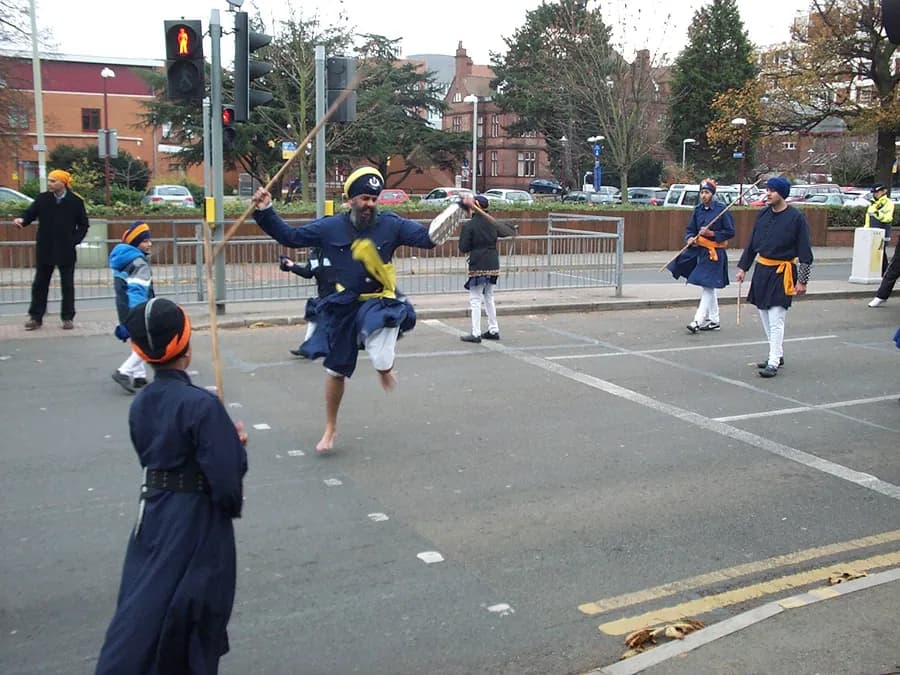
Gatka is a weapon-based martial art most closely associated with the Sikh community of the Punjab, in the northwest of the Indian subcontinent. At first sight it looks like motion for its own sake: a practitioner spins a wooden stick or a curved blade in flowing arcs, footwork tracing circles, often to the beat of a drum. Underneath the spectacle is a training method. The flowing patterns teach a fighter to keep a weapon moving without pause, to protect the body from multiple angles, and to shift smoothly between attack and defense. It is practiced both as a solo discipline and as a paired exchange, and in its fullest form it carries a spiritual dimension as much as a combative one.
Origins and History
Gatka's history is bound tightly to the Sikh martial tradition, and much of it is understood through community memory and religious history rather than a tidy documentary record. The story is usually placed in the Punjab during the era when the Sikh faith was taking shape, roughly from the 16th century onward, a period of frequent conflict on the plains of northern India. Sikh tradition emphasizes the ideal of the sant-sipahi, the saint-soldier, a person expected to be devout in spirit and capable in arms. Physical training with weapons fit naturally into that worldview, and martial practice became woven into the culture of the community.
The art is generally associated with the militarization of the Sikh community under its later Gurus and, above all, with the founding of the Khalsa, the collective body of initiated Sikhs, at the end of the 17th century. From that point the carrying and handling of weapons carried deep religious as well as practical meaning. Skill with the sword, the staff, and other arms was cultivated in this context, and Gatka is best understood as one expression of that broader warrior culture rather than a single school with one named founder. Because the tradition was transmitted largely by demonstration and apprenticeship, precise dates and individual originators are difficult to pin down, and honest accounts tend to speak of lineages and communities rather than a documented inventor.
The word Gatka itself is often linked to the wooden practice stick used in training, and the term as commonly used today seems to have settled into place during the 19th century. Under colonial rule, martial practice among the Sikhs went through periods of both suppression and, later, a degree of official interest, particularly as Sikh soldiers gained a martial reputation within the British Indian Army. Through these shifts the practice endured in the gurdwara and the akhara, the training ground, kept alive as a matter of faith and identity.
Development Over Time
In the modern era, Gatka has moved steadily from battlefield preparation toward cultural performance and sport, without wholly losing its martial character. It is now a familiar sight at Sikh religious festivals, especially the springtime gatherings, where practitioners perform to drumming before crowds. This demonstration form emphasizes flowing display and rhythmic coordination. Alongside it, organized bodies in India and abroad have worked to standardize a competitive version with rules, scoring, and safety equipment, giving young people in the diaspora a structured way to engage with the tradition. The result is a spectrum: at one end, sacred and ceremonial practice tied to community life; at the other, an athletic sport with medals and brackets.
Core Techniques and Concepts
- Continuous flow: The weapon is kept in constant motion so that defense and attack blend into a single unbroken sequence.
- Stick and sword work: Training typically begins with the wooden staff or stick before progressing to the curved blade and other traditional arms.
- Circular footwork: Movement traces loops and turns that let a practitioner face threats from several directions.
- Rhythmic timing: Drills are often set to a drumbeat, using rhythm to build coordination and pace before pressure is added.
- Paired drills: Partner exchanges teach measured distance, line safety, and the timing of strike and counter.
- Discipline and devotion: In its traditional setting, practice is framed as physical training inseparable from spiritual cultivation.
Modern Practice and Relevance
Today Gatka thrives less as a competitive fighting method than as a living cultural art, practiced wherever the Sikh community has settled, from Punjab to Britain, Canada, and beyond. Its direct crossover into cage or ring sport is limited, since it is a weapon art with a ceremonial heart. Yet it holds real interest for anyone thinking about how fighters move. The insistence on unbroken flow, on never letting a weapon go dead, and on protecting the body through continuous circular motion is a coherent tactical idea, and it echoes principles found in other weapon systems around the world. For the modern combat-sports fan, Gatka is a reminder that martial skill and cultural meaning have often been impossible to separate, and that a tradition can survive centuries precisely because it means more than winning.
Technical Deep Dive
Gatka is most effective when practitioners can control the transition moments between range, rhythm, and balance. Those transition moments are where technical identity becomes visible under pressure.
A useful way to study this style is to separate visible techniques from invisible skills. The visible layer includes strikes, entries, grips, and finishes; the invisible layer includes posture management, timing discipline, and recovery decisions after failed attempts.
In weapons-influenced systems, understanding line control and timing windows is as important as tool mechanics. Clean positioning and tactical patience often matter more than speed alone.
Strengths
- Weapon handling, timing, and movement discipline
- Clear technical pathways that are easy to study and pressure-test
- Strong transfer into modern competition when timing and distance matter
- Strong awareness of range, line selection, and tool-to-body integration
Trade-offs
- Training quality varies widely between schools, so fundamentals matter more than labels
- Sport rules can sharpen some attributes while reducing others
- The style's original context may differ from how it is practiced today
- Weapons-based training often needs careful adaptation before it translates into sporting or self-defense contexts
Priority Focus
- Consistent drilling under light to medium pressure
- Testing fundamentals against resisting partners before advancing
- Building attributes from basic to complex
Coaching Notes
- Progress from cooperative drills to constrained sparring before full resistance
- Prioritize repeatable combinations and transitions over isolated highlight techniques
- Use video review to compare tactical intent with actual round behavior
- Track conditioning in relation to technical quality, not only output volume