
Martial Arts Library
Eskrima (Filipino Stick Fighting)
6/18/2026 · Diego Alvarez
Origin
Philippines
Primary Focus
Stick and blade work, footwork, angles, and weapon flow
What It Is
Eskrima is a Filipino martial art centred on stick and blade fighting, using rapid striking patterns, angular footwork, and a weapon-first approach that also translates to empty hands.
History Snapshot
It grew from the indigenous weapon-fighting traditions of the Philippine islands, where the blade was central to daily life and warfare. Its Spanish-derived names, Eskrima and Arnis, reflect the colonial era, and in the modern age it has become the Philippines' recognised national martial art and a global export.
What It Is
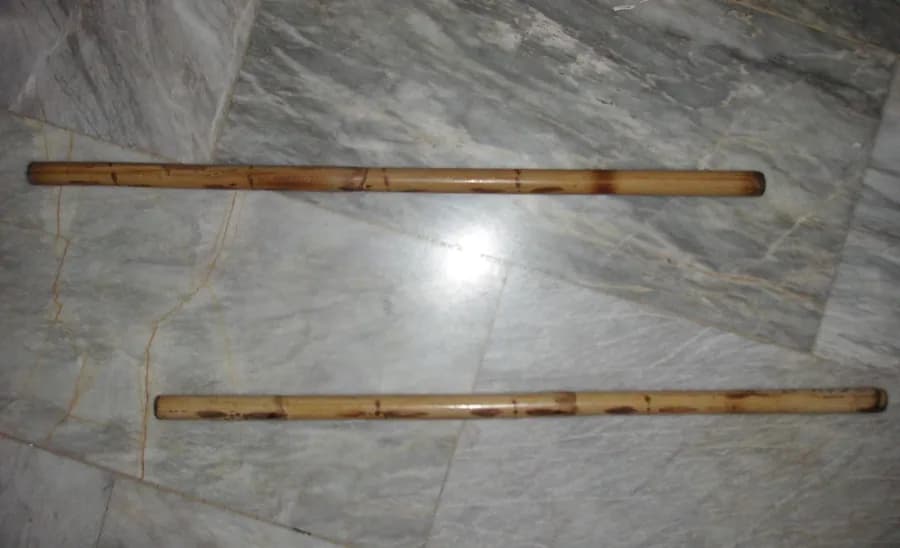
Eskrima is the Filipino art of weapon fighting, best known to outsiders as "stick fighting" because of the rattan sticks its practitioners drill with. But the stick is really a stand-in. At its heart, Eskrima is a blade art: the movements are built around the logic of the edge and the point, and the rattan simply lets people train those patterns at full speed without cutting each other apart. The same names, Eskrima, Arnis, and Kali, are used more or less interchangeably for this broad family of Filipino systems. A defining feature is that Eskrima teaches the weapon first. Beginners pick up a stick early rather than spending years on empty hands, on the reasoning that once you understand the angles, timing, and footwork of an armed exchange, the empty-hand applications follow naturally from the same structure.
Origins and History
Eskrima grows out of the indigenous fighting traditions of the Philippine archipelago, a scattering of islands where communities developed their own weapon-based combat long before outside contact. In a world where the blade, the bolo, the kris, and countless other edged tools, was woven into farming, daily labour, and warfare, skill with a weapon was a practical necessity, and distinct local fighting methods took shape across the islands. This deep indigenous root is the true foundation of the art, and it is generally understood in these broad terms rather than through a single documented lineage.
The names the art carries today come from the colonial period. Spain governed the Philippines for more than three centuries from the 1500s, and the words Eskrima and Arnis both derive from Spanish, reflecting the encounter between local fighting traditions and the language and fencing culture of the colonisers. It is often said that the Filipino arts absorbed some influence from European blade fencing during this era while retaining their own indigenous core, though the exact nature of that exchange is a matter of general understanding rather than precise record. A famous and frequently retold episode, the killing of the explorer Ferdinand Magellan by the forces of the chieftain Lapu-Lapu at Mactan in 1521, is often cited as an emblem of Filipino martial skill and resistance, though it is best treated as a symbolic touchstone rather than a documented instance of any specific system.
A common tradition holds that during the colonial period, when authorities at times restricted the practice of native fighting arts, Eskrima survived in part by being hidden within folk dances and performances, its combat patterns disguised as choreography. This is a widely repeated account within the Filipino martial-arts community; like much of the art's older history, it is best described as tradition rather than firmly documented fact.
Development Over Time
Eskrima was long passed down informally, within families and villages and among circles of practitioners, producing a huge diversity of styles and lineages rather than one unified system. Different regions and masters emphasised different weapons, ranges, and striking patterns, which is why the Filipino arts remain famously varied to this day.
In the 20th century the art became far more organised and visible. Masters began teaching more openly, forming associations, and codifying their methods, and Filipino migration carried Eskrima abroad, especially to the United States, where influential teachers helped it take root and gain a devoted following. Its reputation grew further as its efficient weapon and empty-hand concepts were adopted into military and law-enforcement close-combat training and, later, showcased in film and popular culture. Within the Philippines, the art's national importance was formally recognised when Arnis was designated the country's national martial art and sport, cementing its status as a symbol of Filipino heritage.
Core Techniques and Concepts
- Angles of attack: Eskrima organises striking around a numbered set of angles, teaching students to recognise and counter any incoming line rather than memorising isolated moves.
- Rapid striking patterns: continuous, flowing combinations that build offensive momentum and a defensive structure at the same time.
- Footwork and triangulation: angular stepping that moves the fighter off the line of attack while setting up their own strike.
- Weapon-to-empty-hand transfer: because the system is built on the weapon, its principles carry directly into knife defence and empty-hand striking, trapping, and locking.
- Flow and sensitivity: partner drills such as continuous stick exchanges develop timing, reflexes, and the ability to feel and redirect an opponent's pressure.
Modern Practice and Relevance
Eskrima is one of the most successfully exported traditional martial arts in the world, taught in clubs across the globe and embraced both as a cultural practice and as a practical fighting method. Its relevance to modern combat sports is real and current. Filipino weapon and empty-hand concepts have influenced self-defence and reality-based systems, and many mixed martial artists and coaches cross-train Eskrima specifically for the footwork, hand speed, and sense of angles and timing it develops so well. Its knife-awareness and weapon-handling knowledge also make it a staple of serious self-defence curricula. More than most traditional arts, Eskrima has managed to stay directly useful, prized not as a museum piece but as a living toolkit that sharpens attributes any modern fighter can put to work.
Technical Deep Dive
Eskrima (Filipino Stick Fighting) is most effective when practitioners can control the transition moments between range, rhythm, and balance. Those transition moments are where technical identity becomes visible under pressure.
A useful way to study this style is to separate visible techniques from invisible skills. The visible layer includes strikes, entries, grips, and finishes; the invisible layer includes posture management, timing discipline, and recovery decisions after failed attempts.
In striking-heavy contexts, this style rewards athletes who can maintain stance integrity while changing pace. Distance ownership, exit discipline, and defensive resets determine whether offensive output remains sustainable late in rounds.
In weapons-influenced systems, understanding line control and timing windows is as important as tool mechanics. Clean positioning and tactical patience often matter more than speed alone.
Strengths
- Stick and blade work, footwork, angles, and weapon flow
- Clear technical pathways that are easy to study and pressure-test
- Strong transfer into modern competition when timing and distance matter
- Strong awareness of range, line selection, and tool-to-body integration
Trade-offs
- Training quality varies widely between schools, so fundamentals matter more than labels
- Sport rules can sharpen some attributes while reducing others
- The style's original context may differ from how it is practiced today
- Weapons-based training often needs careful adaptation before it translates into sporting or self-defense contexts
Priority Focus
- Consistent drilling under light to medium pressure
- Testing fundamentals against resisting partners before advancing
- Building attributes from basic to complex
- Develop footwork, head movement, and distance management
Coaching Notes
- Progress from cooperative drills to constrained sparring before full resistance
- Prioritize repeatable combinations and transitions over isolated highlight techniques
- Use video review to compare tactical intent with actual round behavior
- Track conditioning in relation to technical quality, not only output volume
- Drill entries and exits as one unit so offense and defense stay connected