
Martial Arts Library
Dambe
6/17/2026 · Tunde Balogun
Origin
West Africa
Primary Focus
One-handed power striking, defensive framing, and rhythm
What It Is
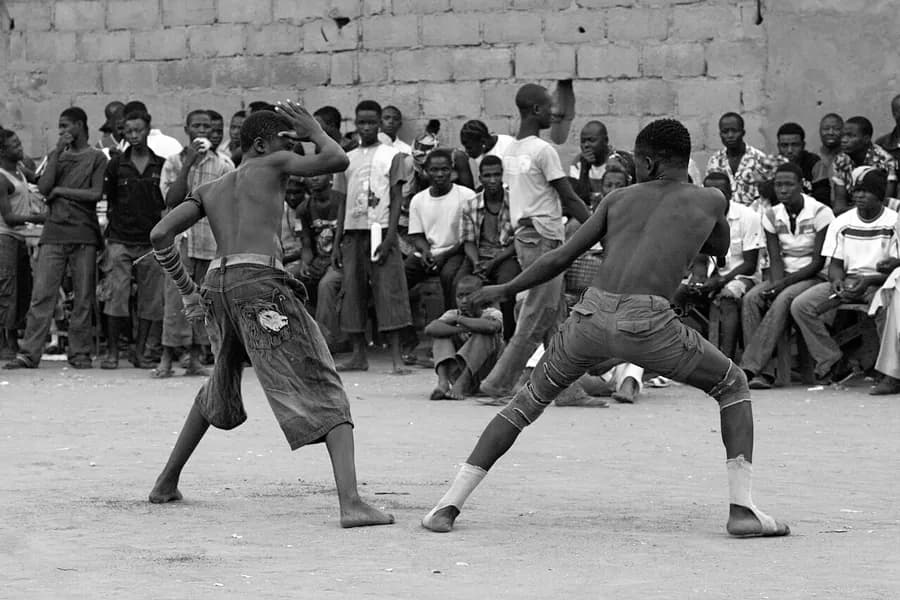
Dambe is a traditional West African striking art in which one hand is bound as the main striking 'spear' while the other arm is used as a shield, contested with ritual and music.
History Snapshot
It is traditionally associated with the Hausa people of West Africa, developed within communities of butchers who held contests at harvest time and other gatherings. Long a rural and cultural practice, it has drawn a large global audience in recent years through online video.
What It Is
Dambe is a traditional striking art from West Africa, a form of boxing that looks unlike anything in the Western ring. Its most striking feature is asymmetry. A fighter's strong hand, called the "spear," is wrapped tightly in cord and cloth and held back as the main weapon, delivering powerful, committed blows. The lead arm, the "shield," is held forward to guard, parry, and frame against the opponent. The lead leg can also be used to kick or to sweep. Bouts are typically fought in rounds and can end when a fighter is knocked down, with a downed opponent said to be "killed" in the sport's traditional language, a dramatic term for a decisive knockdown rather than anything literal. The whole event is steeped in ceremony: drumming, chanting, and a charged, theatrical atmosphere that is inseparable from the fighting itself.
Origins and History
Dambe is traditionally associated with the Hausa people, one of the largest ethnic groups of West Africa, spread across northern Nigeria, Niger, and neighbouring areas. Its origins are generally understood to lie in the region's older cultural and martial traditions rather than in any single documented founding, so the honest picture is one of a practice that developed over a long time within Hausa society, with roots that are described in broad terms rather than precise dates.
The most commonly cited social origin ties Dambe to communities of butchers. In this account, the art developed among butcher guilds and related groups as a test of strength and manhood, with contests held at harvest time and during festivals as travelling fighters moved between towns and villages. Fighting was a way to display courage, settle rivalries between communities, and provide spectacle at seasonal gatherings, all bound up with the agricultural calendar and local custom. Historically it is also generally understood to have carried a preparatory, warrior dimension in some contexts, a way of building the toughness prized in the region's martial culture.
Because Dambe lived as an oral and folk tradition rather than a codified sport with written records, its deeper history should be treated with appropriate caution. Specific claims about exact ages, individual champions of the distant past, or precise ceremonial meanings vary and are not always well documented, and it would be wrong to invent them. What can be said confidently is that Dambe has long been a recognisable and culturally important fighting practice of the Hausa world, passed down through communities and performed at their gatherings.
Development Over Time
For most of its life Dambe remained a largely rural and regional practice, tied to specific communities, festivals, and the informal circuits that travelling fighters followed. It retained its traditional character, the bound hand, the ritual, the drumming, well into the modern era, changing far less than many combat sports that were formalised and internationalised in the 20th century.
The biggest change has come very recently and from an unexpected direction: the internet. Over the past decade or so, video footage of Dambe bouts has spread widely online, and the sport's raw intensity and unusual look have won it a substantial global audience far beyond West Africa. This exposure has begun to nudge Dambe toward greater organisation, with promoters staging more formal events, filming matches for international viewers, and presenting the sport to a worldwide fan base that had never heard of it before. It is an interesting moment for the art, poised between deep tradition and the pull of modern combat-sports commercialisation.
Core Techniques and Concepts
- The spear hand: the bound rear hand is the primary weapon, thrown as a heavy, committed strike aimed to end the bout with a knockdown.
- The shield arm: the lead arm is dedicated to defence, held forward to block, parry, and control the opponent's attacks and distance.
- Lead-leg use: the front leg can kick or sweep, adding a lower-body threat to the one-handed striking game.
- Asymmetric stance: the whole posture is organised around one attacking side and one defending side, changing the timing and rhythm of exchanges compared with two-fisted boxing.
- Ritual and rhythm: drumming, chanting, and psychological display are woven into the contest, part of both the spectacle and the fighters' preparation.
Modern Practice and Relevance
Dambe today sits at a fascinating crossroads. It remains a genuine cultural tradition of the Hausa people, practised and celebrated in its home region, while simultaneously becoming a global curiosity and a growing spectator sport thanks to online video. Its relevance to the wider combat-sports world is partly that of fresh perspective. Dambe challenges the assumptions baked into Western boxing by showing that a striking system can be built around a single weaponised hand and a dedicated shield, producing completely different timing, defence, and attack selection. As international audiences discover it and as the sport slowly organises itself for a bigger stage, Dambe stands as a reminder of how much martial ingenuity exists outside the familiar canon, and of how quickly a once-local tradition can find a worldwide following in the digital age.
Technical Deep Dive
Dambe is most effective when practitioners can control the transition moments between range, rhythm, and balance. Those transition moments are where technical identity becomes visible under pressure.
A useful way to study this style is to separate visible techniques from invisible skills. The visible layer includes strikes, entries, grips, and finishes; the invisible layer includes posture management, timing discipline, and recovery decisions after failed attempts.
In striking-heavy contexts, this style rewards athletes who can maintain stance integrity while changing pace. Distance ownership, exit discipline, and defensive resets determine whether offensive output remains sustainable late in rounds.
In weapons-influenced systems, understanding line control and timing windows is as important as tool mechanics. Clean positioning and tactical patience often matter more than speed alone.
Strengths
- One-handed power striking, defensive framing, and rhythm
- Clear technical pathways that are easy to study and pressure-test
- Strong transfer into modern competition when timing and distance matter
Trade-offs
- Training quality varies widely between schools, so fundamentals matter more than labels
- Sport rules can sharpen some attributes while reducing others
- The style's original context may differ from how it is practiced today
Priority Focus
- Consistent drilling under light to medium pressure
- Testing fundamentals against resisting partners before advancing
- Building attributes from basic to complex
- Develop footwork, head movement, and distance management
Coaching Notes
- Progress from cooperative drills to constrained sparring before full resistance
- Prioritize repeatable combinations and transitions over isolated highlight techniques
- Use video review to compare tactical intent with actual round behavior
- Track conditioning in relation to technical quality, not only output volume
- Drill entries and exits as one unit so offense and defense stay connected