
Martial Arts Library
Choy Li Fut
6/17/2026 · Ray Coleman
Origin
China
Primary Focus
Circular long-range striking and flowing combinations
What It Is
Choy Li Fut is a southern Chinese martial art known for wide, circular long-arm strikes, rolling combinations, and a versatile blend of northern and southern methods.
History Snapshot
It is traditionally traced to Chan Heung, who is said to have founded the system in southern China in 1836 by synthesising the teachings of three masters. It grew into one of the most widely practised southern styles and became closely tied to the revolutionary and cultural currents of its era.
What It Is
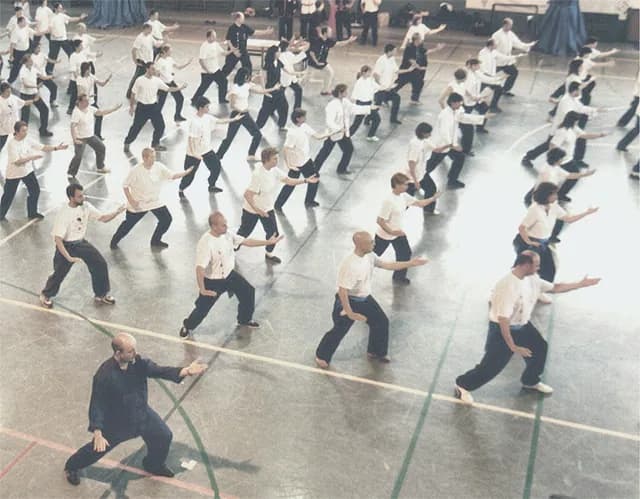
Choy Li Fut (also written Cai Li Fo) is a southern Chinese martial art with a look all its own. Where many southern styles are famous for short, compact, close-range power, Choy Li Fut swings the other way, quite literally. Its strikes travel through long, sweeping arcs, the arms whipping out in wide circular motions that chain together into rolling combinations. A practitioner can throw hooking swings, back-fists, and overhand blows that cover a lot of ground, and the system is built so that these attacks flow one into the next through the turning of the body. The result is a style that feels expansive and rhythmic, designed to keep pressure coming and, in its traditional applications, to deal with more than one attacker at a time.
Origins and History
Choy Li Fut has one of the better-preserved origin stories among southern Chinese arts, and it is generally traced to a single founder: Chan Heung, who is traditionally said to have established the system in 1836 in the Guangdong region of southern China. The name itself encodes its lineage. According to the tradition, Chan Heung honoured the three teachers who shaped his martial education: he studied under a master named Choy (Choy Fook) and a master named Li (Li Yau-San), and the "Fut," meaning Buddha, is generally said to acknowledge the Buddhist, Shaolin-linked roots of the knowledge he received, often associated with a monk teacher. By naming his art after all three influences, Chan Heung signalled that Choy Li Fut was a deliberate synthesis rather than a single inherited line.
That synthesis is the key to the style's character. It is often described as blending the long-range, mobile, wide-swinging methods associated with northern Chinese martial arts with the rooted power and hand techniques of the south. This gave Choy Li Fut an unusually broad toolkit, and it spread quickly through Guangdong and the Pearl River Delta, a densely populated and turbulent part of 19th-century China.
Like many Chinese martial arts of the period, Choy Li Fut became entangled with the political ferment of its time. The 1800s and early 1900s in southern China were marked by unrest, anti-Qing sentiment, and later revolutionary activity, and martial arts schools frequently doubled as networks for these movements. Choy Li Fut is commonly associated in its traditions with anti-Qing resistance, and its schools helped spread the art through the region's clan associations and villages. As with much of this era, specific claims should be held loosely, since martial-arts histories from the period mix documented fact with lineage legend, but the broad picture of an art bound up with southern Chinese social and political life is well established.
Development Over Time
From its 19th-century base, Choy Li Fut grew into one of the most widely practised southern styles, branching into several major lineages as it passed down through Chan Heung's family and prominent students. Different branches developed their own emphases and forms while keeping the core signature of long, circular striking. The art built a large curriculum over time, including extensive empty-hand forms, a wide array of traditional weapons, two-person sets, and its own training apparatus such as wooden dummies and striking devices used to condition the sweeping strikes.
In the 20th century, as Chinese communities migrated and martial arts opened up to the wider world, Choy Li Fut travelled with them. Schools were established across Hong Kong, Southeast Asia, and eventually the West, and it became one of the more recognisable traditional kung fu systems internationally, both as a fighting art and as a vehicle for the athletic, demonstrative side of Chinese martial culture.
Core Techniques and Concepts
- Long-arm circular striking: wide, arcing punches and swings, including hooking blows and back-fists, that generate power through the full extension of the arm.
- Rotational power: force is drawn from the turning of the waist and body rather than from the arm alone, letting strikes flow continuously.
- Rolling combinations: attacks are chained together so that each strike sets up the next, keeping momentum and pressure high.
- Broad, mobile footwork: stances and stepping that support movement and the ability to face attacks from multiple directions.
- Rich weapons and forms curriculum: a large body of traditional forms, weapons, and partner and apparatus training that preserves the system's depth.
Modern Practice and Relevance
Today Choy Li Fut lives on mainly as a traditional martial art, taught in schools worldwide and practised for self-defence, fitness, cultural connection, and performance. It is not a fixture of modern combat sports in the way that Muay Thai or wrestling are, and its wide, looping strikes do not map neatly onto the tight guard and economy of movement that ring competition rewards. Its value for the modern fan is largely as a point of contrast. Set beside the compact, linear mechanics of boxing, Choy Li Fut illustrates a completely different theory of how to generate power and manage range, one built around large circular motion, continuous flow, and the demands of facing several opponents rather than one. Understanding styles like it enriches the way we see striking as a whole, reminding us that the familiar template of the modern combat gym is one answer among many to the old question of how to hit hard and not get hit back.
Technical Deep Dive
Choy Li Fut is most effective when practitioners can control the transition moments between range, rhythm, and balance. Those transition moments are where technical identity becomes visible under pressure.
A useful way to study this style is to separate visible techniques from invisible skills. The visible layer includes strikes, entries, grips, and finishes; the invisible layer includes posture management, timing discipline, and recovery decisions after failed attempts.
In striking-heavy contexts, this style rewards athletes who can maintain stance integrity while changing pace. Distance ownership, exit discipline, and defensive resets determine whether offensive output remains sustainable late in rounds.
Strengths
- Circular long-range striking and flowing combinations
- Clear technical pathways that are easy to study and pressure-test
- Strong transfer into modern competition when timing and distance matter
- Useful footwork, tempo control, and scoring mechanics under pressure
Trade-offs
- Training quality varies widely between schools, so fundamentals matter more than labels
- Sport rules can sharpen some attributes while reducing others
- The style's original context may differ from how it is practiced today
- Pure striking systems may need clinch and takedown defense layers for mixed-rule environments
Priority Focus
- Consistent drilling under light to medium pressure
- Testing fundamentals against resisting partners before advancing
- Building attributes from basic to complex
- Develop footwork, head movement, and distance management
Coaching Notes
- Progress from cooperative drills to constrained sparring before full resistance
- Prioritize repeatable combinations and transitions over isolated highlight techniques
- Use video review to compare tactical intent with actual round behavior
- Track conditioning in relation to technical quality, not only output volume
- Drill entries and exits as one unit so offense and defense stay connected