
Martial Arts Library
Chess Boxing
6/18/2026 · Diego Alvarez
Origin
Europe
Primary Focus
Alternating chess and boxing rounds; mind and body under fatigue
What It Is
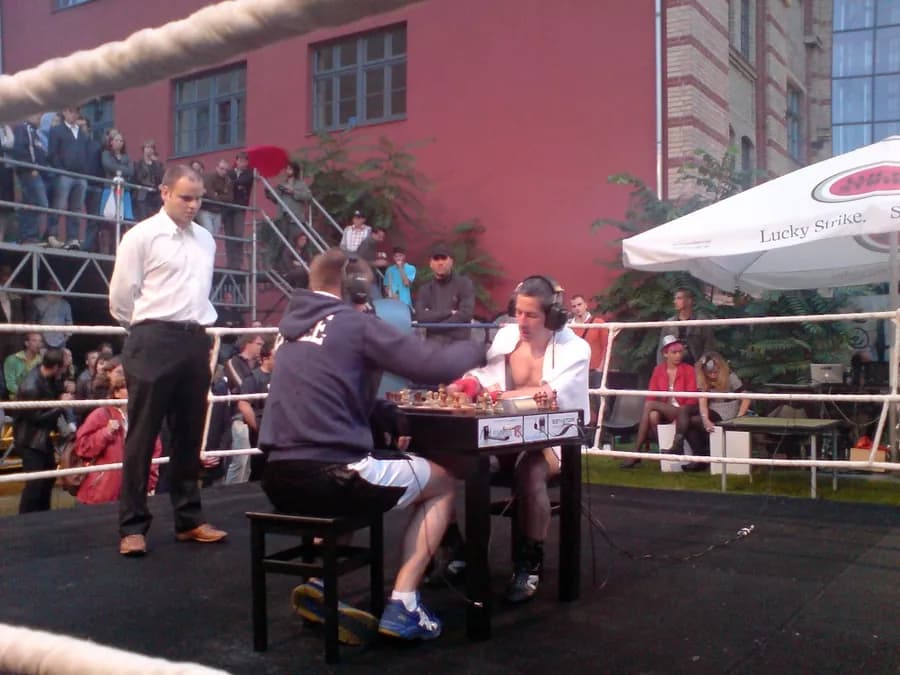
Chess boxing is a hybrid sport in which competitors alternate rounds of fast chess and boxing, and win by either knockout or checkmate.
History Snapshot
The concept appeared in a 1990s French graphic novel and was turned into a real sport in the early 2000s by artist Iepe Rubingh. From a single staged bout in Amsterdam it grew into an organised competitive scene with governing bodies and events across Europe and beyond.
What It Is
Chess boxing is exactly what its name promises and stranger than it sounds. Two competitors face each other across a full contest that alternates between rounds of chess and rounds of boxing, switching back and forth from the first bell to the last. One moment they are hunched over a board playing speed chess with a clock ticking down; a few minutes later they are trading punches in the ring; then they sit back down, gloves off, and try to calculate a combination on the board while their heart is still hammering. A fighter can win in either arena, by knockout or stoppage in the boxing, or by checkmate or running the opponent out of time on the board. The sport asks a genuinely unusual question: can you keep a clear, calculating head while your body is exhausted and your face has just taken a jab?
Origins and History
Chess boxing did not grow out of any old fighting tradition. It began as an idea on the page. The specific fusion of the two disciplines is generally credited to the French comic artist Enki Bilal, whose 1992 graphic novel Froid Équateur featured a chess-boxing match as a piece of dystopian fiction. In Bilal's version the two contests happened in sequence rather than alternating, but the striking image of a sport combining the ultimate mental game with the ultimate physical one lodged in the culture.
The leap from fiction to reality is credited to the Dutch performance artist Iepe Rubingh, sometimes billed under the name Iepe the Joker. In the early 2000s he took Bilal's concept and reworked it into a workable competitive format, crucially deciding that the rounds should alternate, forcing constant switching between mind and body. Rubingh staged what is generally regarded as the first real chess-boxing bout in Amsterdam in 2003 and won it himself. That event was as much art project as sporting contest, but it caught on. Rubingh helped found an organising body to give the new sport rules and structure, and the idea began to spread, particularly in the Netherlands, Germany, and later Britain, India, and Russia.
Because the sport is so young and began as a deliberate invention, its history is unusually well documented and refreshingly free of the myth-making that surrounds older martial arts. There is no ancient lineage to argue over, no disputed founder, just a traceable line from a comic book to a boxing ring in Amsterdam.
Development Over Time
Once it existed as a real event, chess boxing had to solve practical problems the fiction never worried about. Organisers settled on a format of alternating rounds, typically beginning and often ending with chess, with each competitor sharing a total budget of chess time on the clock. Rules had to define what happens when a boxing round threatens to interrupt a critical chess position, how to handle a player stalling on the board to recover from a beating, and what minimum standard of both chess and boxing a competitor must meet to be allowed in. Governing organisations formed to standardise these questions and to sanction bouts, and rival bodies emerged as the sport spread to different countries.
Over the following two decades chess boxing shifted from novelty spectacle toward something closer to a genuine amateur sport, with training gyms, ranked competitors, and events that draw real crowds. It remains niche, and it still trades heavily on its inherent theatricality, but the level of both the chess and the boxing on display has risen well beyond its art-stunt beginnings.
Core Techniques and Concepts
- Round alternation: the defining mechanic; competitors swing between the board and the ring, never settling into one mode.
- Chess under duress: playing accurate speed chess while fatigued and rattled is the sport's central skill, and blunders spike after a hard boxing round.
- Clock management: because chess time is a shared, finite resource, letting the clock run down can lose the match as surely as a knockout.
- Context switching: the ability to drop adrenaline and re-engage cold calculation within seconds separates good chess boxers from merely good boxers or good players.
- Dual-threat strategy: a competitor strong in one discipline may deliberately steer the match toward it, pressing for a knockout or nursing a winning board position.
Modern Practice and Relevance
Chess boxing occupies an odd but affectionate corner of the combat-sports world. It is not going to reshape how anyone trains for MMA or boxing, and it makes no claim to be a self-defence system. Its value is more conceptual: it is one of the clearest demonstrations that composure under physical stress is itself a trainable, competitive skill, something every fighter in every combat sport already knows in their gut. There is a reason coaches talk about "staying calm" and "fighting smart" when the pressure is highest. Chess boxing simply turns that idea into an entire sport, and in doing so it offers a genuinely modern, and genuinely fun, addition to the fight-sport family.
Technical Deep Dive
Chess Boxing is most effective when practitioners can control the transition moments between range, rhythm, and balance. Those transition moments are where technical identity becomes visible under pressure.
A useful way to study this style is to separate visible techniques from invisible skills. The visible layer includes strikes, entries, grips, and finishes; the invisible layer includes posture management, timing discipline, and recovery decisions after failed attempts.
In striking-heavy contexts, this style rewards athletes who can maintain stance integrity while changing pace. Distance ownership, exit discipline, and defensive resets determine whether offensive output remains sustainable late in rounds.
In weapons-influenced systems, understanding line control and timing windows is as important as tool mechanics. Clean positioning and tactical patience often matter more than speed alone.
Strengths
- Alternating chess and boxing rounds; mind and body under fatigue
- Clear technical pathways that are easy to study and pressure-test
- Strong transfer into modern competition when timing and distance matter
- Useful footwork, tempo control, and scoring mechanics under pressure
Trade-offs
- Training quality varies widely between schools, so fundamentals matter more than labels
- Sport rules can sharpen some attributes while reducing others
- The style's original context may differ from how it is practiced today
- Pure striking systems may need clinch and takedown defense layers for mixed-rule environments
Priority Focus
- Consistent drilling under light to medium pressure
- Testing fundamentals against resisting partners before advancing
- Building attributes from basic to complex
- Develop footwork, head movement, and distance management
Coaching Notes
- Progress from cooperative drills to constrained sparring before full resistance
- Prioritize repeatable combinations and transitions over isolated highlight techniques
- Use video review to compare tactical intent with actual round behavior
- Track conditioning in relation to technical quality, not only output volume
- Drill entries and exits as one unit so offense and defense stay connected