
Martial Arts Library
Catch Wrestling
6/17/2026 · Tunde Balogun
Origin
Britain and transatlantic wrestling circuits
Primary Focus
Pins, rides, submission pressure, and painful control
What It Is
Catch wrestling is a submission-oriented grappling style that fuses pinning and top pressure with aggressive hunting for cranks, locks, and chokes.
History Snapshot
It crystallised in the industrial north of England in the 19th century and travelled to America through fairgrounds, carnivals, and challenge matches. There it seeded professional wrestling and left a technical legacy that runs straight into modern MMA and submission grappling.
What It Is
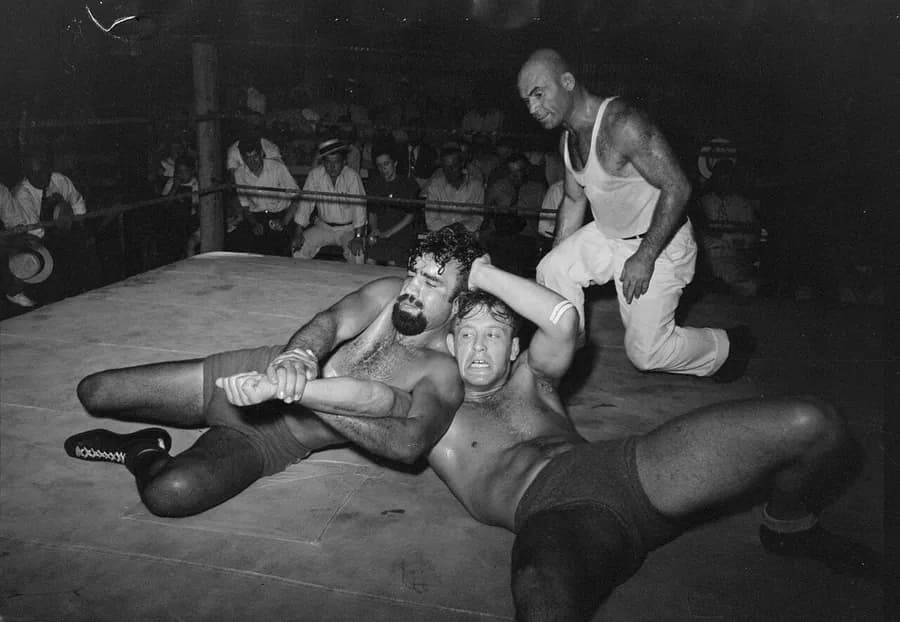
Catch wrestling, sometimes called "catch-as-catch-can," is a grappling style with a well-earned reputation for meanness. Its aim is not just to pin an opponent or score points but to control them so uncomfortably that a submission becomes almost a mercy. A catch wrestler wants to be on top, riding their opponent with crushing weight, working cranks on the neck and joints, and hunting finishes from positions that grind as much as they threaten. The name captures the philosophy: catch any hold you can, anywhere you can, and make it hurt. Compared with more positional grappling systems, catch has a rougher, more improvisational flavour, valuing scrambles, pressure, and punishment over patient, points-based control.
Origins and History
Catch wrestling is generally traced to the industrial towns of northern England, above all Lancashire, in the 19th century. This was a world of factories, mines, and mills, and its working men wrestled, at fairs, in pubs, and in prize matches where money and pride were on the line. Out of this folk-wrestling culture, blended with older regional styles and influences absorbed from wrestlers around the world, came "catch-as-catch-can," a form that, unlike many polite folk styles, allowed holds below the waist and submissions as well as pins. The Wigan area in particular became famous as a stronghold, and its gyms developed a reputation for producing exceptionally tough, technical hookers, the term for wrestlers skilled at painful submission holds.
The art's spread owes almost everything to the fairground and the professional circuit. In the late 1800s and early 1900s, catch wrestlers travelled with carnivals and music halls, taking on all comers in challenge matches. The classic "athletic show" booth, where a local hard man could win money if he lasted a set time against the resident wrestler, was a proving ground where catch men learned to control and submit larger, aggressive opponents quickly and safely. Because their livelihood depended on winning without getting hurt, these wrestlers refined an efficient, no-nonsense toolkit of controls and finishes.
Emigration and touring carried the style across the Atlantic. British and European wrestlers brought catch to the United States, where it merged with American folk wrestling traditions and flourished on the carnival and professional scene. Figures such as Frank Gotch and the earlier Martin "Farmer" Burns became famous American exponents around the turn of the 20th century, and catch wrestling was, for a time, a genuine mainstream spectator sport with legitimate championship matches.
Development Over Time
The commercial pressures that spread catch wrestling also transformed it. As legitimate wrestling contests grew long, grinding, and hard for audiences to follow, promoters increasingly staged worked, entertainment-driven bouts, and catch became the technical seedbed of modern professional wrestling. The "hooks" and "shoots" of the pro-wrestling vocabulary come directly from this heritage. Meanwhile, the genuine submission craft survived in gyms and lineages that kept the real fighting method alive.
One lineage proved especially important. The knowledge preserved in Wigan, associated with the celebrated gym often linked to Billy Riley and known as the "Snake Pit," passed to influential figures such as Billy Robinson and Karl Gotch. Gotch in particular carried catch wrestling to Japan, where it deeply shaped Japanese professional wrestling and the "strong style" and shoot-wrestling movements. That Japanese branch fed directly into the early mixed martial arts scene, giving catch a living presence in modern combat sport rather than a purely historical one.
Core Techniques and Concepts
- Rides and top pressure: staying heavy on top, controlling the opponent's hips and posture, and turning position into a weapon rather than a rest.
- Neck cranks and the double wristlock: signature punishing holds, including neck cranks and the arm lock catch men call the double wristlock (a kimura-type attack).
- Toe holds and leg locks: catch never shied away from attacking the legs, keeping a rich lower-body submission game.
- Pinning awareness: because pins were a route to victory, catch wrestlers develop sharp instincts for turning and breaking an opponent down.
- Scramble-first mindset: constant motion and the willingness to catch a hold mid-transition, rather than waiting for a settled position.
Modern Practice and Relevance
Catch wrestling never grew into a single global governing body the way sport judo or Brazilian jiu-jitsu did, and for much of the late 20th century it survived as a somewhat underground craft passed through specific gyms and coaches. But its fingerprints are everywhere in modern combat sports. The pressure-based top control prized in MMA, the leg-lock revolution reshaping submission grappling, and the whole culture of "positional dominance plus finishing" all rhyme with catch principles. A number of respected modern coaches explicitly trace their methods to catch lineages, and its holds and mindset are constantly rediscovered by grapplers looking for a rougher, more control-oriented edge. As a historical crossroads where folk wrestling, professional showmanship, and real submission fighting all meet, catch wrestling remains one of the most quietly influential arts in the fight world.
Technical Deep Dive
Catch Wrestling is most effective when practitioners can control the transition moments between range, rhythm, and balance. Those transition moments are where technical identity becomes visible under pressure.
A useful way to study this style is to separate visible techniques from invisible skills. The visible layer includes strikes, entries, grips, and finishes; the invisible layer includes posture management, timing discipline, and recovery decisions after failed attempts.
In grappling-heavy contexts, the deepest competitive edge usually comes from connection quality rather than move count. Hand-fighting, shoulder pressure, and angle denial often decide outcomes before obvious scoring actions appear.
Strengths
- Pins, rides, submission pressure, and painful control
- Clear technical pathways that are easy to study and pressure-test
- Strong transfer into modern competition when timing and distance matter
- Reliable clinch and control structures that reward leverage over raw strength
Trade-offs
- Training quality varies widely between schools, so fundamentals matter more than labels
- Sport rules can sharpen some attributes while reducing others
- The style's original context may differ from how it is practiced today
- Ground-heavy systems can be harder to apply against strong anti-grappling or striking-heavy opponents without cross-training
Priority Focus
- Consistent drilling under light to medium pressure
- Testing fundamentals against resisting partners before advancing
- Building attributes from basic to complex
- Practice position control and transitions before submissions
Coaching Notes
- Progress from cooperative drills to constrained sparring before full resistance
- Prioritize repeatable combinations and transitions over isolated highlight techniques
- Use video review to compare tactical intent with actual round behavior
- Track conditioning in relation to technical quality, not only output volume
- Build positional chains first, then layer submissions once control is consistent