
Martial Arts Library
Capoeira Angola
6/18/2026 · Kyle Brenner
Origin
Brazil
Primary Focus
Low grounded movement, ritual, cunning, and traditional play
What It Is
Capoeira Angola is the traditional, slower branch of capoeira, played low to the ground with an emphasis on ritual, deception, and its African cultural roots.
History Snapshot
It represents the older, pre-modern current of capoeira as it survived among Afro-Brazilian communities, particularly in Bahia. In the 20th century Mestre Pastinha became its most influential champion, codifying and defending Angola as the guardian of capoeira's traditional character.
What It Is
Capoeira Angola is the older, more traditional face of Brazilian capoeira, and the difference is visible the moment a game begins. Where the modern Regional style can be fast, upright, and athletic, Angola stays low, slow, and deliberate. Players crouch and crawl through the space, wind their limbs into strange shapes, and study one another for long stretches before committing to anything. It is often described as the most ritualistic and theatrical form of capoeira, and it prizes cunning over speed. The game is patient, sometimes almost teasing, but the low postures are not weakness; they are loaded positions from which a sweep, a hooking kick, or a sudden escape can spring at any moment.
Origins and History
To understand Angola you have to understand that it is essentially capoeira as it existed before anyone tried to modernise it. When enslaved and free Africans in colonial Brazil forged capoeira out of their combined movement, music, and combat traditions, the result was a game played low to the ground, wrapped in music and ritual, and rich with the trickery needed to survive under oppression. That older current is what came to be called Angola. The name itself points back across the Atlantic to Central Africa, and while it should not be read as a literal claim that the whole art came ready-made from one place, it signals the style's self-conscious identity as the keeper of capoeira's African roots.
For most of its early life this traditional capoeira had no separate label at all, because there was nothing to distinguish it from. It was simply capoeira, practised in the streets, ports, and communities of Brazil, especially in the northeastern state of Bahia, and pushed to the margins of society along with the poor Black population that kept it alive. It shared in capoeira's long history of prohibition and suspicion after Brazil abolished slavery in 1888, surviving underground through the same web of nicknames, lookouts, and disguised training that shaped the whole art.
The style acquired a distinct name and a defender only when a modernised branch appeared. In the early 20th century, when Mestre Bimba systematised his faster, more combative Capoeira Regional, it created a need to name and preserve what came before. That role fell above all to Vicente Ferreira Pastinha, better known as Mestre Pastinha, who is widely regarded as the great custodian of Angola. Working in Bahia through the mid-20th century, he is generally credited with organising the traditional style into a coherent school, articulating its philosophy, and insisting fiercely on its African heritage and its character as a game of intelligence rather than brute force. Through Pastinha and the lineage of mestres who followed, Angola became a conscious tradition, defined partly in contrast to the modern branch.
Development Over Time
The split between Angola and Regional gave capoeira two complementary identities, and Angola took on the job of guardianship. Its practitioners tended to resist the sportification, standardised gradings, and acrobatic escalation that spread through much of the wider capoeira world, holding instead to older rhythms, songs, and ways of playing. As capoeira went global from the later 20th century onward, Angola travelled with it, carried by mestres who opened traditional academies abroad and taught the low game and its rituals to students far from Bahia. It has become, in effect, capoeira's living archive, the branch people turn to when they want to understand where the art came from rather than how flashy it can look.
Core Techniques and Concepts
- Low, grounded movement: much of the game happens near the floor, with players weaving through crouched and inverted positions rather than standing and trading.
- Slow, deliberate tempo: Angola is typically played to slower berimbau rhythms, rewarding patience and control over speed.
- Malícia: cunning and misdirection are central; a relaxed posture may hide a trap, and a smile can precede a sweep.
- Ritual and theatre: entering the game, the interplay with the music, and the exchange between players follow customs that give Angola its ceremonial feel.
- Ginga and esquiva: the swaying base step and the ducking evasions remain foundational, but expressed in a lower, more compact form.
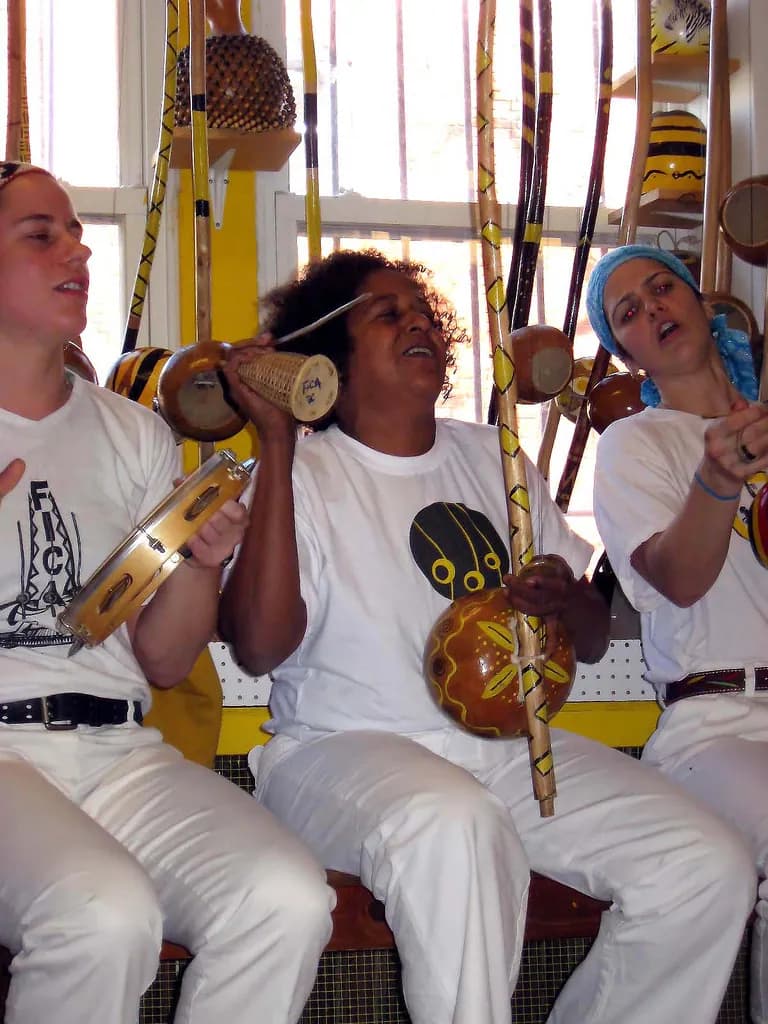
- Music at the centre: the orchestra of berimbaus, drums, and song is treated as inseparable from the game itself.
Modern Practice and Relevance
Capoeira Angola today is practised worldwide, but it occupies a particular niche as the tradition-minded wing of the art. People are drawn to it less for competition, which barely exists in it, than for its depth: the music, the philosophy, the community, and the sense of connection to Afro-Brazilian history. Its relevance to modern combat sports is indirect. You will not see many angoleiros in a cage, and the style makes no claim to be an optimised fighting method. What it offers instead is a reminder that a martial art can be a vessel for memory and identity. In an era when combat systems are constantly stripped down and pressure-tested for efficiency, Angola stands as a deliberate counterweight, valuing tradition, cunning, and cultural meaning as ends in themselves.
Technical Deep Dive
Capoeira Angola is most effective when practitioners can control the transition moments between range, rhythm, and balance. Those transition moments are where technical identity becomes visible under pressure.
A useful way to study this style is to separate visible techniques from invisible skills. The visible layer includes strikes, entries, grips, and finishes; the invisible layer includes posture management, timing discipline, and recovery decisions after failed attempts.
Strengths
- Low grounded movement, ritual, cunning, and traditional play
- Clear technical pathways that are easy to study and pressure-test
- Strong transfer into modern competition when timing and distance matter
Trade-offs
- Training quality varies widely between schools, so fundamentals matter more than labels
- Sport rules can sharpen some attributes while reducing others
- The style's original context may differ from how it is practiced today
Priority Focus
- Consistent drilling under light to medium pressure
- Testing fundamentals against resisting partners before advancing
- Building attributes from basic to complex
Coaching Notes
- Progress from cooperative drills to constrained sparring before full resistance
- Prioritize repeatable combinations and transitions over isolated highlight techniques
- Use video review to compare tactical intent with actual round behavior
- Track conditioning in relation to technical quality, not only output volume