
Martial Arts Library
Capoeira
6/18/2026 · Danny Okafor
Origin
Brazil
Primary Focus
Acrobatic kicks, deception, rhythm, and ritualized play
What It Is
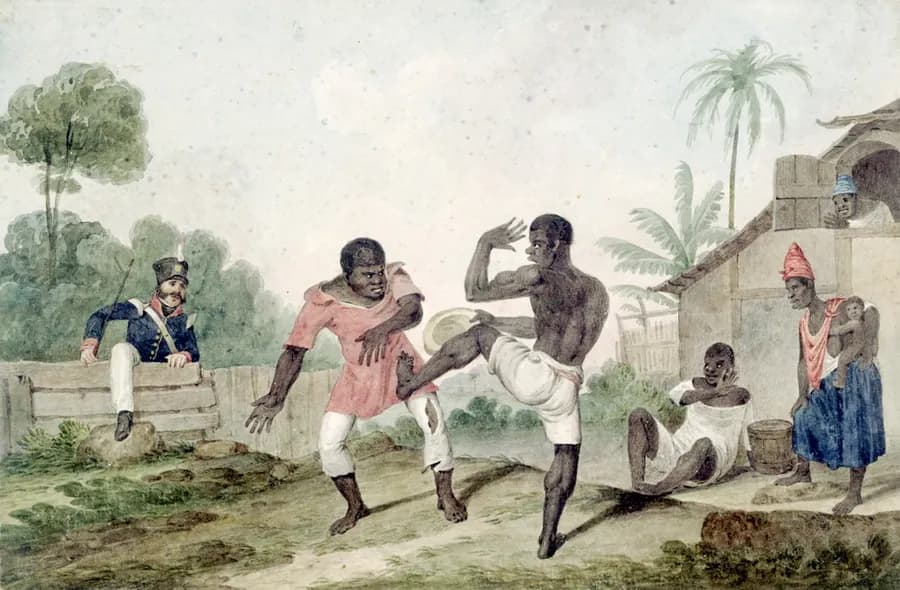
Capoeira is a Brazilian martial art that fuses sweeping kicks, evasive acrobatics, music, and song into a ritual game played inside a circle called the roda.
History Snapshot
It was forged by enslaved and free Africans in colonial Brazil, who blended fighting with dance and music so their combat training could survive under prohibition. Outlawed for decades after abolition, it was later legitimised and grew into a worldwide practice honoured as intangible cultural heritage.
What It Is
Capoeira is a Brazilian martial art that most people first encounter as something closer to a performance: two players circling low to the ground, trading spinning kicks, cartwheels, and sudden inversions while a ring of others sings, claps, and plays instruments. That impression is not wrong, but it is only half the picture. Underneath the flow is a genuine fighting game, a constant conversation of attack and escape where a swept leg or a well-timed headbutt is always a real possibility. The exchange happens inside the roda, a circle of participants, and it is driven by music, above all by the twang of the berimbau, a single-stringed bow whose rhythm dictates whether the game will be slow and cagey or fast and dangerous.
Origins and History
Capoeira's story begins in the brutal machinery of the transatlantic slave trade. From the 16th century onward, Portugal shipped enormous numbers of enslaved Africans to Brazil to work its sugar and later its coffee and mining economies. These people arrived carrying the movement, music, and combat traditions of many African cultures, particularly from West and Central Africa, and in the crucible of Brazilian slavery those traditions fused into something new. Capoeira is generally understood to have taken shape among enslaved and free Black communities during this colonial period, though the exact routes of its development are debated and poorly documented, precisely because the people who created it were denied the means to record their own history.
What is clear is the reason it wears the mask of a dance. Enslaved people were forbidden from training to fight, so the theory long held by practitioners is that combat was disguised as playful, musical movement, allowing fighters to hide their skill in plain sight. Whether every element evolved exactly that way or not, the blend of martial technique with rhythm and song became capoeira's defining feature. It also flourished in the quilombos, communities of escaped slaves, where self-defence against slave-hunters was a matter of survival.
Abolition came to Brazil in 1888, but freedom did not bring acceptance. In the years that followed, capoeira became associated in the public mind with street gangs, disorder, and the urban poor, and it was formally criminalised. For decades, practising openly could mean arrest. Capoeiristas survived by using nicknames, posting lookouts, and keeping the art underground, habits that still echo in modern practice, where nearly everyone adopts an apelido, or playing name.
Development Over Time
The turning point came in the early 20th century, largely through the work of two figures from the state of Bahia. Manoel dos Reis Machado, known as Mestre Bimba, systematised his approach into what became Capoeira Regional, adding structured teaching, gradings, and a faster, more overtly combative emphasis. In the 1930s he is credited with helping win official tolerance for the art, famously demonstrating it to Brazilian authorities and opening a recognised school. Around the same time, Mestre Pastinha championed the older, lower, more ritualistic style, Capoeira Angola, insisting on its African roots and traditional character. Between them, these two branches, one modernising, one preserving, gave capoeira the shape it carries today.
From Bahia the art spread across Brazil and, from the second half of the 20th century, out into the world, carried by touring mestres who opened schools abroad. In 2014 UNESCO recognised the capoeira circle as intangible cultural heritage, a formal acknowledgement of how far the once-outlawed practice had come.
Core Techniques and Concepts
- Ginga: the ceaseless rocking, weight-shifting base step from which everything else launches; a player is almost never still.
- Kicks and sweeps: circular, crescent, and spinning kicks like the meia-lua and armada form the core offence, aimed to flow rather than to stop.
- Esquivas: low, ducking evasions rather than blocks; capoeira answers an attack by moving under or around it.
- Acrobatics: cartwheels (aú), handstands, and inversions used to escape, reposition, and threaten from unexpected angles.
- Malícia: cunning and deception, the habit of hiding true intent behind a relaxed, playful surface.
- Music and song: the berimbau, drums, and call-and-response singing are not decoration; they set the tempo and mood of the game.
Modern Practice and Relevance
Capoeira today is practised on every continent, taught in dedicated academies and increasingly used for fitness, movement training, and cultural education. It is not a mainstream combat sport in the sense of MMA or boxing, and few practitioners treat it as a competitive fighting method. Its influence on contemporary combat sports shows up more subtly, in the occasional spinning or flying kick that a creative MMA striker borrows, and in the way its relentless movement, lateral footwork, and body awareness build athletic qualities that transfer well. But to reduce capoeira to a technique bank misses the point. Its deepest value lies in what it preserves: a living record of resistance, ingenuity, and cultural survival, wrapped inside a game that still gets played to the sound of a single vibrating string.
Technical Deep Dive
Capoeira is most effective when practitioners can control the transition moments between range, rhythm, and balance. Those transition moments are where technical identity becomes visible under pressure.
A useful way to study this style is to separate visible techniques from invisible skills. The visible layer includes strikes, entries, grips, and finishes; the invisible layer includes posture management, timing discipline, and recovery decisions after failed attempts.
In weapons-influenced systems, understanding line control and timing windows is as important as tool mechanics. Clean positioning and tactical patience often matter more than speed alone.
Strengths
- Acrobatic kicks, deception, rhythm, and ritualized play
- Clear technical pathways that are easy to study and pressure-test
- Strong transfer into modern competition when timing and distance matter
Trade-offs
- Training quality varies widely between schools, so fundamentals matter more than labels
- Sport rules can sharpen some attributes while reducing others
- The style's original context may differ from how it is practiced today
Priority Focus
- Consistent drilling under light to medium pressure
- Testing fundamentals against resisting partners before advancing
- Building attributes from basic to complex
- Develop footwork, head movement, and distance management
Coaching Notes
- Progress from cooperative drills to constrained sparring before full resistance
- Prioritize repeatable combinations and transitions over isolated highlight techniques
- Use video review to compare tactical intent with actual round behavior
- Track conditioning in relation to technical quality, not only output volume