
Martial Arts Library
Canne de Combat
6/17/2026 · Ray Coleman
Origin
France
Primary Focus
Stick striking, mobility, angle creation, and precision
What It Is
Canne de Combat is a French weapon sport fought with a light tapered cane, prizing athletic footwork, distance control, and clean, accurate strikes.
History Snapshot
It emerged from the street self-defence culture of 19th-century France, where a walking cane doubled as a respectable weapon. In the 20th century it was rescued from near-extinction and rebuilt into a codified competitive sport.
What It Is
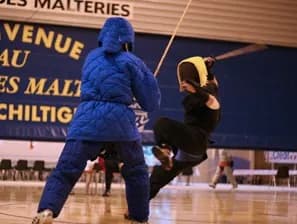
Canne de combat is a French sport fought with a light, tapered cane, usually rattan, that a skilled player can swing fast enough to make the air hiss. It is not the heavy quarterstaff work some people expect from the word "cane." The weapon is roughly a metre long and springy, and the whole game is organised around whipping strikes that arrive from wide, deceptive angles. Bouts are contested by two players in protective gear, scoring clean blows to defined target areas while staying mobile the entire time. Watch a match and the first thing that stands out is the movement: constant, bouncing, ballet-like footwork that keeps a fighter just out of range until the instant they decide to close.
Origins and History
The art belongs to a broader family of French fighting traditions that took shape in the 1800s, the same cultural soil that produced savate. It is generally traced to the streets and boulevards of 19th-century France, where a gentleman's walking stick was both an ordinary accessory and a perfectly deniable weapon. In an era when carrying a blade could mark you as a criminal but carrying a cane marked you as respectable, the walking stick became a self-defence tool of real practical value. Urban self-defence manuals of the period circulated methods for using canes and umbrellas against muggers and street toughs, and instructors in Paris taught cane work alongside boxing and savate as part of a rounded fighting education.
That practical, defensive origin matters, because it shaped the mechanics. The strikes were designed to keep a threat at distance and to land with stinging speed rather than to grapple or close in. Over the late 1800s and early 1900s the cane also acquired a sporting and demonstrative side, performed and taught within the same gymnasiums and clubs that kept savate alive. For a while French cane fighting even enjoyed a fashionable reputation among the well-to-do, who treated it as an elegant physical discipline.
Then it very nearly disappeared. The upheavals of the early 20th century, and the two world wars in particular, gutted the community of teachers and practitioners across many French martial traditions. By the mid-1900s canne de combat survived only in fragments. Its revival is usually credited to dedicated French enthusiasts working from the 1970s onward, most notably efforts associated with Maurice Sarry, who is generally recognised for gathering the surviving knowledge and reorganising it into a coherent, teachable modern sport with clear rules, scoring, and safety standards. That reconstruction is what turned a fading folk method into the structured discipline practised today.
Development Over Time
The modern codification changed the art's character in productive ways. Standardised protective equipment, a fencing-style mask, padded gloves, and body protection, made full-contact competition safe enough to spread. A defined set of legal strikes and target zones gave the sport a clear scoring logic, rewarding clean, committed blows delivered with correct form rather than flailing volume. Attacks came to be organised around a compact vocabulary of named strikes thrown to the head and flanks, each requiring a full arm extension and specific footwork to count.
As it grew, canne de combat developed a competitive circuit in France and gradually attracted practitioners elsewhere in Europe and beyond. It also kept a close relationship with its heavier cousin, the bâton, a longer two-handed stick, so that many clubs teach both. The through-line across all this development is athleticism: the modern sport leans hard into agility, cardiovascular fitness, and precision, giving it as much in common with fencing as with folk stick-fighting.
Core Techniques and Concepts
- Distance management: the entire game lives on the edge of range; players hover just outside striking distance and dart in only to attack.
- Whipping strikes: power comes from arm speed and cane flex, not muscle, so a light weapon can still land a punishing blow.
- Angle creation: strikes arrive on wide arcs from above and to the sides, and the footwork is what generates those angles.
- Guard and recovery: after every strike the cane and body must reset instantly, because a committed swing that fails to recover leaves you exposed.
- Mobility over rooting: unlike many grappling-based folk styles, the sport rewards constant movement, lunges, and quick retreats.
Modern Practice and Relevance
Today canne de combat is a niche but well-organised sport, taught in clubs mainly across France and parts of Europe, with its own federations, gradings, and tournaments. It sits comfortably alongside savate in the French martial landscape and is often trained by the same athletes. For the wider combat-sports audience it offers a valuable point of comparison: it is one of the clearest living examples of how a weapon reshapes timing, entries, and body organisation. The emphasis on measuring distance, disguising intent through footwork, and committing fully to a strike before recovering has obvious echoes in kickboxing and fencing alike. Even for fans who will never pick up a cane, it is a reminder that "traditional" and "athletic" are not opposites, and that a fighting art built around a simple stick can be every bit as refined as any empty-hand system.
Technical Deep Dive
Canne de Combat is most effective when practitioners can control the transition moments between range, rhythm, and balance. Those transition moments are where technical identity becomes visible under pressure.
A useful way to study this style is to separate visible techniques from invisible skills. The visible layer includes strikes, entries, grips, and finishes; the invisible layer includes posture management, timing discipline, and recovery decisions after failed attempts.
In striking-heavy contexts, this style rewards athletes who can maintain stance integrity while changing pace. Distance ownership, exit discipline, and defensive resets determine whether offensive output remains sustainable late in rounds.
In weapons-influenced systems, understanding line control and timing windows is as important as tool mechanics. Clean positioning and tactical patience often matter more than speed alone.
Strengths
- Stick striking, mobility, angle creation, and precision
- Clear technical pathways that are easy to study and pressure-test
- Strong transfer into modern competition when timing and distance matter
- Useful footwork, tempo control, and scoring mechanics under pressure
- Strong awareness of range, line selection, and tool-to-body integration
Trade-offs
- Training quality varies widely between schools, so fundamentals matter more than labels
- Sport rules can sharpen some attributes while reducing others
- The style's original context may differ from how it is practiced today
- Pure striking systems may need clinch and takedown defense layers for mixed-rule environments
- Weapons-based training often needs careful adaptation before it translates into sporting or self-defense contexts
Priority Focus
- Consistent drilling under light to medium pressure
- Testing fundamentals against resisting partners before advancing
- Building attributes from basic to complex
- Develop footwork, head movement, and distance management
Coaching Notes
- Progress from cooperative drills to constrained sparring before full resistance
- Prioritize repeatable combinations and transitions over isolated highlight techniques
- Use video review to compare tactical intent with actual round behavior
- Track conditioning in relation to technical quality, not only output volume
- Drill entries and exits as one unit so offense and defense stay connected