
Martial Arts Library
Brazilian Jiu-Jitsu
6/17/2026 · Sofia Marchetti
Origin
Brazil (early 20th c.), from Japanese jujutsu and judo
Primary Focus
Ground control, positional dominance, and submissions
What It Is
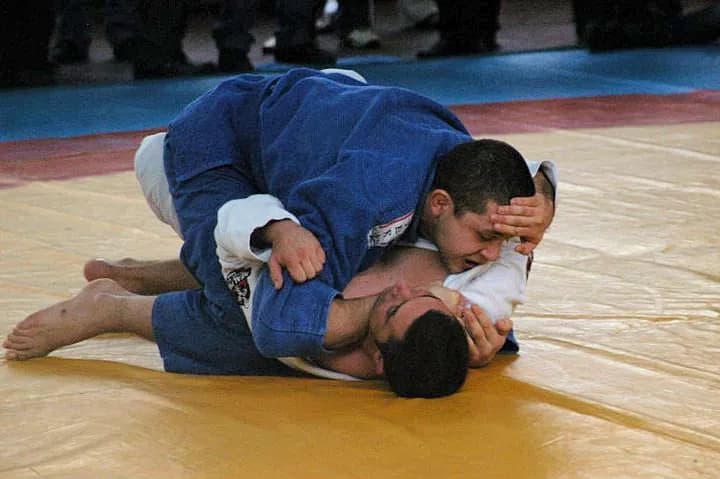
Brazilian Jiu-Jitsu is a grappling art focused on taking a fight to the ground and using leverage, position, and submissions to control and defeat an opponent.
History Snapshot
Brazilian Jiu-Jitsu grew from Japanese judo and jujutsu brought to Brazil in the early 20th century, most famously through Mitsuyo Maeda and the Gracie family, who refined a ground-focused system. Its dramatic success in early no-holds-barred contests carried it worldwide and made it a cornerstone of modern MMA.
What It Is
Brazilian Jiu-Jitsu is the art of winning a fight on the ground. Where a striker wants space, a BJJ practitioner wants to close it, take the opponent down, and then use position and leverage to control them until a submission, a choke or a joint lock, ends things. Its founding promise is that technique beats size: a smaller, weaker person who understands leverage and positioning can neutralize and defeat a bigger, stronger one who does not. That idea, proven again and again on the mat and in the cage, is what turned BJJ into one of the most influential martial arts of the last century.
Origins and History
BJJ's roots run back to Japan. Its parent art is judo, itself refined from older jujutsu by Jigoro Kano, and the crucial link between Japan and Brazil is a judoka named Mitsuyo Maeda. A skilled fighter and traveling ambassador for judo (then often still called jujutsu abroad), Maeda journeyed the world giving demonstrations and taking on challengers, and in the 1910s he settled for a time in Brazil.
There, Maeda taught a young man named Carlos Gracie, and the Gracie family became the engine of what followed. Carlos and his brothers studied and taught the art, but it was Hélio Gracie who is most associated with adapting it. Smaller and physically frailer, Hélio is generally credited with emphasizing leverage, timing, and technique over strength and athleticism, refining a game that a smaller person could use to survive and win against a larger attacker. The family's approach leaned heavily into ground fighting, guard work, and submissions, giving Brazilian Jiu-Jitsu its distinctive character.
Crucially, the Gracies proved their art in public. The tradition of the "Gracie challenge," open matches against practitioners of other styles, and the family's involvement in Brazil's no-holds-barred vale tudo ("anything goes") contests forged BJJ in real, resisting competition rather than choreography. It is worth noting that the Gracies were not the only Brazilian lineage; other branches, such as the one associated with Luiz França and Oswaldo Fadda, also developed and spread the art. But the Gracie name carried it furthest.
Development Over Time
For decades BJJ was largely a Brazilian phenomenon, but that changed dramatically in the 1990s. When members of the Gracie family helped launch the Ultimate Fighting Championship in the United States in 1993, they used it as a proving ground. Royce Gracie, deliberately chosen as a slighter competitor to make the point, defeated a series of larger opponents from other disciplines by taking them down and submitting them. To audiences who had never seen high-level ground fighting, it looked like magic, and it was a revelation: striking alone was not enough.
That moment triggered a global explosion. Grapplers everywhere rushed to learn BJJ, and the art rapidly professionalized as a sport in its own right, with a belt system, major tournaments, and international federations such as the IBJJF governing competition. It also branched into distinct forms: the traditional gi game, played gripping the jacket, and the faster no-gi style closer to what MMA uses. A rich culture of evolving guards, sweeps, and submission systems continues to push the art forward.
Core Techniques and Concepts
- Position before submission: Establish stable, dominant control before hunting the finish.
- The guard: Fighting effectively off your back, using the legs as both defense and offense.
- Positional hierarchy: Advancing through mount, back control, and side control toward better control.
- Submissions: Chokes and joint locks that force an opponent to tap out.
- Leverage over strength: Using frames, angles, and mechanics to conserve energy and beat size.
- Chaining attacks: Linking threats so that escaping one danger opens another.
Modern Practice and Relevance
Brazilian Jiu-Jitsu is now practiced worldwide, both as a competitive grappling sport and as a foundational discipline for mixed martial arts. Its influence on MMA is hard to overstate: after the early UFC, ground control and submission defense became non-negotiable skills, and no fighter can be considered complete without them. Even elite strikers spend years learning enough BJJ to survive and stand back up.
Beyond the cage, BJJ has a large following as a self-defense method and a lifelong pursuit, valued for the way live sparring ("rolling") lets practitioners test their skills at full resistance with relatively low injury risk. From a judoka's voyage to Brazil a century ago to the mats of gyms on every continent, Brazilian Jiu-Jitsu stands as one of the clearest success stories in martial arts history, and a permanent fixture of modern combat sports.
Technical Deep Dive
Brazilian Jiu-Jitsu is most effective when practitioners can control the transition moments between range, rhythm, and balance. Those transition moments are where technical identity becomes visible under pressure.
A useful way to study this style is to separate visible techniques from invisible skills. The visible layer includes strikes, entries, grips, and finishes; the invisible layer includes posture management, timing discipline, and recovery decisions after failed attempts.
In grappling-heavy contexts, the deepest competitive edge usually comes from connection quality rather than move count. Hand-fighting, shoulder pressure, and angle denial often decide outcomes before obvious scoring actions appear.
Strengths
- Ground control, positional dominance, and submissions
- Clear technical pathways that are easy to study and pressure-test
- Strong transfer into modern competition when timing and distance matter
- Reliable clinch and control structures that reward leverage over raw strength
Trade-offs
- Training quality varies widely between schools, so fundamentals matter more than labels
- Sport rules can sharpen some attributes while reducing others
- The style's original context may differ from how it is practiced today
- Ground-heavy systems can be harder to apply against strong anti-grappling or striking-heavy opponents without cross-training
Priority Focus
- Consistent drilling under light to medium pressure
- Testing fundamentals against resisting partners before advancing
- Building attributes from basic to complex
- Practice position control and transitions before submissions
Coaching Notes
- Progress from cooperative drills to constrained sparring before full resistance
- Prioritize repeatable combinations and transitions over isolated highlight techniques
- Use video review to compare tactical intent with actual round behavior
- Track conditioning in relation to technical quality, not only output volume
- Build positional chains first, then layer submissions once control is consistent