
Martial Arts Library
Boxing
6/17/2026 · Ray Coleman
Origin
Ancient Mediterranean roots; codified in 18th–19th c. England
Primary Focus
Punching, movement, defense, and ring control
What It Is
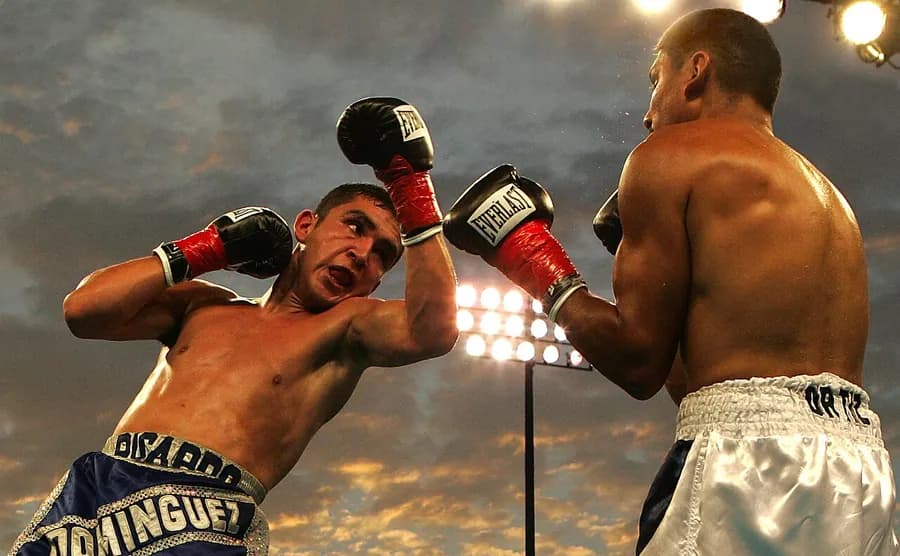
Boxing is a combat sport in which two fighters, using only their fists, trade punches while managing distance, defense, and ring position.
History Snapshot
Fist-fighting is ancient, appearing in Mediterranean antiquity and the early Olympic Games, but modern boxing was codified in England through bare-knuckle prizefighting and later the gloved Marquess of Queensberry rules. From there it grew into one of the world's most popular and influential combat sports.
What It Is
Boxing is fighting stripped down to its most elemental form: two people, two fists, and the space between them. Fighters throw jabs, crosses, hooks, and uppercuts while slipping, blocking, and moving to avoid taking the same in return. It is often called the "sweet science" because, for all its raw violence, high-level boxing is a chess match of feints, angles, and timing. No kicks, no grappling, just the endlessly deep problem of how to hit without being hit.
Origins and History
People have been settling matters with their fists for as long as there have been people, and organized fist-fighting is genuinely ancient. It appears in the art and records of the old Mediterranean world, from Egypt and Mesopotamia to Greece, where boxing was part of the ancient Olympic Games (introduced, by tradition, in the 7th century BC). Greek and later Roman boxers fought with leather thongs wrapped around their hands, and the Roman version in particular could be brutal. With the decline of the classical world, organized boxing largely faded in Europe for centuries.
Modern boxing was born in England. In the 18th century, bare-knuckle prizefighting became a hugely popular spectacle, and it began to acquire structure. James Figg is often remembered as an early champion who did much to popularize the sport in the 1710s and 1720s. A generation later, the champion Jack Broughton introduced an early set of rules (Broughton's Rules, 1743) in an effort to make the brutal contests somewhat safer and more regulated, an important first step toward a real rulebook.
Over the following century the sport ran on codes such as the London Prize Ring Rules, which governed bare-knuckle bouts fought on the turf. But the transformation that produced boxing as we know it came in 1867 with the Marquess of Queensberry Rules. Drafted with the involvement of John Graham Chambers and lending the Marquess of Queensberry's name and endorsement, these rules mandated padded gloves, three-minute rounds, the ten-second count, and a ban on wrestling holds. They effectively created the modern gloved sport.
Development Over Time
The shift from bare knuckles to gloves changed everything about how boxing was fought. Bare-knuckle bouts, oddly, discouraged repeated hard headshots because unprotected hands break easily against skulls, and matches could grind on for dozens of rounds with wrestling throws allowed. Gloves, rounds, and the Queensberry framework encouraged a faster, more technical style built on combinations, head movement, and footwork. The legendary John L. Sullivan straddled the eras, remembered as the last great bare-knuckle heavyweight champion and an early star of the gloved game.
Through the 20th century boxing became a global phenomenon and produced a succession of golden ages, weight divisions, and world-famous champions. Sanctioning bodies, title lineages, and the sport's deep amateur system (including its enduring place in the Olympics) turned it into one of the most widely practiced and watched combat sports on earth, as well as a fixture of film, literature, and popular culture.
Core Techniques and Concepts
- Footwork first: Balance, stance, and movement create every angle for offense and defense.
- The jab: The lead-hand punch that controls range and tempo and sets up everything else.
- Power punches: The cross, hook, and uppercut that end fights when they land clean.
- Defensive layers: Guards, slips, rolls, blocks, and pivots stacked to avoid clean shots.
- Combinations: Punches thrown in sequence to overwhelm and open defenses.
- Ring generalship: Using positioning to cut off space and force opponents into bad exchanges.
Modern Practice and Relevance
Boxing remains one of the world's premier combat sports in its own right, from packed professional arenas to the Olympic amateur ranks and the fitness boxing found in gyms everywhere. Its appeal endures because the fundamental problem it poses, hit and don't get hit, never gets old.
Its influence on other combat sports is enormous. Boxing's hand technique, timing, and head movement form the striking backbone of kickboxing and, crucially, MMA, where clean punching and defensive footwork routinely separate the elite from the merely tough. Nearly every serious mixed martial artist trains boxing in some form, and its principles of distance and timing translate across nearly every striking ruleset. More than three centuries after English prizefighters first laced up, boxing is still the foundational school of striking.
Technical Deep Dive
Boxing is most effective when practitioners can control the transition moments between range, rhythm, and balance. Those transition moments are where technical identity becomes visible under pressure.
A useful way to study this style is to separate visible techniques from invisible skills. The visible layer includes strikes, entries, grips, and finishes; the invisible layer includes posture management, timing discipline, and recovery decisions after failed attempts.
In striking-heavy contexts, this style rewards athletes who can maintain stance integrity while changing pace. Distance ownership, exit discipline, and defensive resets determine whether offensive output remains sustainable late in rounds.
In weapons-influenced systems, understanding line control and timing windows is as important as tool mechanics. Clean positioning and tactical patience often matter more than speed alone.
Strengths
- Punching, movement, defense, and ring control
- Clear technical pathways that are easy to study and pressure-test
- Strong transfer into modern competition when timing and distance matter
- Useful footwork, tempo control, and scoring mechanics under pressure
Trade-offs
- Training quality varies widely between schools, so fundamentals matter more than labels
- Sport rules can sharpen some attributes while reducing others
- The style's original context may differ from how it is practiced today
- Pure striking systems may need clinch and takedown defense layers for mixed-rule environments
Priority Focus
- Consistent drilling under light to medium pressure
- Testing fundamentals against resisting partners before advancing
- Building attributes from basic to complex
- Develop footwork, head movement, and distance management
Coaching Notes
- Progress from cooperative drills to constrained sparring before full resistance
- Prioritize repeatable combinations and transitions over isolated highlight techniques
- Use video review to compare tactical intent with actual round behavior
- Track conditioning in relation to technical quality, not only output volume
- Drill entries and exits as one unit so offense and defense stay connected