
Martial Arts Library
Bokh
6/17/2026 · Marcus Delgado
Origin
Mongolia
Primary Focus
Standing grappling, balance-breaking, and decisive takedowns
What It Is
Bokh is the traditional wrestling of Mongolia, an upright grappling contest won by forcing an opponent to touch the ground with anything above the knee.
History Snapshot
Bokh is generally understood to be centuries old, bound up with the nomadic warrior culture of the Mongolian steppe and celebrated as one of the country's cherished 'three manly games.' It remains a pillar of national identity and a proven foundation for modern combat athletes.
What It Is
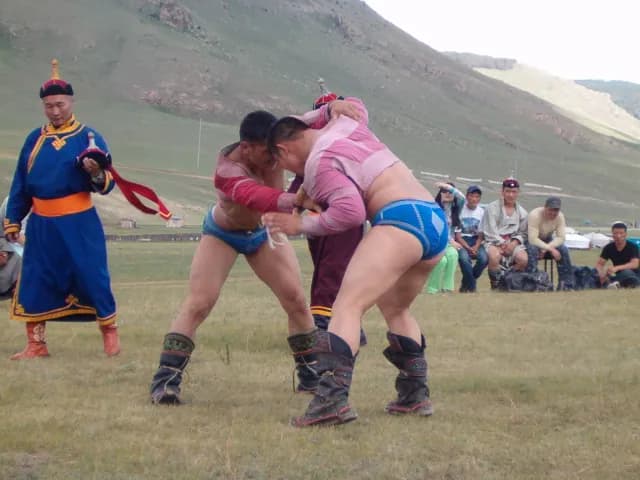
Bokh is Mongolian wrestling, and it is about as pure a grappling contest as exists. There is no ground game, no rounds, and in its traditional form no weight classes: two wrestlers grip up standing and try to break each other's balance until one is thrown. The rule that defines everything is simple, though the exact standard varies by regional style, a wrestler loses if any part of the body above the knee (in some styles, the elbow or anything but the feet) touches the earth. That makes Bokh a relentless battle for standing dominance, where the whole art is in the grips, the posture, and the moment the balance finally goes.
Origins and History
Bokh is old. Exactly how old is not something anyone can state with precision, and reliable accounts describe it as developing over many centuries rather than pinning it to a founding date. What is clear is that it is inseparable from the nomadic culture of the Mongolian steppe, where physical toughness, horsemanship, and combat readiness were survival skills, not hobbies.
Wrestling fit naturally into that world. It required no equipment beyond open ground and two willing people, it tested strength and balance directly, and it made an ideal way to keep fighting men conditioned. It is widely held that the armies of the great Mongol empire used wrestling to keep soldiers fit and to test and select strong men, and while the finer details of that tradition are the stuff of legend as much as record, the association between Bokh and Mongolia's martial heritage runs very deep.
Over time Bokh became far more than training. It stands as one of the "three manly games" of Mongolia, alongside horse racing and archery, the trio of traditional contests at the heart of the Naadam festival. Naadam is the great national celebration of these skills, and its wrestling tournaments are surrounded by ceremony: the eagle dance (devekh) that wrestlers perform as they enter and exit, the open-fronted jacket (zodog) and briefs (shuudag) that make up the traditional dress, and the titles that top wrestlers earn through repeated victories. Through Naadam, Bokh became a public celebration of prestige and national pride.
Development Over Time
Because Mongolia and the surrounding regions are large and historically dispersed, Bokh developed regional variations rather than a single uniform code, differing in dress, rules about what counts as a fall, and ritual. The Khalkha Mongolian tradition and the styles found among Mongols in Inner Mongolia, for example, are related but not identical. What unites them is the upright, grip-based character and the emphasis on decisive standing throws.
For most of its history Bokh was transmitted through community, festival, and family, a living tradition passed down by doing rather than by manual. That continuity is a large part of why it survives so robustly today, still central to Naadam and still a marker of status and manhood in Mongolian culture.
Core Techniques and Concepts
- Grip fighting: Securing dominant holds on the opponent's jacket, arms, or body to control the exchange.
- Balance-breaking: Off-balancing the opponent (kuzushi, in grappling terms generally) as the setup for every throw.
- Posture and base: Maintaining a strong, stable structure so you cannot be easily unseated.
- Trips and throws: Leg trips, lifts, and body throws that put the opponent on the ground.
- Standing dominance: Winning the positional battle on the feet, since there is no ground phase to fall back on.
- Ritual and bearing: The ceremony and carriage that frame the sport as a test of character, not just strength.
Modern Practice and Relevance
Bokh remains a living, thriving sport in Mongolia, and its cultural importance has not faded. But its relevance to global combat sports is what makes it especially striking. Mongolia has produced a remarkable number of elite grapplers on the world stage, and the deep national wrestling culture that Bokh represents is often credited as the foundation. Mongolian athletes have excelled in international judo, and Mongolian wrestlers famously rose to the very top of Japanese professional sumo, dominating its highest ranks in the modern era.
That track record is no accident. A culture that prizes standing grappling, balance, and takedown authority builds exactly the attributes that transfer to judo, sumo, and the wrestling exchanges of modern MMA. For fans trying to understand why a relatively small nation punches so far above its weight in grappling, Bokh is a large part of the answer, an ancient art quietly feeding some of the best combat athletes in the world.
Technical Deep Dive
Bokh is most effective when practitioners can control the transition moments between range, rhythm, and balance. Those transition moments are where technical identity becomes visible under pressure.
A useful way to study this style is to separate visible techniques from invisible skills. The visible layer includes strikes, entries, grips, and finishes; the invisible layer includes posture management, timing discipline, and recovery decisions after failed attempts.
In grappling-heavy contexts, the deepest competitive edge usually comes from connection quality rather than move count. Hand-fighting, shoulder pressure, and angle denial often decide outcomes before obvious scoring actions appear.
In weapons-influenced systems, understanding line control and timing windows is as important as tool mechanics. Clean positioning and tactical patience often matter more than speed alone.
Strengths
- Standing grappling, balance-breaking, and decisive takedowns
- Clear technical pathways that are easy to study and pressure-test
- Strong transfer into modern competition when timing and distance matter
- Reliable clinch and control structures that reward leverage over raw strength
Trade-offs
- Training quality varies widely between schools, so fundamentals matter more than labels
- Sport rules can sharpen some attributes while reducing others
- The style's original context may differ from how it is practiced today
- Ground-heavy systems can be harder to apply against strong anti-grappling or striking-heavy opponents without cross-training
Priority Focus
- Consistent drilling under light to medium pressure
- Testing fundamentals against resisting partners before advancing
- Building attributes from basic to complex
- Practice position control and transitions before submissions
Coaching Notes
- Progress from cooperative drills to constrained sparring before full resistance
- Prioritize repeatable combinations and transitions over isolated highlight techniques
- Use video review to compare tactical intent with actual round behavior
- Track conditioning in relation to technical quality, not only output volume
- Build positional chains first, then layer submissions once control is consistent