
Martial Arts Library
Bojutsu
6/17/2026 · Kenji Watanabe
Origin
Japan and Okinawa
Primary Focus
Staff striking, thrusting, and range management
What It Is
Bojutsu is the martial art of fighting with the bo, a long wooden staff, emphasizing distance control, leverage, and rotational striking power.
History Snapshot
Bojutsu developed within Japanese and Okinawan martial traditions, where the staff served as both an accessible everyday tool and a serious weapon. It was preserved through classical schools and Okinawan kobudo, and remains a foundational weapon discipline today.
What It Is
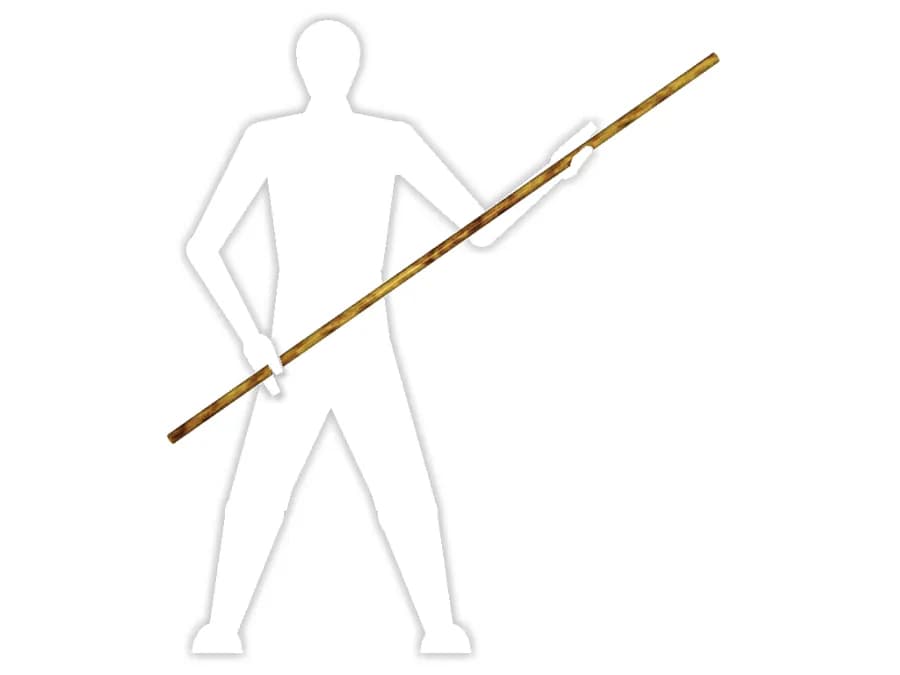
Bojutsu is the art of fighting with a staff. The core weapon is the bo, most commonly a wooden pole around six feet long (the rokushakubo), plain, unglamorous, and deceptively hard to master. There is no edge and no point, just length, weight, and the skill of the person wielding it. That simplicity is the whole appeal. A staff has no moving parts and hides nothing, so everything comes down to timing, distance, leverage, and how well the practitioner can move both ends of the weapon at once. Done well, bojutsu turns an ordinary pole into a blur of thrusts, strikes, and blocks that controls the space around the wielder.
Origins and History
The staff is one of humanity's oldest weapons, which makes any staff art hard to trace to a single origin. Bojutsu, as an organized discipline, is best understood as having grown up within two overlapping martial cultures: classical Japan and Okinawa.
In Japan, the staff was part of the broad weapon curriculum of the old warrior traditions. Many classical schools (koryu) that centered on the sword or spear also preserved staff techniques, because a versatile fighter needed to handle whatever came to hand, and because a long pole was cheap, legal, and everywhere. The bo, along with shorter staffs like the jo, became a standard part of that weapon vocabulary. Precise lineages vary from school to school, and the details are best left to each tradition's own records rather than flattened into one story.
In Okinawa, the staff took on special importance as part of kobudo, the islands' weapon arts. Okinawan tradition strongly associates the bo and its companion weapons with tools of everyday and agricultural life, and a popular narrative holds that commoners developed these arts because they were restricted from carrying conventional weapons. Historians treat parts of that story with some caution, and the truth is likely more complex, but what is not in doubt is that Okinawa preserved a rich, sophisticated body of staff technique that survives to this day. The bo sits at the heart of the Okinawan kobudo curriculum.
Development Over Time
For generations, bojutsu was transmitted the traditional way: through forms (kata), partner drills, and the close relationship between teacher and student within a specific school. Because the staff was so widely useful, it never became the property of any single system, and distinct approaches developed side by side across both Japanese koryu and Okinawan kobudo.
As Okinawan karate spread across the world in the twentieth century, its weapon arts often traveled with it, and many karate practitioners came to study the bo as a natural extension of their empty-hand training, since the body mechanics, stances, and footwork carry over. Classical Japanese staff traditions, meanwhile, have been preserved by dedicated schools focused on maintaining their methods faithfully. Between the two currents, bojutsu has stayed alive as a living discipline rather than a museum piece.
Core Techniques and Concepts
- Range management: Using the staff's length to control distance and keep threats at bay.
- Thrusts and strikes: Driving thrusts down the line and swinging strikes that use the full arc of the weapon.
- Rotational power: Generating force through spinning and rolling actions of the staff.
- Grip and sliding: Shifting the hands along the shaft to change reach, leverage, and which end is live.
- Blocking and redirection: Positioning the staff to parry and deflect incoming attacks.
- Whole-body mechanics: Powering the weapon from the stance and hips rather than the arms alone.
Modern Practice and Relevance
Bojutsu today is practiced mainly as a traditional weapon art, preserved within Okinawan kobudo, classical Japanese schools, and many karate systems that keep it as part of their curriculum. It is not a full-contact combat sport, and no one carries a six-foot staff for self-defense, so its value has shifted toward what it teaches rather than what it delivers in a cage.
That teaching value is real. Staff work sharpens timing, distance awareness, footwork, and the coordination of both hands doing different jobs at once, all transferable athletic qualities. For students of striking arts, the bo is also an excellent lens on how weapon range differs from empty-hand range: the mechanics of controlling a long tool reward precision and structure in a way that punches and kicks alone do not. As a piece of martial heritage and a demanding physical discipline, bojutsu remains one of the most respected weapon arts to come out of Japan and Okinawa.
Technical Deep Dive
Bojutsu is most effective when practitioners can control the transition moments between range, rhythm, and balance. Those transition moments are where technical identity becomes visible under pressure.
A useful way to study this style is to separate visible techniques from invisible skills. The visible layer includes strikes, entries, grips, and finishes; the invisible layer includes posture management, timing discipline, and recovery decisions after failed attempts.
In striking-heavy contexts, this style rewards athletes who can maintain stance integrity while changing pace. Distance ownership, exit discipline, and defensive resets determine whether offensive output remains sustainable late in rounds.
In weapons-influenced systems, understanding line control and timing windows is as important as tool mechanics. Clean positioning and tactical patience often matter more than speed alone.
Strengths
- Staff striking, thrusting, and range management
- Clear technical pathways that are easy to study and pressure-test
- Strong transfer into modern competition when timing and distance matter
- Strong awareness of range, line selection, and tool-to-body integration
Trade-offs
- Training quality varies widely between schools, so fundamentals matter more than labels
- Sport rules can sharpen some attributes while reducing others
- The style's original context may differ from how it is practiced today
- Weapons-based training often needs careful adaptation before it translates into sporting or self-defense contexts
Priority Focus
- Consistent drilling under light to medium pressure
- Testing fundamentals against resisting partners before advancing
- Building attributes from basic to complex
- Develop footwork, head movement, and distance management
Coaching Notes
- Progress from cooperative drills to constrained sparring before full resistance
- Prioritize repeatable combinations and transitions over isolated highlight techniques
- Use video review to compare tactical intent with actual round behavior
- Track conditioning in relation to technical quality, not only output volume
- Drill entries and exits as one unit so offense and defense stay connected