
Martial Arts Library
Bo Staff (Bojutsu)
6/18/2026 · Priya Nair
Origin
Okinawa (Ryukyu Islands)
Primary Focus
Staff control, reach, spinning technique, and footwork
What It Is
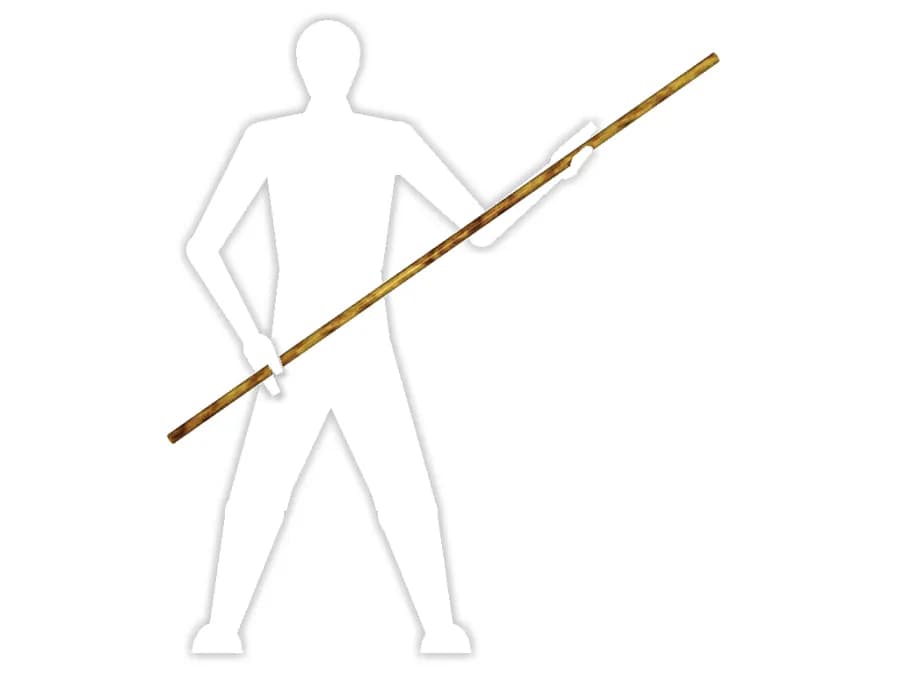
The bo staff is a long wooden pole used as a weapon in Okinawan kobudo, and bojutsu is the art of wielding it for reach, leverage, and defensive control.
History Snapshot
The bo staff became a central weapon of Okinawan kobudo, the islands' tradition of weapon arts, where a simple pole offered reach and defensive power. Its techniques were preserved through kata and passed down alongside karate, and today it thrives in traditional practice and demonstration.
What It Is
The bo is a long wooden staff, typically about six feet in length, and the bo staff arts are the martial systems built around wielding it. The most common form, the rokushakubo, is tapered or uniform hardwood, and in trained hands it becomes a weapon of impressive reach and control. Bojutsu, the art of the staff, is closely tied to Okinawan kobudo, the weapon tradition that grew up alongside Okinawan karate. What looks like a plain pole is, in practice, one of the most technically demanding weapons to master, because its power comes entirely from leverage, timing, and the coordination of both hands.
Origins and History
The bo's story is deeply rooted in Okinawa, the chain of islands that was once the independent Ryukyu Kingdom before becoming part of Japan. Okinawa is the cradle of both modern karate and kobudo, and the bo sits at the center of the latter.
A popular and often-repeated narrative holds that the Okinawan weapon arts arose because commoners, forbidden to carry conventional weapons, adapted everyday farming and household tools for self-defense, and that the bo grew out of the poles used to carry loads or work the fields. It is a compelling story, and there is truth in the connection between kobudo weapons and everyday tools. Historians, however, treat the tidy "peasants versus weapon bans" version with some caution, since the real social history was more complicated and the arts were also cultivated by people of higher standing. What is not in doubt is that Okinawa preserved an unusually rich body of staff technique, and that the bo became the flagship weapon of its kobudo systems.
Whatever its precise social origins, the staff had obvious appeal. It was cheap, legal, and available everywhere; it offered reach that could hold off a shorter weapon; and its blunt versatility made it forgiving to learn but deep to master. Okinawan masters developed detailed systems of kata (forms) that encoded the techniques, and these were passed carefully from teacher to student.
Development Over Time
Bo technique was preserved and transmitted primarily through kata and partner practice within specific kobudo lineages. As Okinawan karate spread to mainland Japan and then across the world in the twentieth century, its weapon arts frequently traveled alongside it, and many karateka took up the bo as a natural companion to their empty-hand training. The stances, footwork, and hip-driven power of karate carry over directly to the staff, which is one reason the two arts pair so naturally.
In recent decades the bo has also found a home in the world of martial arts demonstration and competition. Lighter staffs and flashy spinning routines became a staple of open-tournament forms and the extreme martial arts (XMA) scene, where the emphasis shifts toward speed and spectacle. That modern performance branch sits alongside the traditional kobudo practice, which continues to prize the staff as a serious weapon art rather than a showpiece.
Core Techniques and Concepts
- Reach advantage: Using the staff's length to strike and defend from outside an opponent's range.
- Strikes and thrusts: Swinging blows delivered along the staff's arc and straight thrusts driven down its line.
- Spinning and rotation: Twirling movements that build momentum and flow between offense and defense.
- Grip and sliding hands: Shifting the hands along the shaft to change reach and bring either end to bear.
- Footwork and distance: Movement that preserves the range advantage and opens angles of attack.
- Blocking and parrying: Positioning the staff to intercept and redirect incoming strikes.
Modern Practice and Relevance
Today the bo staff lives in two overlapping worlds: traditional Okinawan kobudo, where it is studied as a genuine weapon art with centuries of technique behind it, and the modern demonstration and competition circuit, where spinning bo forms are a crowd favorite. Many karate schools include bo training as part of a well-rounded curriculum.
As a practical fighting weapon, the bo has little place in the age of modern combat sports, but its training rewards are real. Working the staff sharpens coordination, timing, footwork, and the ability to make both hands cooperate on a single task, all qualities that carry over to other athletic and martial pursuits. It also offers a clear, tangible lesson in how weapon range differs from empty-hand fighting, since controlling six feet of wood forces a precision and structure that punching and kicking alone never demand. As both cultural heritage and physical discipline, the bo remains one of the most recognizable and rewarding weapon arts in the world.
Technical Deep Dive
Bo Staff (Bojutsu) is most effective when practitioners can control the transition moments between range, rhythm, and balance. Those transition moments are where technical identity becomes visible under pressure.
A useful way to study this style is to separate visible techniques from invisible skills. The visible layer includes strikes, entries, grips, and finishes; the invisible layer includes posture management, timing discipline, and recovery decisions after failed attempts.
In striking-heavy contexts, this style rewards athletes who can maintain stance integrity while changing pace. Distance ownership, exit discipline, and defensive resets determine whether offensive output remains sustainable late in rounds.
In weapons-influenced systems, understanding line control and timing windows is as important as tool mechanics. Clean positioning and tactical patience often matter more than speed alone.
Strengths
- Staff control, reach, spinning technique, and footwork
- Clear technical pathways that are easy to study and pressure-test
- Strong transfer into modern competition when timing and distance matter
- Strong awareness of range, line selection, and tool-to-body integration
Trade-offs
- Training quality varies widely between schools, so fundamentals matter more than labels
- Sport rules can sharpen some attributes while reducing others
- The style's original context may differ from how it is practiced today
- Weapons-based training often needs careful adaptation before it translates into sporting or self-defense contexts
Priority Focus
- Consistent drilling under light to medium pressure
- Testing fundamentals against resisting partners before advancing
- Building attributes from basic to complex
Coaching Notes
- Progress from cooperative drills to constrained sparring before full resistance
- Prioritize repeatable combinations and transitions over isolated highlight techniques
- Use video review to compare tactical intent with actual round behavior
- Track conditioning in relation to technical quality, not only output volume