
Martial Arts Library
Bartitsu
6/17/2026 · Sofia Marchetti
Origin
England (London, late 19th c.)
Primary Focus
Hybrid self-defense blending striking, grappling, and cane work
What It Is
Bartitsu is a Victorian-era English self-defense system that deliberately combined Japanese jujitsu, boxing, French savate, and cane fighting for practical urban protection.
History Snapshot
Bartitsu was created in late-1890s London by engineer Edward William Barton-Wright, who fused fighting methods he had encountered at home and abroad into a single self-defense curriculum. Though his club closed within a few years, the system was rediscovered a century later and now stands as a landmark of early cross-training.
What It Is
Bartitsu is arguably the first martial art built the way a modern fight camp thinks: take the best tools from several different systems and train them together for one practical purpose. In its case, that purpose was self-defense for the Victorian city dweller, the gentleman or lady who might have to fend off a mugger on a foggy London street. The answer was a hybrid, mixing Japanese jujitsu, English boxing, French savate kicking, and a sophisticated method of fighting with a walking cane. More than a century before "MMA" entered the vocabulary, Bartitsu was already arguing that no single style has all the answers.
Origins and History
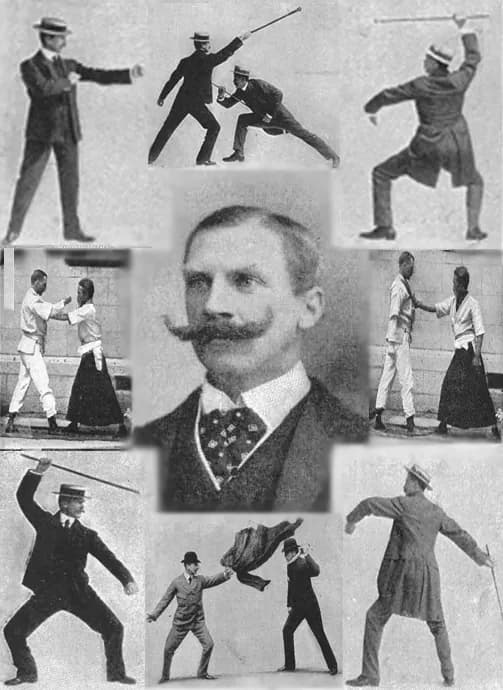
Bartitsu has a clear creator: Edward William Barton-Wright, a British engineer born in 1860. His profession took him around the world, and crucially it took him to Japan in the 1890s, where he studied jujitsu. Returning to London around 1898, he combined "Barton" with "jujitsu" to coin the name Bartitsu, and began promoting his new system through articles in popular magazines, complete with photographs of throws, holds, and cane defenses that fascinated the Victorian public.
Barton-Wright's real innovation was less any single technique than his organizing idea. He argued openly that a person should be able to defend themselves at every range, striking at distance, kicking, clinching and throwing up close, and using an everyday object like a cane as a weapon, and that this required borrowing from more than one tradition. To deliver it, around 1900 he opened the Bartitsu Club in Soho, London, and did something genuinely forward-thinking: he imported expert instructors in each discipline rather than pretending to teach everything himself.
Among those instructors were Japanese jujitsu experts including the young Yukio Tani and Sadakazu Uyenishi, and the Swiss master Pierre Vigny, who taught his own refined system of stick and umbrella fighting. The club became a small hub of martial exchange, unusual for its time in bringing Eastern and Western fighting arts under one roof.
Development Over Time
Bartitsu's first life was short. The Bartitsu Club closed around 1902, and Barton-Wright, never a great businessman, drifted out of the spotlight; his system faded from public memory for most of the twentieth century. But its instructors carried pieces of it onward. Tani and others helped fuel a wave of enthusiasm for jujitsu in Britain, and the Vigny cane method survived in various forms. So even after the parent system dissolved, its components kept circulating.
The word itself got an unexpected boost from fiction. When Arthur Conan Doyle had Sherlock Holmes credit "baritsu" for defeating Moriarty, he almost certainly meant Bartitsu, and that misspelled reference kept a ghost of the name alive for generations of readers. It was partly through that literary thread that later researchers traced their way back to Barton-Wright's real system.
The genuine revival came in the late twentieth and early twenty-first centuries, when martial arts historians and enthusiasts rediscovered Barton-Wright's original articles and began reconstructing the art from them. A dedicated community, sometimes organized as the Bartitsu Society, now studies and practices it as a form of historical martial arts.
Core Techniques and Concepts
- Range versatility: A deliberate toolkit for striking distance, kicking, and grappling range.
- Jujitsu grappling: Throws, locks, and off-balancing drawn from the Japanese methods Barton-Wright studied.
- Boxing and savate: Western punches and French kicks for stand-up exchanges.
- Cane and stick fighting: The Vigny method, turning an ordinary walking stick into a defensive weapon.
- Everyday-object mindset: Treating carried items as tools, an early form of practical self-defense thinking.
- Cross-training principle: The core idea that no single art is complete on its own.
Modern Practice and Relevance
Today Bartitsu lives mainly as a historical martial art, studied by enthusiasts who reconstruct its techniques from period sources and enjoy its distinctly Victorian flavor, cane, tweed, and all. It has also found a natural home in the steampunk and neo-Victorian subcultures, and its Sherlock Holmes connection gives it enduring appeal.
Its deeper relevance to combat sports is conceptual and surprisingly modern. Bartitsu is a documented, century-old proof that the mixed-method thinking behind MMA is not new. Barton-Wright understood that fights happen at different ranges, that different tools suit different moments, and that importing specialist coaches beats faking expertise, all instincts that a contemporary fight team would recognize instantly. For anyone interested in where the idea of cross-training comes from, Bartitsu is one of history's most charming and instructive answers.
Technical Deep Dive
Bartitsu is most effective when practitioners can control the transition moments between range, rhythm, and balance. Those transition moments are where technical identity becomes visible under pressure.
A useful way to study this style is to separate visible techniques from invisible skills. The visible layer includes strikes, entries, grips, and finishes; the invisible layer includes posture management, timing discipline, and recovery decisions after failed attempts.
In grappling-heavy contexts, the deepest competitive edge usually comes from connection quality rather than move count. Hand-fighting, shoulder pressure, and angle denial often decide outcomes before obvious scoring actions appear.
In striking-heavy contexts, this style rewards athletes who can maintain stance integrity while changing pace. Distance ownership, exit discipline, and defensive resets determine whether offensive output remains sustainable late in rounds.
In weapons-influenced systems, understanding line control and timing windows is as important as tool mechanics. Clean positioning and tactical patience often matter more than speed alone.
Strengths
- Hybrid self-defense blending striking, grappling, and cane work
- Clear technical pathways that are easy to study and pressure-test
- Strong transfer into modern competition when timing and distance matter
- Reliable clinch and control structures that reward leverage over raw strength
- Useful footwork, tempo control, and scoring mechanics under pressure
- Strong awareness of range, line selection, and tool-to-body integration
Trade-offs
- Training quality varies widely between schools, so fundamentals matter more than labels
- Sport rules can sharpen some attributes while reducing others
- The style's original context may differ from how it is practiced today
- Ground-heavy systems can be harder to apply against strong anti-grappling or striking-heavy opponents without cross-training
- Pure striking systems may need clinch and takedown defense layers for mixed-rule environments
- Weapons-based training often needs careful adaptation before it translates into sporting or self-defense contexts
Priority Focus
- Consistent drilling under light to medium pressure
- Testing fundamentals against resisting partners before advancing
- Building attributes from basic to complex
- Develop footwork, head movement, and distance management
- Practice position control and transitions before submissions
Coaching Notes
- Progress from cooperative drills to constrained sparring before full resistance
- Prioritize repeatable combinations and transitions over isolated highlight techniques
- Use video review to compare tactical intent with actual round behavior
- Track conditioning in relation to technical quality, not only output volume
- Build positional chains first, then layer submissions once control is consistent
- Drill entries and exits as one unit so offense and defense stay connected