
Martial Arts Library
Baritsu
6/18/2026 · Ray Coleman
Origin
England (literary origin, 1903; rooted in the real Bartitsu)
Primary Focus
Grappling and leverage, filtered through fiction and later recreation
What It Is
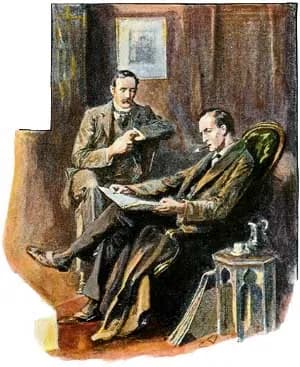
Baritsu is the near-legendary martial art named in the Sherlock Holmes stories, a misspelling of the real Victorian system Bartitsu that took on its own mystique.
History Snapshot
Baritsu entered the language when Arthur Conan Doyle had Sherlock Holmes credit 'baritsu' for his survival against Professor Moriarty. The word is almost certainly a garbling of Bartitsu, a genuine 1890s London self-defense system, and its fame has since inspired real recreation efforts.
What It Is
Baritsu is one of the most famous martial arts that never quite existed. It is the fighting method Sherlock Holmes credits with saving his life, the trick that let him send Professor Moriarty tumbling into the Reichenbach Falls while walking away himself. Readers have puzzled over the word for more than a century, because there was no established art called "baritsu." What there was, and this is the heart of the story, was a very real Victorian system called Bartitsu, and "baritsu" is almost universally understood to be a misspelling of it that escaped into legend.
So Baritsu occupies a strange dual identity: a piece of detective fiction, and a distorted echo of a genuine historical martial art.
Origins and History
The word appears in Arthur Conan Doyle's "The Adventure of the Empty House," published in 1903. In it, a very-much-alive Holmes explains to a stunned Watson how he had survived the struggle at the falls years earlier, saying he had some knowledge of "baritsu, the Japanese system of wrestling," which allowed him to slip Moriarty's grip at the crucial moment. (The earlier story that staged the confrontation, "The Final Problem," had described the fight but never named the method.)
Where did Doyle get the word? The most widely accepted explanation is that he was recalling Bartitsu, the eclectic self-defense system that the engineer Edward William Barton-Wright had recently introduced in London, and that either Doyle or a typesetter dropped the first "t." Bartitsu had been written about in the popular press of the late 1890s and early 1900s, so it would have been fresh in the cultural air when Doyle was writing Holmes's return. Whether the error was Doyle's own memory or a printing slip is not something anyone can state with certainty, and honest accounts leave it as an open question.
What is certain is the consequence. Because the Holmes stories were so widely read, the misspelling became more famous than the correct original. For decades "baritsu" floated as a tantalizing, half-mythical word, its real-world source largely forgotten, which only deepened its mystique.
Development Over Time
For most of the twentieth century Baritsu lived purely in the world of Sherlockiana. Devoted readers of the canon treated the word as one of its enduring little mysteries, debating what Holmes could possibly have meant and whether any real art lay behind it. It became a favorite puzzle for enthusiasts precisely because it sat at the seam between fiction and fact.
The connection to Bartitsu was eventually re-established by researchers and martial arts historians, and interest in the real system revived in the late twentieth and early twenty-first centuries. That revival gave "baritsu" a second life. Modern enthusiasts, sometimes drawn in through the Holmes stories themselves, have reconstructed period self-defense methods from surviving manuals and articles. In that sense the fictional word has helped drive a genuine, if small, movement to recover real historical technique.
Core Techniques and Concepts
Because Baritsu is fictional, it has no fixed syllabus of its own. What people practice under the name draws from the real Bartitsu and the period arts behind it:
- Leverage over strength: Using balance and joint mechanics to overcome a stronger attacker, the classic promise of jujitsu.
- Off-balancing throws: Unseating an opponent by disrupting their base, the kind of move that could plausibly send a Moriarty over a ledge.
- Grappling and joint control: Locks and holds drawn from late-Victorian jujitsu and wrestling.
- Practical self-defense framing: Techniques imagined for a gentleman defending himself in ordinary clothes.
- Historical reconstruction: Rebuilding method from period sources rather than an unbroken lineage.
Modern Practice and Relevance
Baritsu's relevance today is as much cultural as martial. It is a wonderful case study in how fiction and reality feed each other: a real martial art inspired a famous line in a detective story, the story's misspelling outran its source, and the story's popularity eventually helped revive interest in the real art. For fans of combat sports, it is a reminder that the Victorian era was already experimenting with cross-trained, practical self-defense long before anyone used the word "mixed."
Practically, anyone "training Baritsu" is really training reconstructed historical grappling and self-defense, work that overlaps with judo, jujitsu, and the wider historical martial arts community. The name endures mostly because of Holmes, but the skills behind it are real enough, and the story of how a typo became a legend is one of the more charming footnotes in martial arts history.
Technical Deep Dive
Baritsu is most effective when practitioners can control the transition moments between range, rhythm, and balance. Those transition moments are where technical identity becomes visible under pressure.
A useful way to study this style is to separate visible techniques from invisible skills. The visible layer includes strikes, entries, grips, and finishes; the invisible layer includes posture management, timing discipline, and recovery decisions after failed attempts.
In grappling-heavy contexts, the deepest competitive edge usually comes from connection quality rather than move count. Hand-fighting, shoulder pressure, and angle denial often decide outcomes before obvious scoring actions appear.
Strengths
- Grappling and leverage, filtered through fiction and later recreation
- Clear technical pathways that are easy to study and pressure-test
- Strong transfer into modern competition when timing and distance matter
- Reliable clinch and control structures that reward leverage over raw strength
Trade-offs
- Training quality varies widely between schools, so fundamentals matter more than labels
- Sport rules can sharpen some attributes while reducing others
- The style's original context may differ from how it is practiced today
- Ground-heavy systems can be harder to apply against strong anti-grappling or striking-heavy opponents without cross-training
Priority Focus
- Consistent drilling under light to medium pressure
- Testing fundamentals against resisting partners before advancing
- Building attributes from basic to complex
- Practice position control and transitions before submissions
Coaching Notes
- Progress from cooperative drills to constrained sparring before full resistance
- Prioritize repeatable combinations and transitions over isolated highlight techniques
- Use video review to compare tactical intent with actual round behavior
- Track conditioning in relation to technical quality, not only output volume
- Build positional chains first, then layer submissions once control is consistent