
Martial Arts Library
Bajiquan
6/17/2026 · Priya Nair
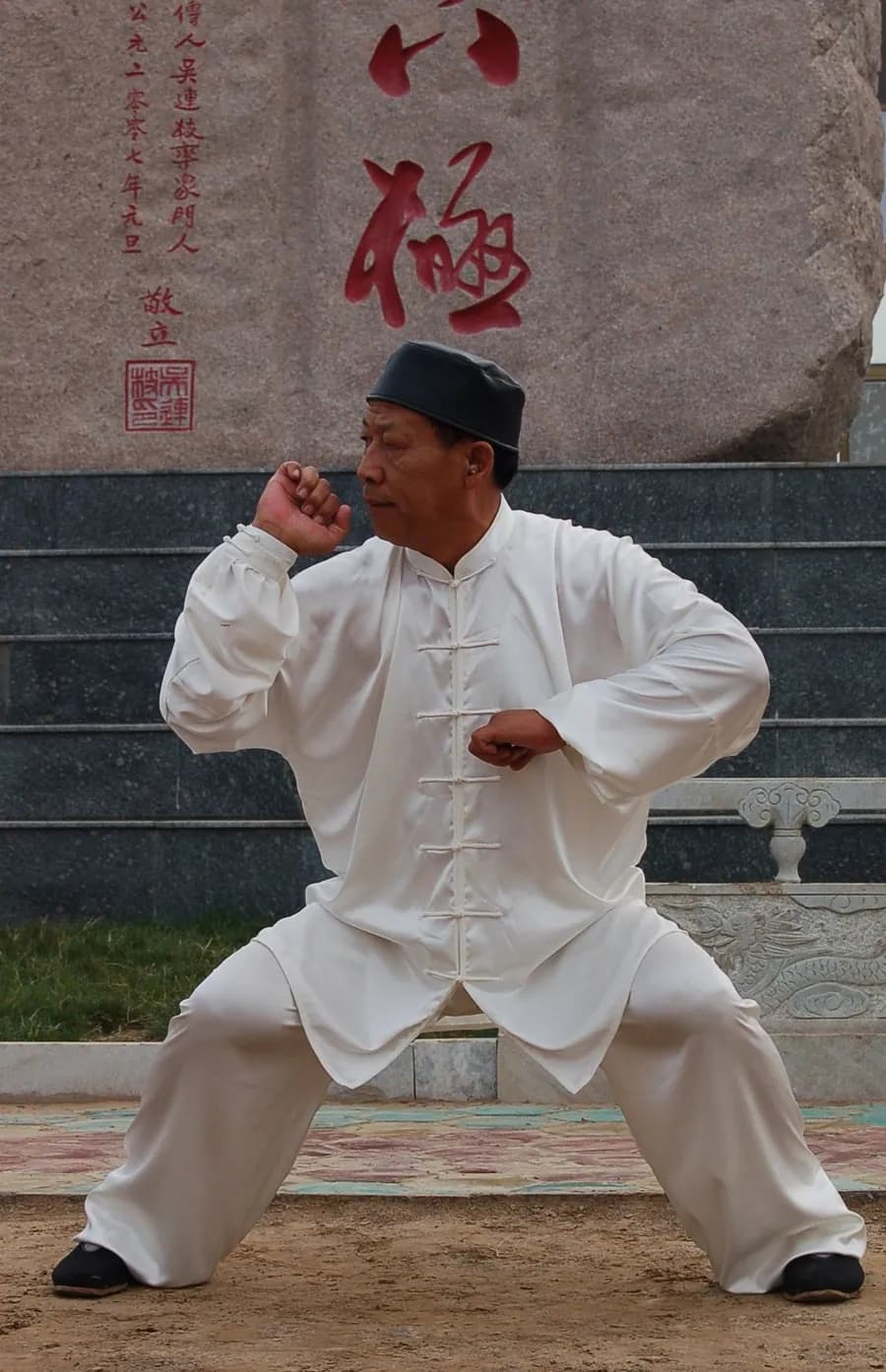
Origin
China (northern tradition; generally traced to the Qing era)
Primary Focus
Short-range striking, explosive power, and crushing entries
What It Is
Bajiquan is a northern Chinese martial art specializing in devastating close-range power delivered through committed footwork, body structure, and elbow and shoulder strikes.
History Snapshot
Bajiquan is generally traced to northern China and is strongly associated with the Cangzhou region of Hebei province, where it developed a reputation for blunt practicality. Over generations it spread through family lineages and eventually gained fame through its association with elite bodyguards.
What It Is
Bajiquan is the northern Chinese art of hitting people at bad-breath range. Where many striking systems want to control distance and pick their moments from the outside, Bajiquan wants to close the gap, crash into the opponent's structure, and deliver short, concussive force from inches away. Its trademark is explosive power generated not by winding up but by sinking, rooting, and driving the whole body as one unit. The name is usually understood to evoke "eight extremes" or "eight directions," a nod to power radiating outward in every line.
If you have seen the art demonstrated, the sound is what stays with you: the sharp stomp of the foot as a technique lands, a physical punctuation mark that is central to how the style times and grounds its strikes.
Origins and History
The precise beginnings of Bajiquan are hard to pin down, as is true of many traditional Chinese arts whose early history passed through oral transmission and family teaching rather than written record. What is generally accepted is that it is a northern system, and it is strongly associated with Cangzhou in Hebei province, a region long famous as a cradle of tough, practical martial arts.
Tradition connects the art's transmission to the Wu family of the Mengcun area, and a figure often named as an early lineage-holder is Wu Zhong, generally placed in the eighteenth century during the Qing dynasty. Beyond that, specifics grow uncertain, and honest accounts of Bajiquan hedge on exact dates and personalities rather than inventing them. What is clearer is the character of the environment that shaped it: a northern countryside where martial skill had real, physical stakes, and where a style earned its reputation by working rather than by looking elegant.
Bajiquan is also frequently paired in training with Piguaquan, a longer-range, whipping art. The two are often described as complementary halves, Baji supplying short-range crushing power and Pigua supplying extension and reach, and the saying that they complete each other has long circulated among practitioners.
Development Over Time
For much of its history Bajiquan spread the way most traditional Chinese arts did: through family lines, village teachers, and small circles of dedicated students, gradually branching into several related lineages. Its rougher, no-nonsense reputation set it apart from more demonstrative styles.
The detail that carried Bajiquan's name furthest is its reputation as a bodyguard's art. It is widely reported, and often repeated in martial arts circles, that practitioners served as personal protectors for prominent Chinese political figures in the twentieth century. Whatever the precise truth of each claim, the association stuck, and it captures something real about how the style is perceived: a method valued for stopping threats at arm's length in the messy, crowded reality of close-quarters violence. In more recent decades the art has also reached global pop culture, appearing in films, television, and video games, which introduced its distinctive look to audiences who had never heard the name.
Core Techniques and Concepts
- Fajin (explosive power): Short, sharp bursts of whole-body force released over a very small distance.
- Zhen jiao (stomping step): A grounding stomp that times and roots strikes while jarring the opponent's base.
- Close-range weapons: Heavy use of elbows, shoulders, hips, and forearms once the gap is closed.
- Structural entry: Driving forward to occupy the opponent's space and collapse their posture.
- Rooted stance: Low, stable positioning that anchors power into the ground.
- Committed lines: Direct, forward-pressing attacks rather than flowing, circular play.
Modern Practice and Relevance
Today Bajiquan is practiced worldwide, both as a preserved traditional art and, increasingly, as a subject of interest for people curious about how older systems solved the problem of close-range fighting. It is not a mainstream competitive combat sport, and its forms-based training does not map neatly onto MMA or kickboxing rulesets.
Its relevance is more conceptual, and genuinely useful. The clinch, the elbow, the shoulder bump, and the art of generating power in tight spaces are all central to modern fighting, and Bajiquan is one of the clearest traditional expressions of that logic. For a fan or a fighter trying to understand how a striking system can be built entirely around the phone-booth range that so many arts avoid, Bajiquan is one of the most instructive places to look. Its emphasis on body structure and short-power mechanics speaks directly to the same problems a modern grappler-striker faces the moment the distance collapses.
Technical Deep Dive
Bajiquan is most effective when practitioners can control the transition moments between range, rhythm, and balance. Those transition moments are where technical identity becomes visible under pressure.
A useful way to study this style is to separate visible techniques from invisible skills. The visible layer includes strikes, entries, grips, and finishes; the invisible layer includes posture management, timing discipline, and recovery decisions after failed attempts.
In striking-heavy contexts, this style rewards athletes who can maintain stance integrity while changing pace. Distance ownership, exit discipline, and defensive resets determine whether offensive output remains sustainable late in rounds.
In weapons-influenced systems, understanding line control and timing windows is as important as tool mechanics. Clean positioning and tactical patience often matter more than speed alone.
Strengths
- Short-range striking, explosive power, and crushing entries
- Clear technical pathways that are easy to study and pressure-test
- Strong transfer into modern competition when timing and distance matter
- Useful footwork, tempo control, and scoring mechanics under pressure
Trade-offs
- Training quality varies widely between schools, so fundamentals matter more than labels
- Sport rules can sharpen some attributes while reducing others
- The style's original context may differ from how it is practiced today
- Pure striking systems may need clinch and takedown defense layers for mixed-rule environments
Priority Focus
- Consistent drilling under light to medium pressure
- Testing fundamentals against resisting partners before advancing
- Building attributes from basic to complex
- Develop footwork, head movement, and distance management
Coaching Notes
- Progress from cooperative drills to constrained sparring before full resistance
- Prioritize repeatable combinations and transitions over isolated highlight techniques
- Use video review to compare tactical intent with actual round behavior
- Track conditioning in relation to technical quality, not only output volume
- Drill entries and exits as one unit so offense and defense stay connected