
Martial Arts Library
Aikido
6/18/2026 · Marcus Delgado
Origin
Japan (early 20th c.)
Primary Focus
Joint locks, throws, and redirection of incoming force
What It Is
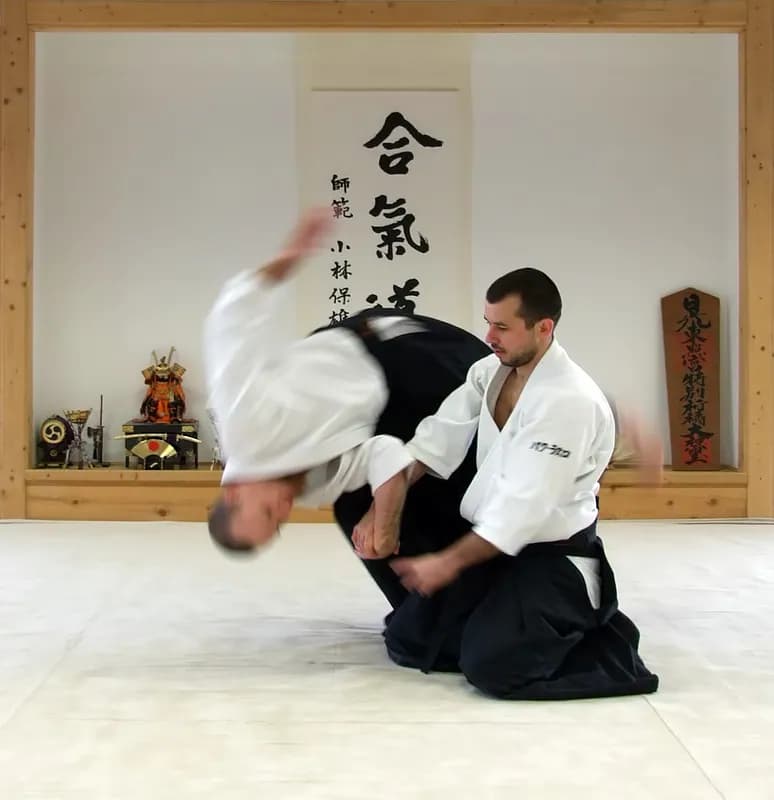
Aikido is a Japanese martial art that neutralizes attacks by blending with an opponent's motion and redirecting it into throws and joint locks rather than meeting force with force.
History Snapshot
Aikido was founded by Morihei Ueshiba, who reworked the joint-locking art of Daito-ryu Aiki-jujutsu and classical weapon work into a system guided by his spiritual convictions. After the Second World War his students spread it worldwide, splitting it into several distinct schools.
What It Is
Aikido is the Japanese martial art of not fighting force with force. Instead of blocking and countering, the aikidoka steps off the line of an attack, connects with the attacker's momentum, and guides it into a throw or a joint lock. Watch it done well and it looks almost collaborative: the person being thrown seems to fling themselves, because in a sense the technique borrows their own energy. The name itself points at the philosophy, usually rendered as "the way of harmonizing energy."
It is a grappling-based art, closely related to older jujutsu, but it is unusual in how deliberately its founder tied technique to a moral vision of resolving conflict without destroying the opponent.
Origins and History
Aikido has a single, well-documented founder: Morihei Ueshiba (1883–1969), known to his students as O-Sensei, "the great teacher." He was born in Tanabe, Japan, and came up in an era when the old warrior arts were being reinvented for a modern age.
The technical core of aikido came from Daito-ryu Aiki-jujutsu, a joint-locking and throwing system Ueshiba studied intensively under the formidable Sokaku Takeda in the 1910s. Daito-ryu supplied much of aikido's grammar: the wristlocks, the pins, the off-balancing entries. Ueshiba also trained in classical weapon arts, and the influence of the sword and the spear runs all through aikido's footwork and its sweeping, extended movements. Many aikido hand techniques make far more sense once you picture a blade in the hand.
The other great influence was spiritual. In the 1920s Ueshiba became deeply involved with Omoto-kyo, a Shinto-derived religious movement led by the charismatic Onisaburo Deguchi. That relationship reshaped how Ueshiba understood what he was doing. He came to see martial training not as a means of defeating enemies but as a discipline for reconciling conflict and protecting even the attacker from harm. Over the 1920s and 1930s his art gradually drifted away from the harder Daito-ryu approach toward something softer, rounder, and more explicitly ethical. The name "aikido" was formally settled during the wartime period, around 1942.
Development Over Time
Aikido spread mainly after the Second World War, carried by a remarkable generation of Ueshiba's students who each emphasized different sides of his teaching, which is why "aikido" today is really a family of related schools rather than one uniform art.
- Kisshomaru Ueshiba, the founder's son, organized and institutionalized the mainstream Aikikai, building it into an international federation.
- Koichi Tohei stressed the internal, energetic dimension (ki) and eventually founded his own school.
- Gozo Shioda developed the crisp, physically robust Yoshinkan style, which found favor with police training.
- Kenji Tomiki, a judo man by background, created a rare competitive form (often called Shodokan) that introduced sparring and matches.
- Morihiro Saito preserved the weapons-heavy approach Ueshiba taught in his later Iwama years.
That branching is part of why aikido feels so varied from dojo to dojo, ranging from flowing and almost meditative to sharply martial.
Core Techniques and Concepts
- Blending (irimi and tenkan): Entering into or turning around an attack to join its motion rather than oppose it.
- Circular movement: Redirecting force along curves so it dissipates instead of colliding.
- Joint locks: Controlling wrists, elbows, and shoulders through leverage, with techniques like nikyo and sankyo.
- Throws: Off-balancing an attacker and projecting them, as in the signature four-direction throw (shihonage).
- Ukemi: The art of falling and rolling safely, essential and trained constantly.
- Weapons foundation: Wooden sword (bokken) and staff (jo) practice that informs empty-hand movement.
Modern Practice and Relevance
Aikido occupies an unusual place in the modern martial landscape. It is practiced worldwide, largely as a non-competitive discipline focused on refinement, etiquette, and personal development, and its effectiveness in full-contact competition is openly debated, in part because most schools deliberately avoid resisting sparring.
But its influence on combat sports is real if indirect. Its joint-lock mechanics overlap with the standing locks used in judo and MMA, its footwork and off-line movement teach lessons in evasion, and its ukemi is genuinely excellent training for falling without injury. Just as important is what aikido preserved as an idea: that a martial art can be organized around de-escalation and control rather than damage. In an era of increasingly efficient fighting systems, that philosophical stubbornness is a large part of why aikido still draws students who want something more than a way to win.
Technical Deep Dive
Aikido is most effective when practitioners can control the transition moments between range, rhythm, and balance. Those transition moments are where technical identity becomes visible under pressure.
A useful way to study this style is to separate visible techniques from invisible skills. The visible layer includes strikes, entries, grips, and finishes; the invisible layer includes posture management, timing discipline, and recovery decisions after failed attempts.
In weapons-influenced systems, understanding line control and timing windows is as important as tool mechanics. Clean positioning and tactical patience often matter more than speed alone.
Strengths
- Joint locks, throws, and redirection of incoming force
- Clear technical pathways that are easy to study and pressure-test
- Strong transfer into modern competition when timing and distance matter
Trade-offs
- Training quality varies widely between schools, so fundamentals matter more than labels
- Sport rules can sharpen some attributes while reducing others
- The style's original context may differ from how it is practiced today
Priority Focus
- Consistent drilling under light to medium pressure
- Testing fundamentals against resisting partners before advancing
- Building attributes from basic to complex
Coaching Notes
- Progress from cooperative drills to constrained sparring before full resistance
- Prioritize repeatable combinations and transitions over isolated highlight techniques
- Use video review to compare tactical intent with actual round behavior
- Track conditioning in relation to technical quality, not only output volume