
Martial Arts Library
Acrobatic Kung Fu
6/18/2026 · Kenji Watanabe
Origin
China (traditional roots; modern performance form 20th c.)
Primary Focus
Aerials, flips, balance, and performance-oriented martial movement
What It Is
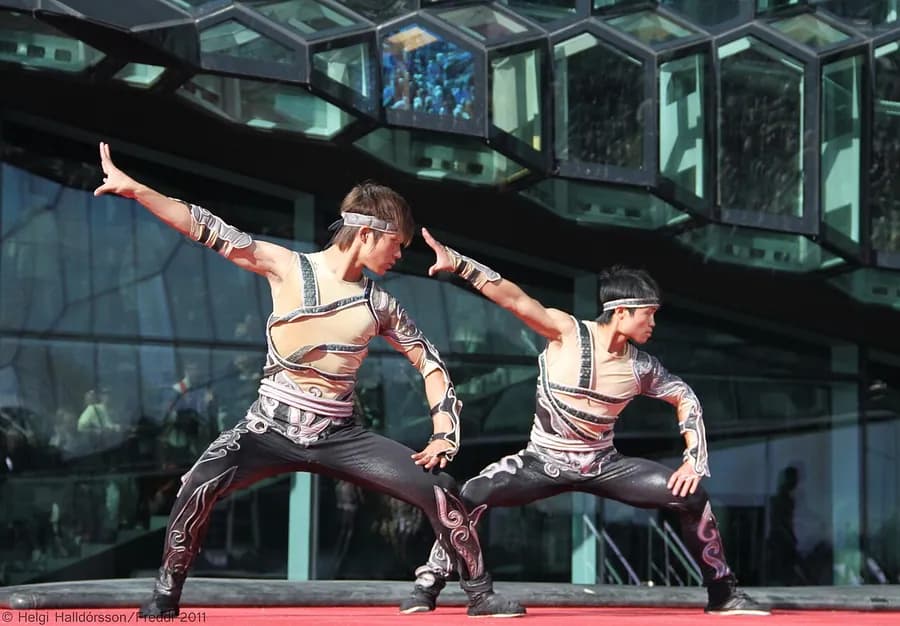
Acrobatic kung fu is a performance-driven expression of Chinese martial arts that fuses traditional hand and kicking techniques with gymnastic flips, aerials, and theatrical staging.
History Snapshot
Acrobatic kung fu grew out of centuries in which Chinese fighting arts overlapped with temple demonstration, folk opera, and traveling entertainment. In the modern era, standardized wushu and martial arts cinema pushed the acrobatic side into a discipline of its own.
What It Is
Acrobatic kung fu is what happens when the flashiest edges of Chinese martial arts get pushed as far as the human body will allow. It keeps the vocabulary of traditional systems, the stances, the kicks, the weapon forms, but bends them toward height, rotation, and visual drama. A butterfly kick becomes a full aerial twist. A simple sweep becomes the setup for a no-hands flip. It is less a fighting method than a way of performing martial movement, and it lives most naturally on a stage, a competition floor, or a film set rather than in a cage.
That distinction matters. Nobody wins a street fight with a triple aerial. But the athleticism underneath is real, and the roots of the movement run deep into Chinese martial culture.
Origins and History
There has never been a single school called "acrobatic kung fu" the way there is a Wing Chun or a Bajiquan. What we now group under that label is better understood as the acrobatic thread that has run through Chinese fighting arts for a very long time.
Much of it is generally traced back to temple and folk demonstration. The Shaolin tradition, however much its precise history is tangled with legend, became famous partly through public displays of strength, flexibility, and daring movement. Monks and traveling performers demonstrated forms not just to teach but to draw a crowd, and crowd-pleasing rewards the spectacular. Over centuries, showmanship and combat training grew alongside each other.
The other great feeder was Chinese opera, especially the Peking (Beijing) opera tradition that matured in the nineteenth century. Opera performers trained from childhood in a brutal regimen of tumbling, weapon handling, and stylized combat. Their "fight scenes" were choreographed acrobatic set pieces, and the physical training was closely related to martial practice even though its purpose was theater. Generations of performers blurred the line between stage acrobat and martial artist.
By the twentieth century, two forces gave the acrobatic side a clearer identity. The first was the standardization of wushu as a modern sport under the People's Republic. Contemporary wushu forms rewarded difficulty, height, and clean execution, encouraging athletes to add ever more demanding jumps and landings to their routines. The second was cinema.
Development Over Time
Martial arts film is where acrobatic kung fu reached the wider world. Hong Kong and mainland productions turned choreographed, gravity-defying combat into a global genre. Performers with opera and wushu backgrounds became stars precisely because they could make impossible movement look fluid, one reason so many famous action performers trained in opera academies or on wushu teams before they ever stepped in front of a camera. On screen, the priorities of the acrobatic tradition, spectacle, rhythm, and clean visual lines, became the whole point.
As competitive wushu spread internationally and film choreography kept raising the bar, the acrobatic style effectively split off into its own performance discipline. Modern competition routines and stage troupes now train aerials and tumbling with the same seriousness a gymnast brings, while still dressing the movement in traditional martial forms.
Core Techniques and Concepts
- Aerial technique: Kicks and strikes executed while airborne, from the classic butterfly kick to full-twisting variations.
- Explosive takeoff: Powerful, precise leg drive to generate the height that everything else depends on.
- Rotational control: Managing the body's spin in the air so a flip or twist finishes facing the right way.
- Landing mechanics: Absorbing repeated high-impact landings safely, the least glamorous and most essential skill.
- Form integration: Weaving traditional stances, hand shapes, and weapon work into the acrobatic flow.
- Timing and presentation: Pacing a routine so its peaks land with an audience, closer to choreography than to sparring.
Modern Practice and Relevance
Today acrobatic kung fu belongs mainly to the performance and competition world: wushu athletes, stage troupes, stunt performers, and the extreme-martial-arts (XMA) scene that grew up around demonstration tournaments. It is judged on difficulty and artistry, not on whether it could stop an attacker.
Its relevance to combat sports is indirect but genuine. The training builds explosive power, air awareness, and body control that transfer well to other athletic pursuits, and the discipline of drilling a movement until it is both safe and clean is exactly what serious fighters respect. Plenty of MMA athletes borrow acrobatic conditioning for mobility and coordination, even as they leave the actual aerials at the gym door. What acrobatic kung fu really preserves is a very old idea in Chinese martial culture: that a fighting art can also be a performing art, and that moving beautifully is a skill worth mastering in its own right.
Technical Deep Dive
Acrobatic Kung Fu is most effective when practitioners can control the transition moments between range, rhythm, and balance. Those transition moments are where technical identity becomes visible under pressure.
A useful way to study this style is to separate visible techniques from invisible skills. The visible layer includes strikes, entries, grips, and finishes; the invisible layer includes posture management, timing discipline, and recovery decisions after failed attempts.
Strengths
- Aerials, flips, balance, and performance-oriented martial movement
- Clear technical pathways that are easy to study and pressure-test
- Strong transfer into modern competition when timing and distance matter
Trade-offs
- Training quality varies widely between schools, so fundamentals matter more than labels
- Sport rules can sharpen some attributes while reducing others
- The style's original context may differ from how it is practiced today
Priority Focus
- Consistent drilling under light to medium pressure
- Testing fundamentals against resisting partners before advancing
- Building attributes from basic to complex
- Develop footwork, head movement, and distance management
Coaching Notes
- Progress from cooperative drills to constrained sparring before full resistance
- Prioritize repeatable combinations and transitions over isolated highlight techniques
- Use video review to compare tactical intent with actual round behavior
- Track conditioning in relation to technical quality, not only output volume